
Written by: JJ Tan
Key Takeaways
- Manual invoice processing in hospitality creates hidden costs in labour, errors, and missed supplier savings.
- Cost-effective invoice scanning balances subscription price with time savings, accuracy, and real-time cost visibility.
- Manual entry, basic OCR tools, and all-in-one platforms each carry very different total costs of ownership once labour and setup are included.
- Specialist automation tools such as Jelly can cut admin time, improve margins, and support stronger supplier negotiations across multiple sites.
- Hospitality teams that want to explore invoice automation can book a chat with Jelly and see potential savings for their restaurants, pubs, or hotels.
Understanding True Cost-Effectiveness for Hospitality Businesses
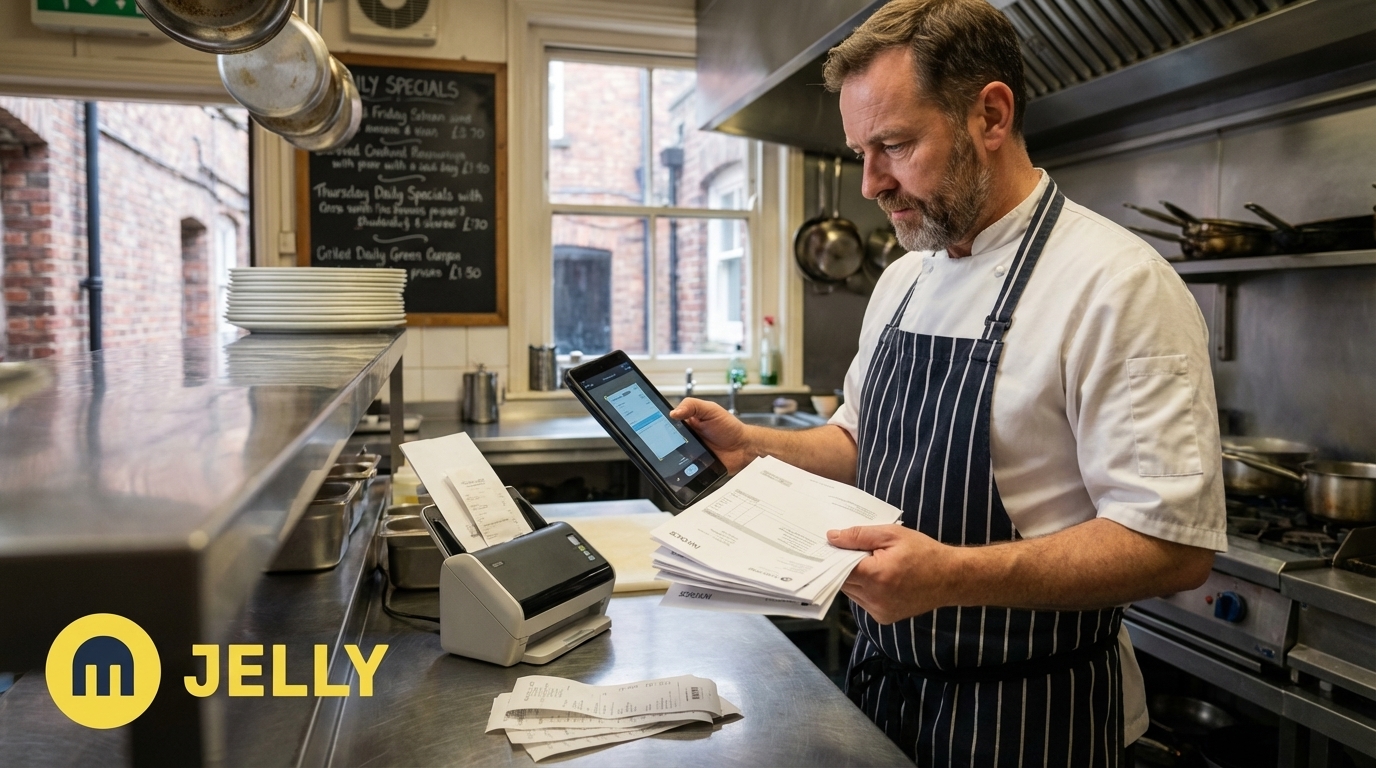
Manual invoice processing creates hidden costs in every hospitality business. Typos, duplicates, and missing paperwork delay financial insight and block early-payment discounts. Manual accounts payable workflows often generate data entry errors that take hours to correct and remove the chance to claim early-pay discounts. Many independent operators lose 10 to 20 hours a month on low-value admin instead of menu development, service, or growth.
Cost-effectiveness in invoice scanning rests on total value, not only subscription price. Labour savings from automation, fewer errors, and faster access to cost data all feed into long-term return on investment and stronger margins.
Clear evaluation criteria make comparisons easier. Key factors include automation level, accuracy and speed, integration with existing tools, ease of onboarding, quality of real-time insights, and overall value once hidden costs and setup time are included.
Comparing Invoice Scanning Approaches: Manual vs Automated Options
Manual data entry remains the default in many kitchens. It carries no software fee yet demands 10 to 20 hours of staff time each month for each site, delivers slow and error-prone data, and makes detailed dish costing and supplier negotiation difficult. Total cost of ownership is high once labour, lost insights, and missed discounts appear in the figures.
Basic OCR tools and digital filing systems introduce simple search functions and remove some paper clutter. They still need extensive manual checking and retyping, rarely capture line items in detail, and often sit separate from accounting and POS systems. Total cost of ownership rises as teams spend time supervising the tool and moving data between systems.
All-in-one food and beverage management platforms combine inventory, recipes, ordering, and sometimes invoice scanning. These suites can work well for large groups with dedicated head office teams, yet for mid-sized operators they often feel complex, time-consuming to implement, and expensive to train staff on. Total cost of ownership reflects setup projects, configuration, and ongoing training, not only the licence fee.
Dedicated AI invoice automation products such as Jelly focus on one core job. They capture every line item, deliver data in usable dashboards, link to accounting tools, and fit hospitality workflows. Total cost of ownership is usually lower because labour, error rates, and decision delays all reduce as soon as invoices start to flow through the system.
Jelly vs. Alternative Invoice Scanning Solutions: A Comparison for UK Hospitality
|
Feature / Criteria |
Jelly |
Manual / Basic OCR |
All-in-One Platforms |
|
Automation Level |
Jelly automates invoice capture from photos or emails, records every line item including quantity, SKU, price, and tax, and sends approved invoices to Xero with one click. |
Manual entry or simple OCR involves typing data by hand, checking every field, and moving details between systems with little or no automation. |
All-in-one tools can automate invoice capture as part of broader inventory and recipe management but often require significant setup for accurate extraction. |
|
Accuracy & Speed |
Jelly delivers high accuracy so teams can rely on figures for cost control and menu decisions, with invoices processed and insights typically available within 24 hours. |
Manual methods are slow and prone to typos, duplicates, and missed invoices, so cost data often arrives days or weeks after the spend. |
Many platforms offer accurate results once fully configured, yet implementation and fine-tuning can take time before the data becomes dependable. |
|
Real-time Insights |
Jelly feeds automatic dashboards, Flash Reports, price alerts, and live dish costing, and POS integrations show dish profitability while services are running. |
Manual or basic OCR workflows usually provide historic data only, with no immediate view of current costs or gross profit by dish or site. |
All-in-one suites can offer very detailed reporting, although users often need training and regular use to avoid feeling overwhelmed. |
|
Total Value |
Jelly users commonly save 10 to 20 hours of admin time per month and report average improvements such as a 2 percent increase in gross margin and a 3 percent reduction in food cost, for £129 per month per location. |
Manual methods carry very high hidden costs in labour, delayed insights, lost discounts, and margin erosion caused by slow reactions to cost changes. |
All-in-one platforms often involve higher licence fees, long implementations, and a need for dedicated internal expertise, creating a higher total cost of ownership. |
Teams that want to see how this comparison applies to their sites can schedule a chat with Jelly and review potential savings line by line.
Real-World Scenarios for UK Hospitality Businesses
Scenario 1: Growing independent restaurant with 1 to 3 sites
Many growing restaurants face invoice piles on the pass, limited visibility of total weekly spend, and chefs who spend hours on paperwork. Jelly provides fast onboarding, price alerts for quick supplier conversations, and automatic dish costing so chefs can focus on food and service while owners keep control of margins.
Scenario 2: Boutique hotel with several F&B outlets
Hotels with bars, restaurants, and room service often manage many suppliers, complex stock, and multiple revenue streams. Jelly consolidates all F&B invoices into one view, tracks spend by supplier and category, and supports real-time menu engineering for each outlet.
Scenario 3: Pub group focused on consistency and profit
Pub groups need to protect group-level margins while allowing local teams to run their businesses. Jelly offers central invoice scanning and reporting, along with local dashboards so managers can track food costs. Price alerts make supplier price changes visible early, which helps maintain consistent margins across sites.
Key Benefits of Jelly’s Automated Invoice Scanning for Hospitality
Stronger financial control is one of the main gains from Jelly. Daily Flash Reports on gross profit margin, live dish costing, and immediate price alerts help teams act on issues such as rising ingredient costs before they erode profit.
Time savings arrive quickly once invoices move into Jelly. Many sites remove 10 to 20 hours of manual admin per month, which frees chefs, managers, and finance teams to focus on guests, staff, and growth projects instead of data entry.
Profit margin improvements follow from better data and faster reactions. Jelly customers often see around a 2 percent uplift in gross margin and a 3 percent reduction in food costs within a few months, and examples such as Amber restaurant report monthly savings in the range of £3,000 to £4,000 with a high return on investment.
Simplicity and speed of value matter for busy teams. Jelly is designed for hospitality users, with a clear interface and a short learning curve, so most sites start to see useful insights in their first week.
Teams that want to explore these benefits can book a chat with Jelly and review how invoice automation could work in their own kitchens and bars.
Conclusion: Smart Choices for Sustainable Profitability in Hospitality
Cost-effective invoice scanning in 2026 depends on more than the monthly software fee. Automation, accuracy, and timely insight into ingredient and dish costs all contribute to better decisions and stronger margins for UK restaurants, pubs, and hotels.
Jelly offers focused invoice automation with clear pricing at £129 per month per location, fast onboarding, and results such as average 3 percent reductions in food costs. This turns invoice management from a manual burden into a reliable source of financial insight.
Hospitality businesses that want to understand the numbers for their own operations can book a chat with Jelly and assess the true cost-effectiveness of automated invoice scanning.
Frequently Asked Questions about Invoice Scanning Cost-Effectiveness
Q: How quickly can I expect to see ROI from an automated invoice scanning system like Jelly?
A: Many Jelly users see clear returns within the first three months. Typical results include around a 2 percent increase in gross profit margins, a 3 percent reduction in food costs, and the removal of 10 to 20 hours of manual work per month, all for £129 per location. Amber, a Jelly customer, reports savings of about £3,000 to £4,000 per month with a strong overall return.
Q: My current system is free spreadsheets. Why should I invest in a paid solution like Jelly?
A: Spreadsheets appear free yet rely on significant manual work, higher error rates, and delayed insight into costs. These hidden costs restrict growth and reduce profit. Jelly automates invoice capture, updates dish costs in near real time, flags supplier price shifts, and reduces admin time, which can more than offset the subscription fee.
Q: Is Jelly easy enough for my chefs, who are not very tech-savvy, to use effectively?
A: Jelly is built for chefs and managers who spend their time on the floor or in the kitchen. Users can photograph or email invoices, then view live dish costs and price alerts without complex menus. Many teams report that tasks which once took close to half an hour now take only a few minutes, and most users gain confidence within their first week.
Q: How does Jelly compare to free invoice scanning apps or basic OCR solutions?
A: Free or basic OCR tools often capture only header details and still need manual checking and typing into other systems. Jelly captures each line item, including quantities, SKUs, and tax, and links this data to recipes and profit reports so teams can act on accurate information without extra admin.
Q: What is the real difference between Jelly and comprehensive restaurant management platforms?
A: Comprehensive platforms usually cover many areas such as reservations, staff, and stock, and they often require long projects and dedicated specialists. Jelly focuses on invoice automation and financial insight, with faster setup and a lower monthly cost per site, which suits independent operators and growing groups that want quick, measurable gains.