
Written by: JJ Tan
Key Takeaways
- Diverse invoice formats across paper, PDF, email, and EDI create hidden admin costs, errors, and slow financial insight for UK hospitality teams.
- Multi-format invoice scanning automates data capture from every supplier format, which cuts manual data entry time and improves accuracy.
- Centralised, real-time invoice data supports faster menu costing, more effective supplier negotiations, and smoother month-end accounting.
- Amber Restaurant in East London cut supplier costs by £3–4k per month after automating invoices from mixed formats.
- Jelly provides multi-format invoice scanning, purpose-built for UK hospitality, and you can book your operation and have a quick Jelly chat.
The Problem: The Unseen Costs of Diverse Invoice Formats in Your UK Kitchen
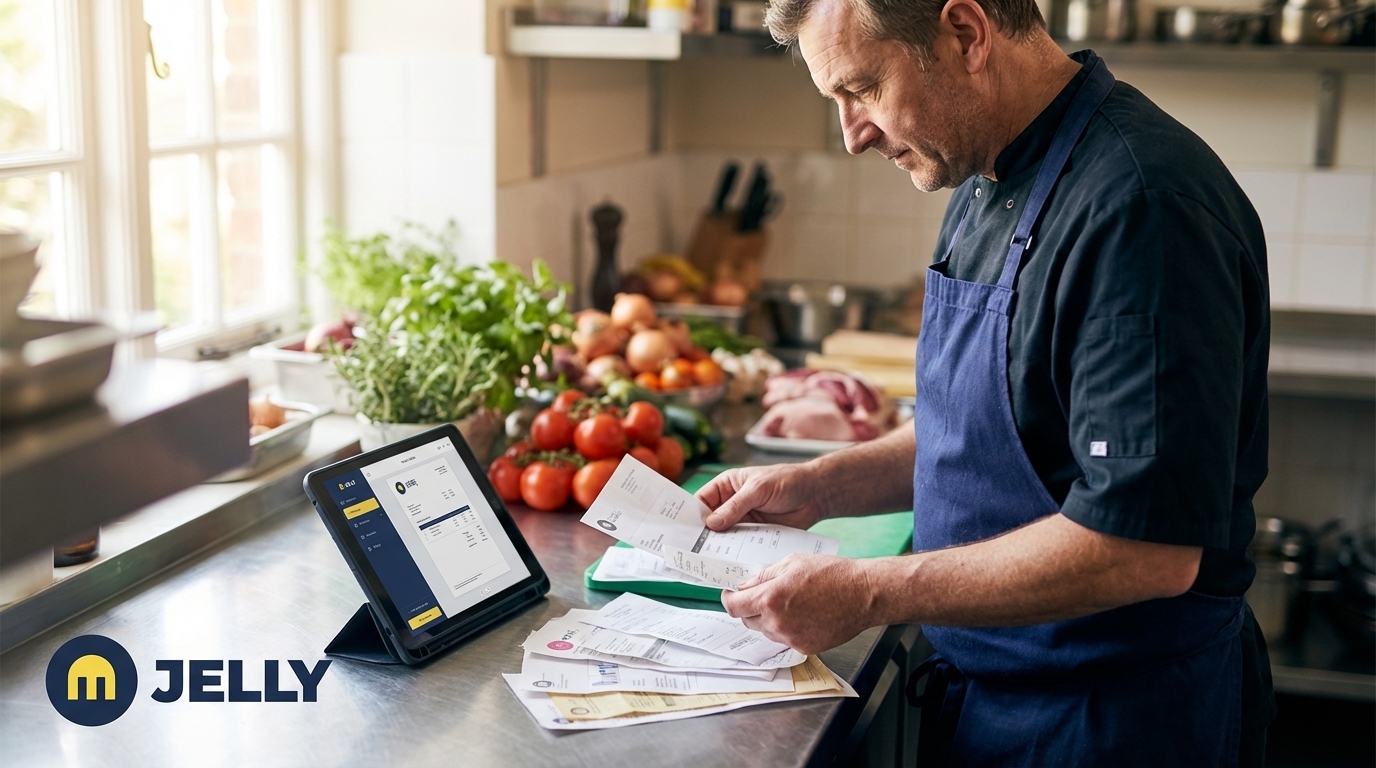
Many UK restaurants, pubs, and hotels deal with a patchwork of invoice formats. Meat suppliers may still send paper invoices, produce vendors email PDFs with changing layouts, beverage distributors rely on EDI, and niche suppliers sometimes fax or handwrite delivery notes. Each format needs its own handling process, which creates friction across purchasing and finance.
This format mix often pushes kitchen managers and owners into 10–20 hours of manual data entry every week as they copy line items into spreadsheets. Errors creep in when teams handle dozens of layouts, so stock numbers drift, price increases slip through, and late or incorrect payments strain supplier relationships.
The financial effect builds over time. A single unnoticed 10% ingredient increase can reduce gross margin by 2–3 percentage points. Cost pressures that grew through 2024 and 2025 have made this kind of slippage far more damaging for hospitality businesses in 2026.
Manual systems also delay management information. Month-end reports arrive late, so owners react to past issues instead of live costs. Pricing opportunities disappear before teams even see the data.
The Solution: Introducing Jelly – Your Automated Multi-Format Invoice Scanning Partner
Jelly provides a single system that captures invoices in every format your suppliers use. The platform reads paper images, PDFs, email attachments, and EDI files, then standardises the data for easy review and export.
Key features that reduce multi-format invoice headaches:
- Comprehensive invoice capture: Process paper invoices via photo upload, capture email PDFs automatically, and integrate EDI feeds without extra admin.
- Line-item digitisation: Extract quantities, SKUs, prices, and VAT with high accuracy across all formats, ready for analysis and reporting.
- Accounting integration: Push digitised invoices directly to Xero and other UK accounting platforms, which cuts bookkeeping time by up to 90%.
- Real-time price alerts: Flag price changes across all suppliers so you can respond before they hit your margins.
- Unified dashboard: View all supplier spend, trends, and variances in one place instead of chasing information across formats.
Teams start by forwarding invoice emails to a dedicated Jelly address or photographing paper invoices. Jelly takes on the capture, extraction, and coding so staff can focus on service and menu quality.
See how Jelly can automate your kitchen management. Book a chat.
Streamlining Operations: How Multi-Format Invoice Scanning Transforms UK Hospitality
Eliminating Manual Data Entry Errors Across All Invoice Types
Manual transcription across mixed formats increases the risk of mistakes. A misplaced decimal or wrong quantity changes stock, menu costs, and profit figures. Automated scanning uses OCR and AI to capture data consistently, whatever the layout.
Jelly handles handwritten quantities on delivery notes as well as multi-page PDF catalogues. The system improves with use, recognises recurring layouts, and produces consistent data quality that manual processes struggle to match.
Gaining Real-time Cost Visibility, No Matter the Format
Centralised invoice processing gives instant visibility of ingredient costs and supplier spend. When every invoice flows into one system, kitchen managers can track trends, monitor key lines, and understand margin impact without waiting for spreadsheets.
Jelly users receive price alerts and short flash reports as invoices arrive. This live view supports quick decisions on recipe tweaks, menu pricing, and supplier choices before costs harm profitability.
Empowering Strategic Supplier Negotiations with Consolidated Data
Scattered invoices make it hard to build a clear picture of supplier performance. Multi-format automation consolidates quantities, prices, and delivery histories into a single record, which gives owners evidence for discussions with suppliers.
Jelly users can see every change on a given product, challenge unjustified increases, and request credits where appropriate. When Murat Kilic of Amber Restaurant gained this consolidated view, he saved £3–4k monthly through improved supplier negotiations based on clear pricing data.
Enhancing Accounting Efficiency and Compliance for UK Businesses
Finance teams benefit when all invoice data is digitised in a standard structure. Automated capture reduces keying, speeds up approvals, and shortens the month-end close, while audit trails remain intact.
Jelly sends invoices to Xero and other UK accounting platforms in a single click, whether the source was paper, PDF, or EDI. This approach reduces bookkeeping time and supports compliance with UK accounting and VAT requirements.
Case Study: How Amber Restaurant Saved Thousands with Multi-Format Invoice Scanning
Amber, a Mediterranean restaurant in East London, faced fast-changing ingredient prices and complex supplier paperwork. The team received a mix of paper delivery notes, emailed PDFs, and EDI invoices, which staff then keyed into spreadsheets.
After introducing Jelly, Amber photographed paper invoices at goods-in, forwarded email invoices to Jelly, and allowed EDI feeds to flow directly into the system. Jelly flagged price changes automatically, produced clear spend reports, and created a reliable record for supplier discussions.
This change led to savings of £3–4k per month through better supplier credits and purchasing decisions, plus a strong return on subscription cost. Murat summed up the impact by stating, “Jelly keeps my business alive.
Comparison: Jelly vs. Traditional Invoice Management & Complex Competitors
|
Feature |
Jelly |
Manual Spreadsheets |
Generic Solutions |
|
Multi-format support |
Paper, PDF, email, EDI |
Manual entry only |
Limited formats |
|
Setup time |
About 1 week to value |
Immediate but limited |
3–6 months |
|
Data accuracy |
High automated extraction accuracy |
Higher error rate |
Variable quality |
|
Real-time alerts |
Instant price notifications |
Manual checking required |
Basic reporting |
Future-Proofing Your UK Kitchen: Navigating E-Invoicing Mandates with Jelly
Understanding the Upcoming UK E-Invoicing Mandate (Budget 2026)
The UK government plans mandatory e-invoicing for all VAT invoices from 2029, which will change how hospitality businesses handle B2B and B2G transactions.
This policy aims to standardise formats and reduce admin across the economy. For hospitality, it creates pressure to modernise invoice processing while still dealing with existing paper and PDF habits.
How Jelly Prepares You for the Shift to E-Invoicing
Jelly already supports structured formats such as EDI, which sit close to emerging e-invoicing standards. Users move towards compliance while keeping current workflows intact.
The format-agnostic design means teams can adopt e-invoicing without a disruptive technology switch. Jelly manages the technical detail while operators stay focused on guests and menus.
Adapting to Mixed Invoice Formats: Today and Tomorrow
Suppliers will not all move to e-invoicing at the same pace. Many will still send paper or PDF invoices well into the transition period.
Jelly lets teams process a photo of a delivery note alongside an electronic invoice in the same workflow. This single process maintains data quality and avoids the cost of running separate systems for old and new formats.
See how Jelly can automate your kitchen management. Book a chat.
Conclusion: Future-Proof Your Kitchen with Multi-Format Invoice Scanning
Diverse invoice formats have become a quiet drain on profit across UK hospitality. Each hour spent keying paper receipts, PDF attachments, and EDI exports removes time from guests and menu development, and small pricing changes often pass unnoticed.
Multi-format invoice scanning turns that complexity into structured data. Operators gain live cost visibility, stronger supplier negotiations, and faster accounting. Budget 2025 highlighted ongoing financial pressure on the sector, and those pressures remain in 2026, so efficient operations now matter more than ever.
Jelly helps UK restaurants, pubs, and hotels remove invoice chaos, control costs, and prepare for the shift to e-invoicing. Businesses that adopt structured automation today are better placed to protect margins and invest in guest experience tomorrow. See how Jelly can automate your kitchen management. Book a chat.
Frequently Asked Questions
How quickly can a UK restaurant, pub, or hotel see value from multi-format invoice scanning with Jelly?
Many sites see value within the first week, once suppliers start sending invoices to Jelly and teams begin photographing paper copies. Price alerts and spend visibility appear immediately, and meaningful savings often follow within three months. Some customers, such as Stuart Noble at Cairn Lodge Hotel, reported margin improvements in the first month.
Is Jelly compliant with UK accounting standards and regulations?
Jelly captures and organises invoice data in line with UK accounting practices, which simplifies record-keeping for tax and audit. One-click integrations with platforms such as Xero maintain clear audit trails, with VAT, suppliers, and expense codes handled consistently in the background.
What kind of support does Jelly offer UK hospitality businesses?
Jelly offers UK-based onboarding and support for restaurants, pubs, and hotels. The team helps configure the account, trains staff, and follows up during the first weeks to fine-tune workflows. Ongoing support is available for questions, new locations, and process changes as the business grows.