
Written by: JJ Tan, Founder, Jelly | Last updated: 22 June 2026
Key takeaways for UK hospitality teams
- Invoice automation for UK hospitality captures supplier invoices via mobile photo or email, extracts every line item, and feeds data directly into accounting, inventory, and menu-costing systems.
- Generic tools like Xero or SAP Concur handle financial records but fail to deliver ingredient-level insights or real-time dish margin visibility that busy kitchens require.
- Hospitality-specific mobile workflows, such as Jelly’s, deliver price alerts within 24 hours, connect live costs to menu profitability, and maintain HMRC MTD compliance through direct Xero integration.
- Operators using Jelly report saving 10–20 admin hours monthly, catching supplier price changes quickly, and achieving average gross-profit gains of two percentage points within three months.
- Experience the full mobile scanning workflow live by seeing Jelly in action, the fastest route from manual invoice chaos to live gross-profit visibility.
Why generic invoice apps fall short in busy kitchens
General AP tools such as Xero, Pleo, and SAP Concur are built for finance teams, not chefs. They process invoices as financial documents, not as ingredient-level data. A hospitality kitchen needs to know that chicken thighs from Supplier A rose 8p per kg this week, not simply that an invoice from that supplier was received and coded to a nominal ledger.
Manual invoices require significant human work from receipt to payment when data entry, approvals, exception handling, and vendor queries are included. Generic automation cuts that time but still delivers no dish-level insight. With UK restaurant net margins typically between 2% and 6%, losing even one or two percentage points to undetected price creep is operationally critical. Generic apps do not surface that risk.
From 6 April 2026, sole traders and landlords with gross income above £50,000 must keep digital accounting records and submit quarterly updates via MTD-compliant software. Copying totals between spreadsheets or re-entering figures manually breaks the required digital link and is non-compliant under MTD rules. Generic tools that lack a direct API connection to HMRC-recognised software create compliance exposure for hospitality operators.
Hospitality-specific platforms address these gaps by redesigning the invoice workflow from the ground up. A mobile scanning workflow differs from generic AP automation at every stage.
How a mobile invoice scanning workflow fits a restaurant day
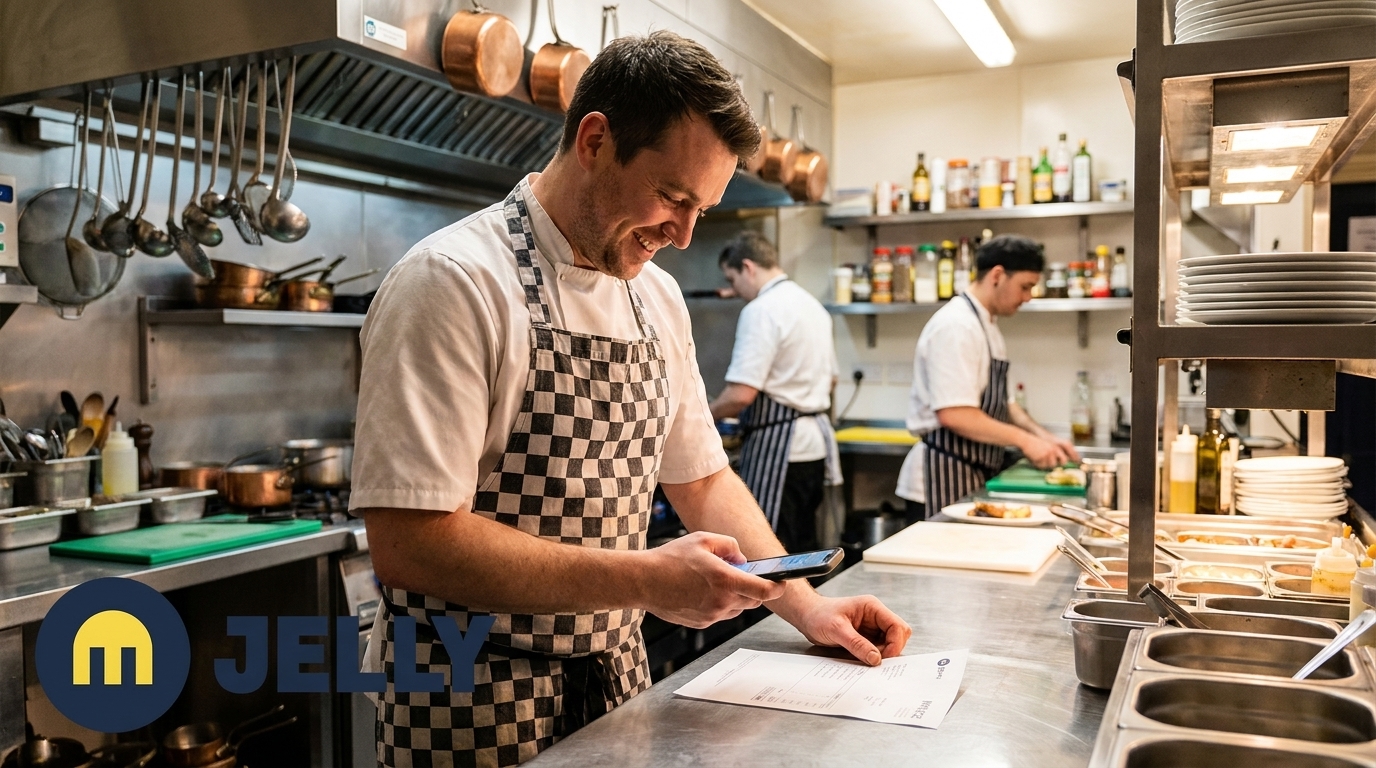
A hospitality-specific mobile scanning workflow starts the moment a delivery arrives. The chef or manager photographs the paper invoice on a smartphone. The app extracts every SKU, unit, quantity, and price, not just the invoice total. Those line items populate the ingredient library automatically.
Jelly accepts invoices by photo or by forwarding supplier emails to a dedicated address. Both routes digitise every line item in under 24 hours, and most operators see their first price alerts within the same working day. POS connection takes approximately five minutes. Open Jelly, click Integrations, sign in to the POS, grant permissions, and select which categories to sync. From that point, sales data flows in real time and dish margins update with every transaction.
Real-time price alerts that strengthen supplier negotiations
Price volatility is the primary margin threat in UK hospitality. Suppliers adjust prices frequently, and without line-item invoice data, operators have no systematic way to detect incremental increases before they compound.
Jelly's Price Alert feature flags every price movement, up or down, by ingredient, quantity, and supplier, the moment a new invoice is processed. Amber restaurant in East London uses Jelly's price change insights to react to fluctuations in the same week they occur, saving £3,000–£4,000 per month and achieving approximately 68× ROI. Stuart Noble, Head Chef at Cairn Lodge Hotel, reports a 5% reduction in food costs within one month of adopting the platform.
Concrete price-movement data changes the dynamic of supplier negotiations. Rather than suspecting a price increase, operators can present the exact date, SKU, and percentage change and request a credit note or alternative pricing.
Catching price increases is only half the equation. Operators also need to understand how those changes affect profitability. The step that generic tools cannot replicate is the connection between an updated ingredient cost and a live dish margin.
Turning invoice data into live menu profitability
Jelly's Kitchen section connects ingredient costs directly to menu performance. Chefs build recipes by clicking on ingredients already populated from scanned invoices. Unit conversions and wastage percentages are calculated automatically. What previously took 28 minutes per dish in a spreadsheet takes approximately three minutes in Jelly.
Because ingredient costs update with every new invoice, gross profit percentages on every dish stay current. A margin that drops below target displays in red. A margin that improves displays in green. Jelly's Flash Report delivers a daily, weekly, or monthly GP view by pulling cost data from invoices and sales data from integrated POS systems. Owners and finance managers gain visibility they previously waited weeks to receive from an accountant.
Sushi Revolution uses Jelly to set separate GP targets for dine-in and delivery menus, accounting for 30% delivery commissions, and achieves actual gross profits 2–3% above target on average. The same operator reduced monthly stocktake time from two to three hours down to five to twenty minutes using Jelly's inventory tools.
Time savings and margin gains from invoice automation
Organisations typically achieve full payback on an AP automation investment within 6 to 12 months, and companies using manual AP processes spend four times more per invoice than those with fully automated AP. For hospitality operators, the ROI compounds because automation also protects menu margins.
Jelly customers save 10–20 hours of admin per month and see gross margins increase by an average of two percentage points within the first three months. One operator improved gross profit from 65% to 72% within 12 weeks on approximately £500,000 in revenue. Populu lifted GP from 68% to 72% across 16 locations. Against those razor-thin margins, a two-point GP improvement is material.
Free and paid invoice tools compared for UK operators
The table below compares hospitality-specific invoice automation platforms available to UK operators in 2026. POS partners that Jelly integrates with natively are not included as competing platforms.
| Platform | Mobile invoice scanning | Real-time menu profitability | Onboarding speed | Pricing (per site/month) |
|---|---|---|---|---|
| Jelly | Photo or email, line-item extraction, <24 hr to first alert | Live GP per dish via POS integration, Flash Report daily | Value in first week, POS connected in ~5 min | £129 flat fee, no per-user charge |
| MarketMan | Invoice scanning with line-item extraction | Menu costing available, setup complexity reported as high | Weeks to full deployment reported by users | Pricing on request, typically higher than Jelly |
| Nory | Invoice capture included in platform | GP reporting via POS, broader all-in-one feature set | Longer onboarding, suited to multi-site groups | Pricing on request, positioned at larger operators |
| Kitchen Cut | Invoice import, less emphasis on mobile-first capture | Recipe costing and menu GP, legacy interface | Typically weeks, designed for large chains | Higher price point, targeted at enterprise |
Note: MarketMan, Nory, and Kitchen Cut pricing is not publicly listed; figures reflect publicly available operator reports and are indicative only. Jelly pricing is confirmed at £129/month per location with no variable user fees.
Implementation checklist for single-site operators
A single-site UK restaurant, pub, or hotel can be fully operational on Jelly within one week by following these steps.
- Create a Jelly account and assign a dedicated invoice email address to each supplier.
- Photograph any outstanding paper invoices using the Jelly mobile app to populate the ingredient library immediately.
- Connect your POS system via the Integrations tab. This requires admin access to the POS account and follows the process described earlier.
- Build your top ten dishes in the Kitchen section by selecting ingredients from the populated library. Jelly calculates costs and GP automatically.
- Once those dishes are costed, set GP target thresholds so the Flash Report can flag any that fall below your minimum acceptable margin.
- With both costing and targets in place, enable Price Alerts to receive notifications the moment a supplier change threatens those margins.
- Connect Xero for one-click export of digitised invoices, maintaining the digital links required under MTD.
Walk through this checklist with a specialist before you commit, and see exactly how each step works in your kitchen.
Conclusion: choosing the right invoice app for your kitchen
Manual invoice processing costs UK hospitality operators 10–20 admin hours monthly. In an industry where net margins rarely exceed 6%, undetected ingredient price increases erode profitability faster than most operators realise. Generic tools handle the accounting side but deliver no dish-level insight. Hospitality-specific mobile automation that scans invoices on arrival, alerts on price changes, updates live dish margins, and exports to Xero closes that gap.
Jelly is built exclusively for UK restaurants, pubs, and boutique hotels. At £129 per site per month with no per-user fees, 24-hour onboarding, and native POS integrations, it provides a fast route from manual invoice chaos to live gross-profit visibility. Operators such as Amber are seeing four-figure monthly savings and Sushi Revolution has lifted GP by 2–3 percentage points using the same workflow described above.
See how Jelly fits your kitchen in a 30-minute session, with no commitment required.
Frequently asked questions
How do I automate my invoices as a UK restaurant owner?
The simplest approach uses a dedicated email address provided by your automation platform or a mobile app for paper invoices. Forward supplier invoices to that address or photograph paper invoices on arrival. Hospitality-specific tools such as Jelly extract every line item, including ingredient, quantity, unit, and price, without manual entry. Once extracted, that data feeds your ingredient library, updates dish costs in real time, and exports to accounting software such as Xero in one click. The entire setup, including POS connection, typically takes less than one working week for a single-site operator.
Does invoice automation help with HMRC Making Tax Digital compliance?
Invoice automation supports MTD compliance when it connects directly to HMRC-compatible software. MTD for VAT already requires all VAT-registered UK businesses to keep digital records and submit returns via HMRC-compatible software, with no manual reconstruction of figures permitted. From 6 April 2026, sole traders and landlords with qualifying gross income above £50,000 must also keep digital records and submit quarterly income tax updates via compliant software. Invoice automation platforms that integrate directly with Xero maintain the unbroken digital link that HMRC requires and remove the compliance risk of spreadsheet-based processes where figures are copied or re-entered manually.
What is the difference between Jelly and a general accounting tool like Xero for invoice management?
Xero is an accounting platform that records invoices as financial transactions against nominal ledger codes. It does not extract individual ingredient lines, does not alert you when a specific ingredient price changes, and does not connect those costs to the gross profit margin of a dish on your menu. Jelly sits upstream of Xero. It captures and extracts every line item from every supplier invoice, uses that data to keep dish costs and GP margins live, and then pushes the digitised invoice to Xero in one click. The two tools are complementary, with Jelly handling the kitchen intelligence layer that Xero is not designed to provide.
How quickly can a single-site pub or restaurant see a return on invoice automation?
Most Jelly customers receive their first price alerts within 24 hours of forwarding their first invoice. Dish costing improves from the moment the ingredient library is populated, which typically happens within the first week. Across Jelly's customer base, gross margins increase by an average of two percentage points within three months, and admin time falls by 10–20 hours per month from day one. At £129 per month, the platform pays for itself many times over once even a single supplier price increase is caught and challenged, or a single underperforming dish is repriced.
Can Jelly handle multiple suppliers and multiple sites?
Jelly is designed for operators managing multiple suppliers across one or more sites. Each supplier can be assigned a dedicated invoice email address, and paper invoices from any supplier can be photographed and uploaded via the mobile app. The ingredient library consolidates all supplier data into a single view, so price movements across every supplier are visible in one place. For multi-site operators, each location runs at £129 per month with its own data, while management retains a central view of GP performance across all sites. This setup enabled Populu to lift gross profit from 68% to 72% across 16 locations.