
Written by: JJ Tan, Founder, Jelly | Last updated: 22 June 2026
Key Takeaways for Pub Waste Reduction
- UK pubs lose significant margin to waste. Repeatable systems that combine measurement, FIFO, segregation, and automation recover meaningful gross profit within three months.
- England’s Simpler Recycling rules from 31 March 2026 require four-stream separation. Non-compliance risks fines and £130.75-per-tonne landfill tax from April 2026.
- Weekly bin weighing, strict FIFO rotation, and colour-coded bins create accountability and cut spoilage without adding admin hours.
- Connecting Jelly to your POS automates invoice capture, live dish costing, and Price Alerts so margins stay accurate and supplier changes are flagged instantly. See the automation in action.
Before You Begin: Set Your Pub Up for Success
Start with the basics so every later step runs smoothly. Gather current waste logs or bin weights for at least two weeks, supplier invoices (paper or email), and confirmation that your POS system integrates with Jelly. Assign one person weekly stock responsibility because shared ownership often causes over-ordering and weak accountability. With that single owner in place, equip the kitchen with bin scales, date labels, and colour-coded bins so they have the tools needed from day one.
Why Cutting Waste Matters for Pubs in 2026
England’s Simpler Recycling framework requires households and local authorities to separate waste into four streams from 31 March 2026, replacing inconsistent local rules with a single national standard. Non-compliance can result in compliance notices, monetary fines, prosecution, and £118-per-hour charges for regulatory enforcement work. At the same time, England’s standard landfill tax rate increased to £130.75 per tonne from April 2026, which raises the direct cost of poor waste practices.
Commercial kitchens in the UK hospitality sector contribute to a collective annual financial loss of £3.2 billion. Operators who follow a structured system like the one below typically see several percentage points of gross-margin improvement within three months.
| Scenario | Annual Revenue | GP Gain | Estimated Annual Value |
|---|---|---|---|
| Conservative (2% GP gain) | £500,000 | +2 pp | £10,000 |
| Typical (3% GP gain) | £500,000 | +3 pp | £15,000 |
| High-volume (3% GP gain) | £1,000,000 | +3 pp | £30,000 |
The steps below show how to capture those gains while staying compliant. Start by establishing a measurement baseline because you cannot reduce what you do not track.
Step 1: Establish a Weekly Waste-Tracking Baseline
Objective: Quantify what is being thrown away before attempting to reduce it.
Action: Weigh each bin category at the end of every service and record the figure alongside covers served. Writing results on a visible board builds staff accountability and highlights the direct link between waste volumes and trading activity.
Inputs: Bin scales, colour-coded bins, a simple log sheet or Jelly’s invoice dashboard for cost context.
Success criteria: Four consecutive weeks of recorded bin weights per category, benchmarked against covers. Use the table below as a template to track your baseline. The waste-per-cover metric in the final column shows whether your waste problem comes from volume or efficiency.
| Week | Food Waste (kg) | Covers Served | Waste per Cover (g) |
|---|---|---|---|
| Week 1 | — | — | — |
| Week 2 | — | — | — |
| Week 3 | — | — | — |
| Week 4 | — | — | — |
Suggested visual: Photo of labelled bin station with weekly log board visible.
Jelly’s automated invoice scanning gives each waste line a cost context immediately, with no spreadsheet required. See how invoice automation builds your baseline without manual entry.
Step 2: Implement Strict FIFO Stock Rotation
Objective: Eliminate spoilage caused by older stock being buried behind newer deliveries.
Action: Label deliveries with receipt dates so staff can see at a glance which items are oldest. Store newer items behind older ones so the oldest stock sits at the front and is easiest to reach. Train staff to retrieve from the front every time, which reinforces the physical layout. Finally, conduct regular manual expiry checks to catch any items that slip through. Clear labelling of receipt or expiration dates on sealed containers supports accurate FIFO rotation and prevents use of items past their use-by dates.
Inputs: Date labels, shelf organisers, staff briefing (15 minutes is sufficient).
Success criteria: Zero expired items found during weekly stock check for four consecutive weeks.
| FIFO Checklist Item | Frequency | Owner |
|---|---|---|
| Label all deliveries with receipt date | Every delivery | Goods-in staff |
| Place new stock behind existing stock | Every delivery | Goods-in staff |
| Check expiry dates across all fridges | Daily | Prep chef |
| Log and cost any write-offs | Weekly | Head chef |
| Review slow-moving lines with Jelly Price Alert | Weekly | Head chef / manager |
Inventory reports from POS systems flag slow-moving products so operators can run targeted promotions or adjust reorder quantities. That prevents over-ordering and excess stock that later becomes spoilage. Jelly’s Price Alert feature surfaces ingredient-level cost changes the moment a new invoice arrives, giving the same visibility for purchasing decisions.
Step 3: Separate Waste Streams to Meet Simpler Recycling Rules
Objective: Achieve legal compliance and avoid fines under the Simpler Recycling framework.
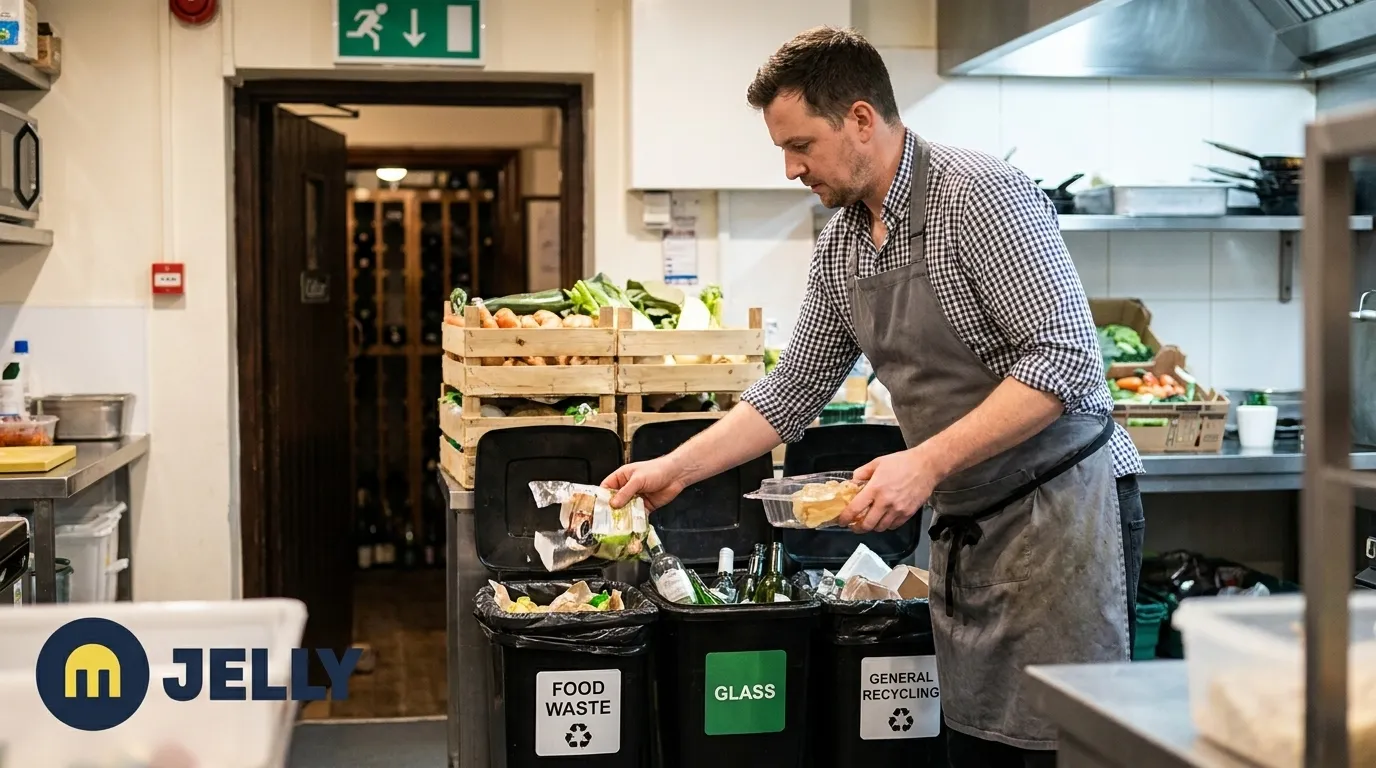
Action: Separate waste into four streams: residual (non-recyclable) waste, food waste, paper and card, and dry recyclables including plastic, metal, and glass. Use colour-coded bins and labels, weigh bins daily, and maintain close relationships with waste collectors to solve site-specific challenges.
Inputs: Four-stream bin station, signage, staff training session (30 minutes), waste contractor confirmation of collection schedule.
Success criteria: Zero contamination flags from waste contractor for eight consecutive weeks. Compliance audit passed.
Businesses with 10 or more full-time employees in England fall within scope of Simpler Recycling rules from 31 March 2025, even if staff are spread across multiple sites. Responsibility may also extend to landlords and facilities managers, so confirm your tenancy agreement before assuming compliance sits solely with the operator.
Suggested visual: Four-bin station with colour-coded lids and printed stream labels.
Step 4: Improve Cellar and Draught Management
Objective: Reduce beer waste from line contamination, temperature variance, and unlogged drip-tray volumes.
Action: Maintain cellar temperature between 10–12 °C. Clean lines on the supplier-recommended schedule and log the volume wasted per clean. Introduce a drip-tray log to record daily spillage volumes. Even modest reductions across a busy week build into meaningful cost savings.
Inputs: Cellar thermometer, line-cleaning log, drip-tray measure.
Success criteria: Cellar temperature within range on every daily check. Line-waste volume declining week on week over the first month.
Suggested visual: Cellar temperature log on clipboard next to keg stack.
Step 5: Control Spirits and Manage Glass Waste
Objective: Eliminate free-pour variance and reduce glass collection costs.
Action: Fit measured pourers on all spirits. Train bar staff on the correct glass angle to minimise foam and overpour on draught products. Beyond liquid waste, glass disposal represents a significant volume and collection cost for busy bars. For glass disposal, a glass crusher reduces bottle waste volume by 70–80% before collection, and for a busy bar the crusher typically pays back within six months through collection cost savings alone.
Inputs: Measured pourers, glass crusher (or bottle crusher for smaller operations), pour-variance log.
Success criteria: Spirit variance below 2% on weekly stock count. Glass collection frequency reduced by at least one lift per month.
Step 6: Cut Open Wine and Perishable Spoilage
Objective: Extend shelf life of opened bottles and prevent accelerated produce spoilage.
Action: Use vacuum pumps on all opened wine bottles. Separate ethylene-producing items such as apples, bananas, and tomatoes from ethylene-sensitive produce such as lettuce, broccoli, and carrots by at least 6 to 8 inches to prevent accelerated ripening and decay. Connect your POS to Jelly so that slow-moving wine lines trigger a real-time alert before the bottle becomes a write-off.
Inputs: Vacuum pumps, fridge reorganisation, Jelly Sales Mix report to identify low-velocity wine SKUs.
Success criteria: Open-bottle write-offs reduced by 50% within six weeks.
Step 7: Turn Surplus into Revenue with Menu Engineering
Objective: Convert at-risk ingredients into revenue before they become waste.
Action: Repurpose prep trim, secondary cuts, and surplus ingredients into other dishes and create daily specials designed to use up at-risk food before it becomes waste. Use Jelly’s Sales Mix report, which pulls live data from your POS, to identify which dishes sell fastest and can absorb surplus ingredients profitably.
Inputs: Jelly Sales Mix report, daily specials board, chef briefing at start of each service.
Success criteria: At-risk ingredient write-offs reduced by 30% within the first month. At least one surplus-driven special per service week.
Suggested visual: Jelly Sales Mix dashboard screenshot showing dish popularity and GP margin side by side.
Step 8: Automate Data Capture and Live Costing
Objective: Remove manual admin so the previous seven steps run on accurate, real-time data without relying on spreadsheets.
Action: Connect Jelly to your existing POS in under five minutes. From that point, every invoice scanned via photo or email updates ingredient costs automatically. Every dish margin refreshes in real time, and the Price Alert feature flags supplier price increases the same week they happen. The Flash Report delivers a daily or weekly gross-profit view without waiting for month-end accounts.
Inputs: Jelly account, POS admin credentials, supplier invoice email address or phone camera.
Success criteria: Zero manual invoice entry. GP margin visible daily. At least one supplier credit note claimed within the first month using Price Alert data.
One Jelly customer, The Howard Arms, reached 80% gross profit after implementation. Amber restaurant saves £3,000–£4,000 per month through invoice automation, price-change alerts, and tighter menu controls. Jelly users cut food costs by an average of 3% in the first three months.
Walk through the full automation workflow with the Jelly team.
Common Mistakes and Troubleshooting for Pub Waste Systems
- No date labelling on deliveries: Older stock gets buried and expires. Fix: make date labelling a non-negotiable goods-in step, checked by the shift manager.
- Mixing waste streams: Contamination triggers higher collection costs and potential fines under Simpler Recycling rules. Fix: post laminated stream guides above every bin station and run a 30-minute refresher each quarter.
- Ignoring Price Alerts: Ingredient costs creep up unnoticed and erode dish margins. Fix: assign one person to review Jelly’s Price Alert report every Monday morning and action any increases above 5%.
- Splitting stock responsibility across multiple people: As emphasised in the prerequisites, a single named owner prevents the over-ordering and accountability gaps that occur when multiple people share the task. Fix: designate a single named owner per site.
- Measuring waste without linking it to covers: Raw bin weights are meaningless without a denominator. Fix: always record covers alongside waste weights to track waste-per-cover as the primary KPI.
How to Measure Success Across Your Pub
Track three metrics weekly so progress stays visible. Monitor bin weight per cover and target a consistent week-on-week reduction. Watch gross-margin movement via Jelly’s Flash Report and aim for a clear uplift within 90 days. Check compliance audit scores against the four-stream Simpler Recycling requirement so legal risk stays low.
| KPI | Baseline (Month 1) | Target (Month 3) | Measurement Tool |
|---|---|---|---|
| Waste per cover (g) | Record actual | –20% vs baseline | Bin scales + covers log |
| Gross profit margin | Record actual | +2–3 pp | Jelly Flash Report |
| Waste stream contamination flags | Record actual | Zero per month | Waste contractor report |
| Supplier price credits claimed | £0 | At least 1 per month | Jelly Price Alert |
Advanced Tips and Next Steps for Growing Pub Groups
After the eight steps are embedded at a single site, expand Jelly’s reporting to multi-site dashboards to compare waste-per-cover and GP margin across locations. Use Jelly’s Cookbook to build standardised recipes that lock in portion sizes and wastage percentages, which prevents margin drift as staff turn over. For operators approaching five or more sites, Jelly’s centralised invoice and costing data removes the need for a dedicated back-office team to reconcile supplier pricing manually. Book a demo to explore multi-site reporting with the Jelly team.
FAQ
What are the Simpler Recycling requirements for pubs in England?
Businesses in England with 10 or more full-time employees must separate waste into four streams: food waste, paper and card, dry recyclables (plastic, metal, and glass), and residual non-recyclable waste from 31 March 2025. The rules apply even if staff are spread across multiple sites, and responsibility may extend to landlords and facilities managers depending on tenancy arrangements. As outlined earlier, non-compliance carries fines, prosecution risk, and £118-per-hour enforcement charges, while the April 2026 landfill tax increase to £130.75 per tonne raises the cost of unsegregated waste. Pubs should confirm their waste contractor can collect all four streams separately and post clear bin signage in all waste-handling areas.
How does FIFO reduce spoilage in pub kitchens?
FIFO (First In, First Out) organises storage so the oldest stock sits at the front of shelves, fridges, and dry stores, with newer deliveries placed behind. This approach ensures perishable items are used before they expire rather than being buried and forgotten. In practice, FIFO requires labelling every delivery with its receipt date, training staff to always retrieve from the front, and conducting daily expiry checks. For bar coolers, FIFO prevents carbonation degradation in craft beers and time-sensitive beverages. The discipline also improves stock accuracy, making it easier to identify slow-moving lines and adjust ordering quantities to prevent over-purchasing of perishable stock.
What is a realistic gross-margin improvement from reducing pub waste?
Operators who combine measurement, FIFO, waste segregation, and automated invoice tracking typically recover several percentage points of gross margin within 90 days. On £500,000 annual revenue, a 2 pp gain is worth £10,000 per year, while a 3 pp gain is worth £15,000. Jelly users cut food costs by an average of 3% in the first three months. Individual results vary based on starting waste levels, menu complexity, and how consistently the steps are applied. The fastest gains usually come from Price Alert-driven supplier negotiations and eliminating untracked spoilage write-offs.
Do pubs need specialist software to track waste, or will a spreadsheet work?
Spreadsheets can record bin weights and cover counts, but they cannot update dish costs automatically when supplier prices change, flag price increases in real time, or connect waste data to live sales mix information. Manual entry also introduces errors and requires 10–20 hours of admin per week that most pub teams cannot spare. Automated platforms like Jelly scan invoices line by line, update recipe costs instantly, and integrate with POS systems to deliver live gross-profit data without manual reconciliation. In practice, spreadsheets tell you what happened last month, while automated systems tell you what is happening today, when corrective action is still possible.
Conclusion: A Repeatable System for Lower Waste and Higher Margin
The eight steps above, covering baseline measurement, FIFO rotation, four-stream waste separation, cellar management, pour control, perishable spoilage reduction, menu engineering, and automated data capture, form a complete and repeatable system for reducing waste in UK pubs efficiently. Followed consistently, the system delivers the margin gains outlined at the start while keeping operations compliant with the 2026 Simpler Recycling framework. Jelly connects every step by automating invoice capture, surfacing live dish costs, and integrating with your existing POS so the gains are measurable from week one. Book a demo or schedule a chat with the Jelly team today and find out how quickly the margin improvements stack up.
