
Written by: JJ Tan, Founder, Jelly
Key Takeaways
- Manual spreadsheet inventory systems drain 10–20 hours per week on data entry, reconciliation and reporting for UK restaurants, pubs and boutique hotels.
- Without real-time visibility, food-cost variances and missed supplier price changes silently erode 2 percentage points of gross profit each month.
- Restaurants using manual processes waste 4–10% of purchased food through over-ordering, spoilage and untracked losses that automation can surface immediately.
- POS integration and automated invoice capture remove weeks of reporting lag, so teams can make same-day decisions on pricing, supplier credits and menu mix.
- Switch to Jelly to automate the entire workflow and reclaim hours every week while protecting your margins.
How static spreadsheets fall behind live kitchen operations
A spreadsheet captures a snapshot, then starts to age the moment you save it. Ingredient prices change with every delivery. Portion yields shift with every prep session. Sales volumes move with every service. Manual inventory systems cannot reconcile these moving parts in real time. That gap between the spreadsheet and the pass quietly grows into margin leakage, phantom stock and missed supplier credits.
Manual inventory systems: time drain and wasted food
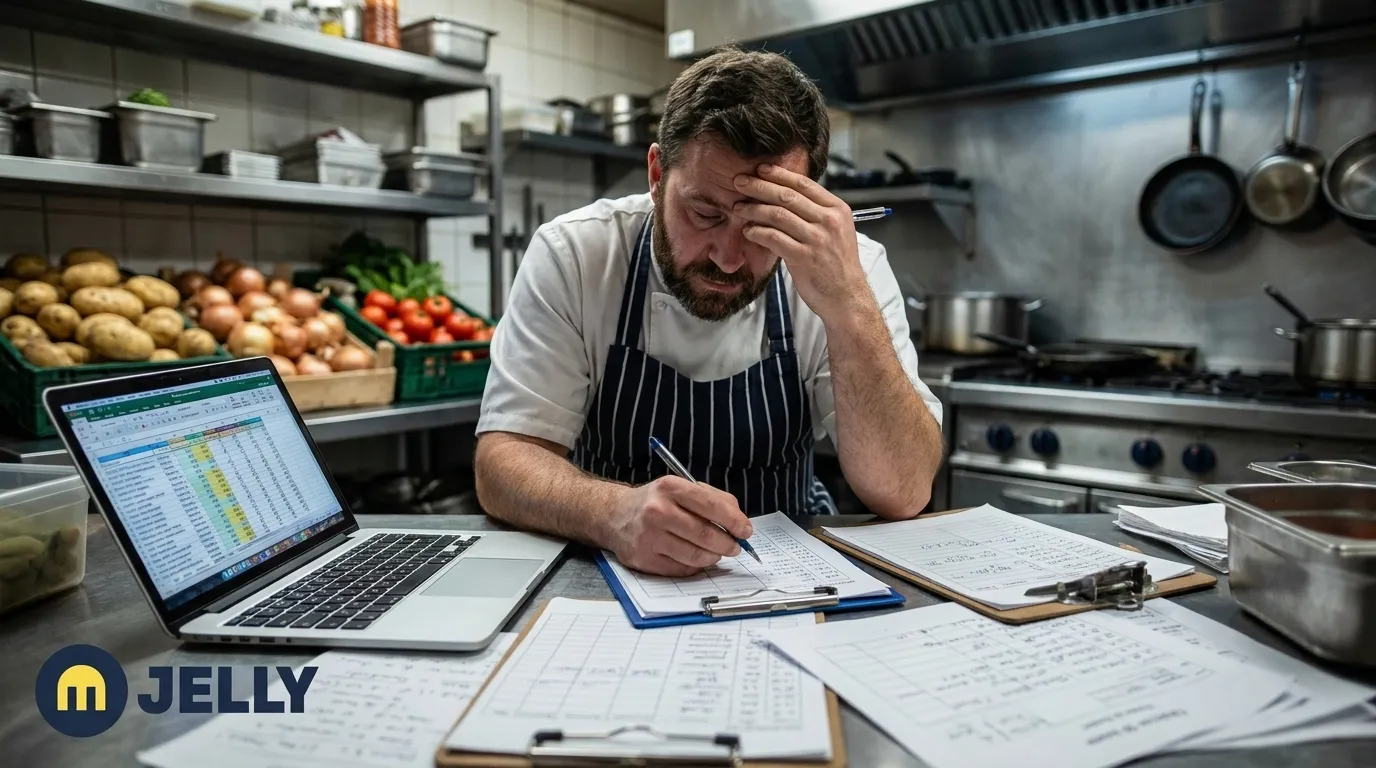
The labour burden from manual inventory is heavy. Operators using manual processes typically spend 10–20 hours per week on data entry, price checking, stock counting and invoice reconciliation. That time could support service, menu development or growth planning instead.
Inaccurate manual inventory records arising from rushed data entry, inaccurate estimates and poor record-keeping create wasted ingredients, overstocking and unexpected shortages. Neglecting product expiration dates is one of the leading causes of food waste and spoilage, made worse by over-ordering that creates excess inventory. Industry data suggests restaurants waste between 4 and 10 percent of the food they purchase, and that range widens without automated tracking.
Lack of waste tracking and loss monitoring allows losses from staff errors during preparation, cooking or service, improper storage practices and supply chain issues to silently erode profits. These are not dramatic single events. They are the accumulated effect of small variances that manual systems surface too slowly to fix.
Spending too many hours on manual admin? Book a demo and see how Jelly automates the process.
Food-cost variance from spreadsheets
Missed real-time visibility quickly damages margins. A food-cost variance, if not caught in real time, can create significant lost margin while remaining hidden inside monthly COGS reports. For operators who rely on monthly accountant reports, that variance stays invisible until it is already baked into the numbers.
Poor inventory control and related practices can push restaurant food costs from the normal 28–35% range up to 38–42%. On £500,000 in annual revenue, that shift represents tens of thousands of pounds in lost gross profit per year.
Stuart Noble, Head Chef at Cairn Lodge Hotel, experienced this directly: “Price hikes were crushing our margins, I felt helpless. With Jelly, every dish cost is up-to-date at my fingertips. We slashed food costs by 5% in a month.” Ruth Seggie, Owner of The Howard Arms, saw her gross profit reach 80% after switching: “Our accountant said we’d be lucky to hit 60%. Now I sleep better knowing my costs are under control and can react instantly, not weeks later.”
At Amber, a Mediterranean restaurant in East London, Chef-Owner Murat Kilic previously relied on manual spreadsheet costing. After automating invoice processing and enabling real-time price-change alerts, Amber now saves £3,000–£4,000 per month, which equates to approximately 68× ROI on the platform cost. “Jelly keeps my business alive,” Kilic says.
No POS integration and its impact on decisions
When your point-of-sale system does not connect to your cost data, sales-mix information arrives too late to guide purchasing. A dish that sold poorly last week continues to drive ingredient orders this week. A dish whose margin collapsed after a supplier price increase continues to sell at the same price.
A 2% labour cost spike at one location over two weeks equates to more than 50 shifts of accumulated overspend before detection under monthly reporting cycles. The same pattern applies to food cost. By the time a monthly report flags the problem, the damage has already occurred.
Blind supplier negotiations follow from this lack of data. Without item-level price-change data tied to actual sales volumes, operators cannot quantify the impact of a price increase on a specific dish’s margin. They also cannot present a strong case to a supplier for a credit note or rate reduction.
The 80/20 rule and why manual counting breaks down
Even when operators recognise these visibility gaps, manual inventory discipline only partially solves them. Tableview’s 2026 Restaurant Inventory Management Guide describes the 80/20 approach as a practical inventory discipline in which a short list of high-risk items, such as expensive proteins and premium liquor, drives most cost and risk, and these should be counted daily while lower-risk items are counted weekly.
In practice, a chef or manager must physically count high-value items every single day. Par levels must be revisited at least quarterly and whenever the menu or season changes. A par set in January will be wrong by the time patio season arrives. Without automation, this discipline demands consistent manual effort that most kitchens struggle to sustain.
The hidden labour cost sits in the remaining 80% of lower-priority items. Weekly counts, manual par-level calculations and spreadsheet updates accumulate into hours of admin with no direct revenue return. Sushi Revolution’s monthly stocktake using Jelly takes 5–20 minutes, down from 2–3 hours previously, which shows clearly how much time automation can recover.
Manual data entry versus Jelly automation
| Task | Manual spreadsheet process | Jelly automated process | Time saved |
|---|---|---|---|
| Invoice capture | Manual data entry per line item | Photo or email scan, every SKU, quantity and price digitised automatically | Hours per week |
| Dish costing | 28 minutes per menu item in spreadsheet | 3 minutes, ingredients pre-populated from scanned invoices | ~25 minutes per dish |
| Price-change detection | Manual comparison of invoices, often missed | Instant Price Alert flags every increase or decrease by supplier | Immediate vs. weeks |
| GP margin reporting | Monthly accountant report | Daily Flash Report from live POS and invoice data | Weeks of lag eliminated |
How Jelly automates inventory for UK operators
Jelly automates the flow from invoice receipt to dish costing and gross profit reporting. Every invoice, whether received by email or photographed on delivery, is scanned automatically. Every line item, quantity, price and tax code is captured without manual input. This data feeds directly into live dish costing. As ingredient prices update, every recipe’s gross profit margin updates in real time. A red percentage flags a dish that has dropped below target. A green percentage confirms it is on track.
The Price Alert feature surfaces every supplier price movement the moment a new invoice is processed. Chefs receive concrete data to negotiate credits, switch suppliers or adjust menu pricing before margin damage accumulates. Jelly’s Price Changes feature provides real-time insights into ingredient price fluctuations, enabling pricing decisions, ingredient substitutions and supplier switches.
Flash Reports deliver a daily, weekly or monthly gross profit view calculated from invoice costs and POS sales data. The Sales Mix report, powered by native integrations with Square, EPOS Now, Lightspeed and Toast, shows which dishes are most popular and most profitable. This insight supports confident menu decisions. All four POS integrations connect in under five minutes and deliver item-level sales data as soon as each transaction completes. Jelly works alongside these systems rather than replacing them.
Accounting integration with Xero means digitised invoices push through in one click, which reduces bookkeeping time by 90%. Sushi Revolution achieved gross profits 2–3% higher on average after using Jelly to set separate target margins for dine-in and delivery menus, accounting for 30% delivery commissions. Jelly costs a flat £129 per location per month, with no per-user charges and no variable fees.
The global Food Automation Market is projected to grow from USD 14.3 billion in 2026, driven by operators moving from manual processes to integrated, technology-driven operations. UK operators who adopt automation now position themselves ahead of that curve.
Ready to stop flying blind on margins? Schedule a chat with the Jelly team today.
One-week migration roadmap to Jelly
- Day 1 — Set up invoice capture: Forward your supplier email addresses to your dedicated Jelly inbox, or photograph your next delivery invoices directly into the app. Price Alerts activate within 24 hours of the first invoice.
- Day 2 — Connect your POS: Open Jelly, click Integrations, sign in to your POS (Square, EPOS Now, Lightspeed or Toast), grant permissions and select which categories to sync. This step takes about five minutes.
- Day 3 — Build your first recipes: In the Kitchen section, click on ingredients already populated from your scanned invoices to build dish recipes. Jelly handles all unit conversions and wastage calculations automatically.
- Day 4 — Review your first Price Alerts: Check which ingredient prices have moved since your last delivery. When you spot an increase, use that concrete data to contact suppliers for credits or to flag dishes that need repricing.
- Day 5 — Connect Xero: Enable the one-click Xero integration to push all digitised invoices into your accounting software and remove manual bookkeeping entry.
- End of week 1 — Review your Flash Report: Your first daily GP report is live. Compare actual margins against targets and identify the highest-priority dishes to review.
Frequently Asked Questions
How many hours per week does manual restaurant inventory actually take?
The time burden is significant, typically 10–20 hours per week across invoice capture, dish costing updates, stocktakes and margin reporting, as detailed earlier in this article. This figure includes time spent by owners, finance managers and chefs. Jelly’s automation cuts this dramatically and frees teams to focus on guests and growth.
What is food-cost variance and why does it matter for gross profit?
Food-cost variance is the difference between the ingredient cost assumed when a dish was priced and the actual cost at the time it is sold. As discussed earlier, this variance accumulates invisibly under monthly reporting cycles. Jelly’s live dish costing updates every recipe’s margin the moment a new invoice is processed, so operators can reprice, substitute or negotiate before the variance compounds.
What happens if my restaurant has no POS integration?
Without a POS integration, sales-mix data must be entered manually, which introduces delay and error into margin calculations. You cannot see in real time which dishes are selling, so purchasing decisions rely on estimates rather than actual consumption. Jelly integrates natively with Square, EPOS Now, Lightspeed and Toast, delivering item-level sales data as soon as each transaction completes. Setup takes under five minutes for all four systems. For operators on other POS systems, Jelly continues to add integration partners over time.
How quickly does Jelly deliver value after onboarding?
Price Alerts activate within 24 hours of the first invoice being processed, either by forwarding a supplier email or photographing a delivery note. Most operators see their first actionable supplier insight within the first week. Gross profit improvements of 2 percentage points are typical within the first three months, and Jelly users cut food costs by an average of 3% over the same period. Amber saved £3,000–£4,000 per month from the first month of use.
Does Jelly replace my existing accounting or POS software?
Jelly does not replace your existing tools. It integrates directly with Xero for accounting and with Square, EPOS Now, Lightspeed and Toast for POS data. Instead of replacing these systems, Jelly connects them, pulling sales data from your POS and pushing digitised invoices to your accounting software. Dish costing and gross profit reporting then rely on live, accurate figures from both sides of the equation.
Conclusion: move away from manual spreadsheets and protect margin
Restaurant inventory problems from manual spreadsheets with no automation integration create more than a minor inconvenience. They represent 10–20 hours of weekly labour, delayed margin visibility, missed supplier credits and a structural 2-percentage-point drag on gross profit that compounds every month. The operators who have moved to Jelly, including Amber, Cairn Lodge, The Howard Arms and Sushi Revolution, are not using a different strategy. They use the same ingredients, menus and suppliers. The difference is that they can see what is happening in real time and act on it the same day.
Jelly onboards in a week, costs £129 per location per month and requires no lengthy implementation. The first Price Alert typically arrives within 24 hours of the first invoice.
Book a demo today and see how Jelly restores control of your margins in the first week.