
Written by: JJ Tan, Founder, Jelly
Key Takeaways for Cutting Café Food Costs
- Food cost percentage must be calculated against VAT-exclusive revenue. A 3-point gap on £10k weekly sales costs over £15k in lost profit annually.
- Daily waste logging for 14 days reveals patterns that drive smarter ordering and can recover monthly revenue without menu changes.
- Standard recipes and portion scales deliver 5–15% lower food costs and close the gap between theoretical and actual cost.
- Menu engineering using contribution margins and cross-utilisation can reduce overall food costs by 3–5 percentage points while cutting waste.
- Start your 7-day Jelly trial to automate invoice scanning, live dish costing and real-time margin tracking.
Daily Food Waste Tracking for UK Cafés
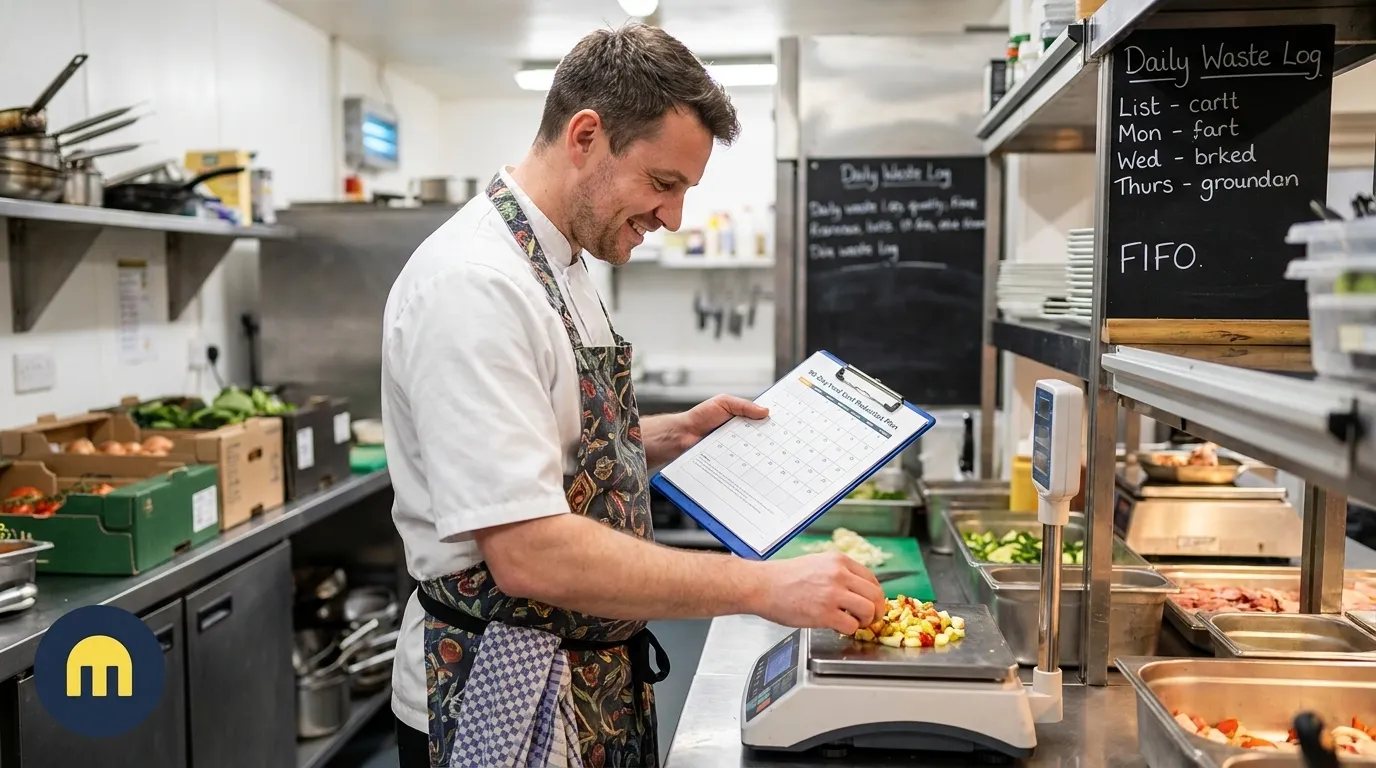
A simple daily waste log for two weeks reveals patterns, such as 12 pastries discarded every week, that drive smarter ordering and portion decisions. Cafés using a weekly track-and-adjust rhythm for waste often cut unnecessary orders and protect margin without changing the menu.
Under the Separation of Waste (England) Regulations 2025, all workplaces in England must separate food waste from general waste (along with dry recyclables and residual waste), with micro-businesses permitted until 31 March 2027 to comply, so a daily waste log acts as both a profit tool and a compliance record. The gov.uk food-waste hierarchy places prevention at the top, ahead of redistribution and recycling, and a structured daily log gives you the clearest view of where prevention should start.
Use this 7-step daily waste-tracking checklist to support both compliance and cost control:
- Assign one team member per shift as waste logger before service begins.
- Place a dedicated waste bowl and digital scale at each prep station.
- Record every discarded item by category: trim waste, spoilage, over-production, and plate returns.
- Weigh and log each category in grams at the end of prep and again at close.
- Photograph the waste log daily and upload it to your kitchen management system.
- Compare today's waste against the prior 7-day average and flag any category above 10% variance.
- Brief the opening team each morning on the previous day's top waste category and agree one corrective action.
Use this 14-day waste log template as your baseline:
| Date | Category | Item | Weight (g) | Estimated Cost (£) | Root Cause | Action Taken |
|---|---|---|---|---|---|---|
| Day 1 | Spoilage | Croissants | 480 | 1.92 | Over-ordered | Reduce par by 4 units |
| Day 1 | Over-production | Prepared milk | 600 | 0.54 | Slow 5pm trade | Batch prep to order after 4pm |
| Day 2–14 | [Category] | [Item] | [g] | [£] | [Cause] | [Action] |
Portion Control with Scales and Standard Recipes
Restaurants using standard recipes achieve 5–15% lower food costs than those without.
Follow this portion-control checklist for a 14-day baseline:
- Calibrate all prep scales weekly and post target weights beside each station.
- Build a standard recipe card for every dish, listing ingredient weights to the nearest gram.
- Weigh three random portions per dish per service for the first 14 days and record results.
- Calculate the average actual weight versus the recipe target weight for each dish.
- Retrain any cook whose portions deviate more than 5% from the recipe card.
- Update recipe cards immediately when supplier pack sizes or ingredient specs change.
Standardised recipes reduce food cost, protect gross profit, and usually deliver measurable savings within the first month when the checks run consistently.
Menu Engineering with Contribution Margins
Menu engineering ranks every dish by popularity and contribution margin, which is the net revenue per cover after ingredient cost, so you can decide which items to promote, reprice, re-engineer, or remove.
Use this menu-engineering checklist:
- Pull a sales-mix report covering the last 28 days from your POS system.
- Calculate the contribution margin for each dish: selling price (ex-VAT) minus recipe cost.
- Plot dishes on a 2×2 matrix: high margin/high volume (Stars), high margin/low volume (Puzzles), low margin/high volume (Ploughhorses), low margin/low volume (Dogs).
- Promote Stars with placement and upsell training, and investigate Puzzles for marketing opportunities.
- Re-engineer Ploughhorses by reducing portion cost or increasing price by £0.50–£1.00.
- Map every ingredient across all dishes and identify single-use ingredients. Cascading ingredient use across premium and lower-cost preparations can reduce overall food costs by 3–5 percentage points while also reducing waste volumes.
- Review the sales mix monthly and repeat.
Cross-utilisation allows cafés to order larger quantities at better pricing, prep in bulk, and reduce spoilage risk by spreading demand across multiple menu items. Jelly's Sales Mix report, powered by live POS data, surfaces this analysis automatically.
FIFO, Par Levels and Smarter Supplier Consolidation
First-in, first-out rotation and par-level management give you reliable daily controls that prevent spoilage and over-ordering.
Use this FIFO and par-level workflow:
- Label every delivery with the receipt date before it enters the storeroom or fridge.
- Place new stock behind existing stock on every shelf, every delivery.
- Set par levels for each ingredient based on actual sales data from the prior two weeks, not intuition.
- Conduct a weekly stock check against par levels. This habit can cut food cost by 2–4 percentage points.
- Order only to par and decline supplier upselling on volume unless the ingredient is cross-utilised across three or more dishes.
On supplier consolidation, reducing the number of suppliers can unlock volume discounts and simplify invoice management, but you need tight price monitoring to avoid hidden increases. A 2% price increase typically boosts bottom-line profit more than a 5% cost cut at ordinary operating margins, so documenting price discrepancies promptly becomes a powerful negotiation tool. Jelly's Price Alert feature flags every invoice line-item price change the moment an invoice is scanned, giving chefs the documented evidence needed to claim credits and negotiate better rates, as demonstrated at Amber restaurant in East London, where price-change alerts contributed to consistent savings of £3,000–£4,000 per month.
Food Cost Formulas: Theoretical vs Actual
Two formulas govern food cost control in any UK café.
Theoretical food cost % = (Sum of [recipe cost × quantity sold] for all dishes ÷ Net food sales) × 100
Example: A café sells 80 flat whites at a recipe cost of £0.55 and 60 avocado toasts at a recipe cost of £1.80. Net food sales for the day are £420 (ex-VAT). Theoretical food cost = ((80 × £0.55) + (60 × £1.80)) ÷ £420 × 100 = (£44 + £108) ÷ £420 × 100 = 36.2%.
Actual food cost % = (Opening inventory + Purchases − Closing inventory) ÷ Net food sales × 100
Example: Opening inventory £1,200, weekly purchases £3,800, closing inventory £1,100, net food sales £14,000. Actual food cost = (£1,200 + £3,800 − £1,100) ÷ £14,000 × 100 = 28.6%.
Variance = Actual food cost % − Theoretical food cost %
A healthy actual-versus-theoretical gap is 1–3 percentage points; at £100,000 per month in food sales, a 3-point gap equals £3,000 per month per location in losses. In hospitality, the gap due to waste, over-portioning, or errors can often exceed 2 percentage points.
Use this 30-day action-plan timeline:
| Week | Action | Expected Outcome |
|---|---|---|
| Week 1 | Set up daily waste log; photograph and upload all invoices to Jelly; connect POS integration | Baseline waste data; live ingredient costs; real-time GP visible |
| Week 2 | Build standard recipe cards in Jelly Cookbook; weigh 3 portions per dish per service | Theoretical food cost calculated automatically; portion drift identified |
| Week 3 | Run first sales-mix report; identify Stars and Dogs; consolidate single-use ingredients | Menu re-engineering priorities confirmed; cross-utilisation plan drafted |
| Week 4 | Conduct weekly stock count; review Price Alerts; negotiate credits with suppliers | Actual vs theoretical variance calculated; first supplier credits claimed |
Manual Spreadsheets vs Jelly's Live Dish-Costing Workflow
| Task | Manual spreadsheet | Jelly |
|---|---|---|
| Costing one menu item | ~28 minutes per dish | ~3 minutes per dish |
| Invoice data entry | Manual line-by-line; error-prone | Automated scan of every line item via photo or email |
| Ingredient price updates | Manual, often weekly or monthly | Live on every new invoice; Price Alert fired instantly |
| GP margin visibility | Delayed, dependent on accountant monthly report | Real-time Flash Report; daily, weekly, or monthly view |
| Monthly admin hours | 10–20 hours per month | Automated; hours reclaimed for operations |
| GP improvement (first 90 days) | No systematic improvement | Average +2 percentage points; Sushi Revolution achieved 2–3% higher gross profit |
Common Mistakes That Keep Café Food Costs High
Three linked operational errors account for most avoidable food cost variance in UK cafés, and each one weakens the others if left unchecked.
- Missed invoice line items. A 2% price increase typically boosts bottom-line profit more than a 5% cost cut at ordinary operating margins. Manual invoice processing often misses the small line-item changes that automated scanning catches on arrival.
- Inconsistent portion weights. Without fixed recipes, portions can vary significantly from the intended size. That drift turns a profitable dish into a loss-maker within a single service.
- Delayed price checks. Monthly stock counts identify problems about four weeks after they began, so the margin damage is already recorded in the P&L.
Jelly's automated invoice scanning removes these failure points by digitising every line item, including quantity, SKU, price, and tax, the moment an invoice arrives, and by firing a Price Alert for any change.
90-Day Café Food Cost Success Checklist
Use this checklist to track progress across the full 90-day programme and keep every site on the same path.
- Days 1–7: Connect POS to Jelly; upload first week of invoices; activate Price Alerts.
- Days 8–14: Complete 14-day waste log baseline; identify top three waste categories by cost.
- Days 15–21: Build standard recipe cards for top 20 dishes in Jelly Cookbook; record theoretical food cost.
- Days 22–28: Run first actual vs theoretical variance calculation; target gap below 3 percentage points.
- Days 29–35: Conduct first weekly stock count against par levels; adjust ordering quantities.
- Days 36–60: Review Sales Mix report; re-engineer or reprice two to three Ploughhorse dishes; consolidate one single-use ingredient per week.
- Days 61–75: Use Price Alert data to negotiate with at least two suppliers; claim any credits owed within the 30-day window.
- Days 76–90: Compare current food cost % against Day 1 baseline; confirm 3% reduction; present Flash Report to management or investors.
Work through this 90-day checklist inside Jelly and track your margin lift in real time.
Frequently Asked Questions
Who owns the 14-day waste log in a multi-site café?
Ownership should sit with the head chef or kitchen manager at each site, with the operations director or finance manager holding oversight across all locations. In practice, the daily logging task is delegated to a nominated team member per shift, but the head chef reviews and signs off the log at the end of each day. For multi-site operators, Jelly provides a central dashboard so the operations team can monitor waste data and GP margins across every location without requiring physical presence. The key principle is that accountability must be named and site-specific, because shared responsibility across a team without a named owner usually results in the log not being completed consistently.
When should price checks happen after a supplier invoice arrives?
Price checks should happen on the same day the invoice arrives, not at the end of the week or month. Raising any discrepancy promptly with documentation can help secure a credit. Jelly's Price Alert feature fires automatically the moment an invoice is scanned, flagging every line-item price increase or decrease with the exact amount and the supplier responsible. This timing means the head chef or owner can contact the supplier the same day, before the margin impact compounds across multiple deliveries.
How quickly can Jelly integrate with your POS?
Connecting any of Jelly's supported POS systems takes approximately five minutes. The process follows the same flow across all integrations: open Jelly, click Integrations, sign in to the POS, grant permissions, and select which POS categories to sync. The only common friction point appears when the user does not have admin access to their POS account, and Jelly flags this requirement upfront. Once connected, the POS delivers item-level sales data to Jelly in real time, and POS-to-dish linking only surfaces items sold since the integration was connected, which keeps the mapping clean and free of legacy menu clutter.
What results have UK cafés seen in the first 90 days?
Results vary by starting food cost percentage and the consistency with which the daily and weekly workflows are followed, but Jelly customers see an average gross margin improvement of 2 percentage points within the first three months. Stuart Noble, Head Chef at Cairn Lodge Hotel, reported a 5% reduction in food costs within a month of using Jelly. Amber restaurant in East London saves £3,000–£4,000 per month consistently, representing approximately 68 times return on the monthly subscription cost. Sushi Revolution achieved gross profits 2–3% higher on average after implementing Jelly's dish costing and delivery menu tools. The fastest gains typically come from Price Alerts in the first week, followed by portion-control improvements in weeks two and three, and menu re-engineering benefits from week four onwards.
Conclusion: Start Cutting Café Food Costs Today
The 3% food cost reduction pathway stays straightforward when you follow each step in sequence. A 14-day waste log identifies where money leaves the kitchen. Standard recipes and portion scales then close the gap between theoretical and actual food cost. Menu engineering redirects sales toward high-margin dishes, and weekly Price Alerts ensure supplier price creep is caught and challenged within the 30-day credit window. The obstacle is not knowledge, it is the 10–20 hours of monthly admin that manual spreadsheets demand, which leaves no time to act on the data.
Jelly removes that obstacle. Automated invoice scanning, live dish costing, real-time Flash Reports, and a five-minute POS integration turn every tactic in this playbook into an automatic workflow, so margins improve without adding administrative burden to the kitchen team.
Start a Jelly trial today and aim for a 3% food cost reduction within your next 90 days.