
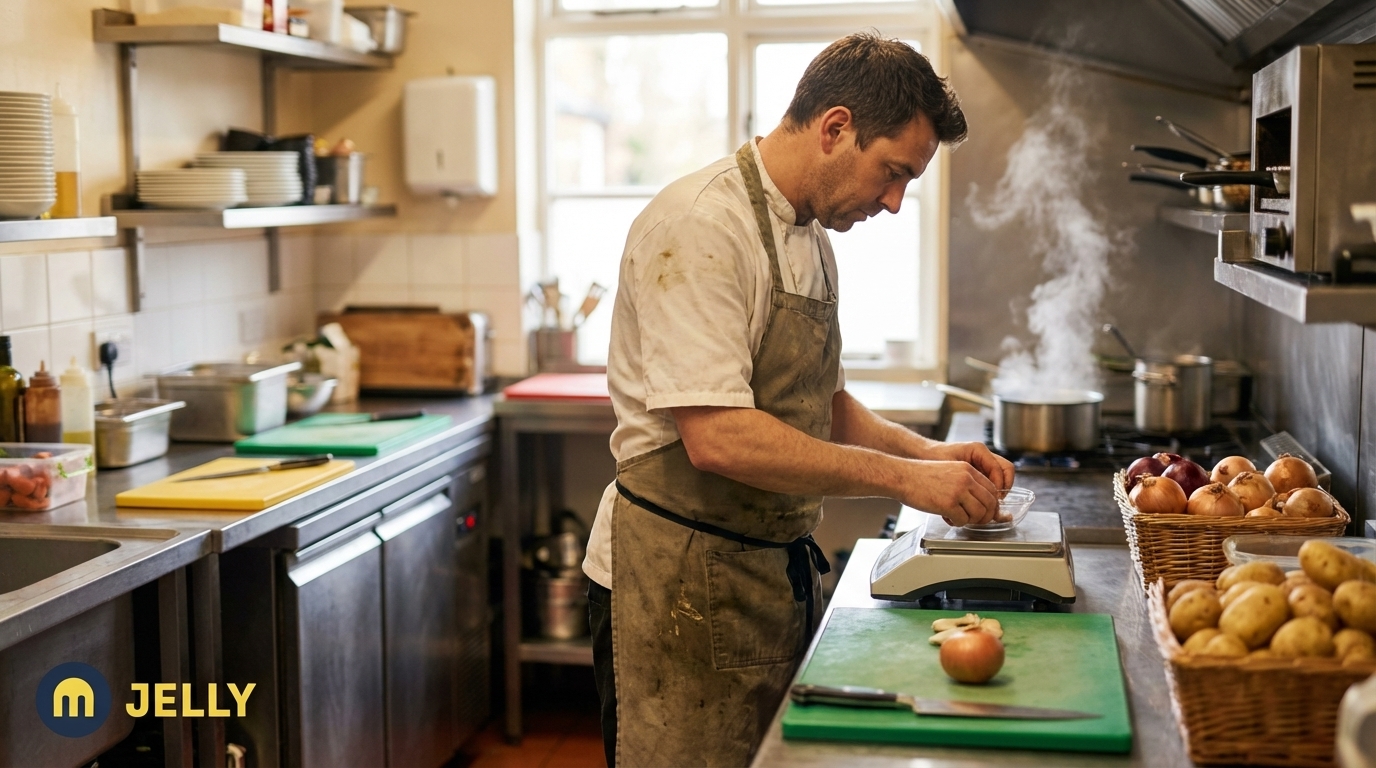
7 Food Cost Reduction Strategies for UK Hospitality 2025

The UK hospitality sector faces significant challenges in 2025, including volatile ingredient prices, staffing shortages, and increased operational costs. Restaurants, pubs, and hotels need clear strategies to protect profitability as National Insurance Contributions (NICs) rise and business rates relief reduces.

This guide outlines 7 key food cost reduction strategies with practical steps, and shows how technology, especially a robust food cost calculator and management system like Jelly, can improve operational efficiency and protect margins. For hospitality businesses generating over £500,000 annually, applying these strategies supports both resilience and sustainable growth in a demanding market.

The Stakes: Why Tight Food Cost Management Matters in 2025

The economic landscape for UK hospitality has shifted. Inflation affects ingredient costs, supply chain volatility creates unpredictable pricing, and reduced business rates relief and increased NICs add pressure to already narrow margins. Staffing challenges continue, which forces operators to examine labour costs and overall operational efficiency.

Proactive food cost management delivers more than lower expenses. Effective control supports higher profitability, less waste, better staff efficiency, and stronger competitiveness. Real-time visibility of costs and margins enables informed decisions that protect the bottom line while maintaining quality and service standards.

Government support, such as grants and business rates relief, offers some help, but internal cost control remains essential. Hospitality businesses that use government support alongside data-led cost management are better placed to succeed in 2025.

Revenue keeps a business busy, but profit keeps it viable. In this environment, manual spreadsheet-based cost management is inefficient and can steadily erode profit. Book a chat to see how automated food cost management can improve control of your operation.

Streamlining Margins: 7 Proven Food Cost Reduction Strategies for 2025

1. Optimise Supplier Relationships and Negotiations

Strong supplier relationships provide the basis for effective cost control. In 2025, this means building strategic partnerships based on data and transparency rather than relying only on transactional ordering. Regular review and renegotiation of vendor contracts can secure better rates or terms, and reliable data strengthens your position in every negotiation.

Effective supplier management includes regular contract reviews, competitive bidding for major suppliers, and relationships that consider more than price. Key factors include delivery reliability, consistent product quality, fair payment terms, and willingness to collaborate during challenging periods. Many successful operators keep relationships with multiple suppliers for critical ingredients so they are not dependent on a single source.

Jelly supports this approach with its Price Alert feature, which flags every price increase or decrease at the line-item level. Chefs and managers receive clear evidence when prices shift, which makes it easier to phone a supplier, negotiate improved rates, or request credit notes where appropriate. This proactive monitoring keeps you informed about price changes and helps protect margins.

Supplier scorecards can also support better decisions. These track price, delivery performance, quality consistency, and responsiveness to issues. A structured view of performance helps you decide which suppliers earn long-term loyalty and which may need replacing.

2. Master Inventory Management and Waste Reduction

Inventory management is a common source of hidden loss in hospitality. Poor control leads to over-ordering, spoilage, theft, and weaker margins. Smart inventory management and waste-tracking apps reduce waste and help prevent over-ordering. These tools work best when combined with clear storage standards, rotation procedures, and tracking systems.

Perpetual inventory systems give real-time stock visibility and help avoid both stockouts and overstock. Defined par levels for each ingredient ensure adequate stock while limiting capital tied up in inventory. The first-in-first-out (FIFO) method is particularly important for perishable items, as it supports the use of older stock before it spoils.

Portion control strongly influences waste and cost. Training kitchen teams to use standard portioning tools, followed by regular portion checks, keeps dishes consistent. Even small deviations from standard portions can add up to substantial extra cost over time. Daily inventory checks and integrated POS systems help track usage patterns and highlight emerging issues before they become expensive problems.

Modern inventory management also benefits from technology that tracks waste patterns and identifies root causes. Over-production, poor storage, and excessive trim waste each require different solutions. Clear tracking of where and why waste occurs makes it easier to design targeted changes. Some operators who introduce waste tracking by category and time period uncover trends that were invisible when they relied on manual methods.

3. Use Strategic Menu Engineering to Protect Profit

Menu engineering turns a menu into a structured profit tool rather than just a list of dishes. This method reviews every menu item through two lenses, popularity and profitability. Planned menu engineering promotes high-profit dishes, removes weak performers, and re-prices underperforming items, which supports a data-led approach to menu changes.

The classic menu engineering matrix groups dishes into four types: “Stars” (high profit, high popularity), “Plough Horses” (low profit, high popularity), “Puzzles” (high profit, low popularity), and “Dogs” (low profit, low popularity). Each type requires a different response. Stars should be easy to find and protected from cost increases. Plough horses may need cost reductions or price rises. Puzzles can benefit from better menu placement or staff training to increase sales. Dogs usually need removal or complete reworking.

Jelly’s Menu Engineering (Sales Mix) feature links with your POS system and simplifies this analysis. It highlights which dishes are both popular and profitable so you can make practical decisions that improve overall profit. Live Dish Costing updates gross profit margins whenever new invoices adjust ingredient prices. This makes it easier to spot underperforming dishes early, before they have a major effect on your results.

Practical menu engineering also considers layout, descriptions, and pricing psychology. High-margin items should appear in prominent menu positions, with clear and appealing descriptions and prices that balance value perception and profit. Monthly or quarterly menu reviews keep the menu aligned with changing costs and evolving customer preferences.

4. Digitise Invoice Processing and Expense Tracking

Manual invoice processing is a major hidden cost in many hospitality operations. Time spent on data entry, the risk of errors, and delays in accessing cost information all reduce profitability and weaken decision-making. In 2025, relying on manual invoice handling is comparable to sending letters instead of emails; it takes longer and introduces more scope for mistakes.

Traditional invoice processing usually involves receiving paper or email invoices, entering data into spreadsheets or accounting software, checking for mistakes, and reconciling deliveries. Many operators spend 10–20 hours per week on this work, while still facing missed price changes, incorrect quantities, or invoices that slip through the net.

Accurate and timely data underpins effective cost reduction. Jelly’s Automated Invoice Scanning digitises every line item from a photo or email upload, capturing quantity, SKU, price, and tax without manual entry. This automation can save 10–20 hours of administration per month and feeds real-time cost data into your system, so you can respond quickly to price changes or supplier issues.

Digitised invoice processing also supports better cash flow management. Invoices stay organised and visible, payment terms are tracked automatically, and early payment discounts can be captured more reliably. Integration with accounting platforms such as Xero helps keep financial records current, reduces the time and cost of monthly bookkeeping, and provides more up-to-date financial insight.

5. Optimise Staffing and Labour Costs with Smart Scheduling

Labour is the largest controllable cost for most hospitality businesses, and current trading conditions make careful planning essential. Aligning staffing with sales forecasts improves labour cost control, and structured scheduling helps maintain service levels without consistent overstaffing during quieter periods.

Effective labour optimisation starts with a clear understanding of trading patterns. Historical sales data reveals busy times, seasonal peaks, and day-of-week shifts. These insights underpin schedules that match staffing levels to likely demand. Cross-trained team members give managers the flexibility to adapt staffing to changes in demand while maintaining service standards.

Use of Artificial Intelligence in workforce management is a top strategy for refining scheduling and recruitment. Modern scheduling tools can analyse historical data, weather, local events, and other indicators to predict demand and recommend staffing plans. This reduces both understaffing, which harms guest experience, and overstaffing, which raises costs.

Productivity metrics provide an additional layer of insight into labour efficiency. Measures such as sales per labour hour, covers per server, or kitchen productivity ratios highlight where improvements are possible. Regular review of these metrics helps refine scheduling and informs training plans that can improve performance.

Operators who want to improve cost control beyond staffing can use automation across the wider back-of-house. Book a chat to see how Jelly supports broader kitchen and cost management.

6. Implement Robust Recipe and Dish Costing

Accurate recipe and dish costing is central to profitable menu management. Traditional methods take time, invite errors, and often rely on outdated prices. The reality of true dish costing, which includes unit conversions, yield percentages, preparation time, and waste factors, means many operators either avoid detailed costing or work from rough estimates.

Comprehensive dish costing goes beyond a simple ingredient total. True costs factor in yields, waste percentages such as trim and cooking loss, and labour required for preparation. For example, a beef dish that requires extensive butchery typically carries higher waste and labour costs than a dish that uses pre-portioned cuts.

Clear visibility of plate costs supports better pricing decisions, highlights opportunities to reduce costs, and shows which dishes genuinely contribute to profit. Many operators discover that perceived high-margin items are less profitable than expected once all inputs are fully accounted for.

Jelly simplifies accurate recipe and dish costing. In the Kitchen section, chefs can build recipes by selecting ingredients already imported from scanned invoices. Jelly completes unit conversions and calculations automatically, which significantly reduces the time required to cost a menu item. As ingredient prices update from invoices, each dish reflects its current cost and profitability.

Regular recipe costing reviews, carried out monthly or after notable ingredient price changes, help keep pricing aligned with costs. These reviews also highlight dishes that may need reformulation, price adjustments, or removal from the menu.

7. Use Technology for Real-time Financial Visibility

Hospitality businesses that use technology for real-time visibility gain clearer control over performance. There is a clear shift toward technological solutions and reduced manual labour in hospitality kitchens, and digitisation and automation of back-office processes free staff for guest-facing roles and improve accuracy.

Traditional financial reporting often arrives weeks or months after the activity it describes. This delay makes it harder to address issues quickly or respond to new opportunities. Real-time financial visibility, by contrast, allows operators to identify problems early, act on opportunities as they appear, and base decisions on current information rather than historical snapshots.

Integrated systems that combine invoices, inventory data, and sales information create a complete view of financial health. This integration enables automatic calculation of food costs, real-time gross profit margins, and swift identification of variances from expected performance. When systems share data, silos reduce and less manual work is needed to understand how the business is performing.

Jelly supports real-time financial visibility by integrating invoices, inventory, and POS data, so you can see food costs and profitability at any time. The Flash Report feature provides daily, weekly, or monthly gross profit views based on actual costs and sales. This helps teams respond promptly to performance changes.

Technology that offers mobile and cloud access adds further flexibility. Managers and owners can check key metrics from any location, and cloud-based systems ensure data stays current whether you are on site, at home, or managing multiple locations.

Choosing Your Food Cost Calculator: Jelly vs Traditional Methods

Clear understanding of the differences between traditional food cost calculation methods and modern integrated platforms helps explain why many hospitality businesses are moving to comprehensive solutions.

Feature / Method

Manual/Spreadsheet Food Cost Calculator

Jelly’s Integrated Food Cost Calculator and Management

Invoice Data Entry

Manual, prone to errors, time-consuming

Automated scanning of every line item

Dish Costing Accuracy

Requires manual updates, often outdated

Live, real-time updates as invoice prices change

Time to Cost a New Dish

Longer and dependent on manual calculations

Average 3 minutes

Supplier Price Change Alerts

Requires manual tracking

Automated Price Alert feature

Menu Profitability Insights

Needs significant manual analysis

Real-time Sales Mix and Flash Report

Accounting Integration

Often depends on manual entry or export/import

One-click push to Xero

Delivery Menu Management

Involves complex manual adjustments

Easy duplication with delivery commission factored in

This comparison shows that traditional methods can appear low-cost at first, but hidden costs in time, errors, and missed opportunities often outweigh any savings. Modern integrated systems like Jelly replace manual processes and add capabilities such as real-time margin updates and automated price change alerts.

For growing hospitality businesses, the choice between manual tools and integrated platforms often affects scalability. Processes that feel manageable in a single site can quickly become burdensome across multiple locations, while integrated platforms scale more easily and support centralised oversight.

Frequently Asked Questions (FAQ)

How critical is a real-time food cost calculator for growing hospitality businesses in 2025?

A real-time food cost calculator is highly important for growing hospitality businesses in 2025. Rapid price changes and tight margins mean that decisions based on outdated data can lead to avoidable profit loss. Real-time information supports swift adjustments to pricing and purchasing, which directly influences profitability. In a volatile market, a dish that generated profit last week may lose money this week after supplier price increases. Systems that update costs automatically as invoices arrive ensure that decisions reflect current conditions.

Can automating invoice management really save significant time and money?

Automated invoice management can save significant time and reduce errors. Many operators currently spend 10–20 hours each week entering invoice data, checking for discrepancies, and updating costs. These hours can instead support revenue-building activity, staff development, or guest experience improvements. Automation also enhances accuracy by capturing price changes and quantities at the line-item level, which strengthens cost control and supports more reliable profitability.

What’s the biggest mistake restaurants make when trying to reduce food costs?

The most common mistake is working without complete, real-time data. Some operators focus only on visible actions such as switching to cheaper ingredients or reducing portion sizes, which can damage quality and guest satisfaction. The most effective savings come from visibility across the operation, including detailed spend, emerging cost trends, and true menu profitability. Without this insight, decisions rely on guesswork and can miss higher-impact opportunities for improvement. Systems that provide complete and current cost information give a stronger base for decisions.

How can technology directly help chefs manage food costs better?

Technology reduces the administrative load of food cost management and gives chefs faster access to usable data. Modern platforms cut out manual spreadsheet work and allow chefs to build recipes quickly from ingredients captured on scanned invoices. Price changes appear promptly through tools such as Jelly’s Price Alert, which makes it easier to respond and protect margins. Real-time gross profit data remains available without complex calculations. This shift frees chefs to focus on food and team leadership while maintaining control of profitability, and provides clear data for supplier discussions and menu decisions.

Is it worth investing in food cost management technology for smaller operations?

Food cost management technology can deliver strong value for smaller operations as well as larger groups. Smaller businesses often have limited time for manual administration, so automation can release a meaningful share of the owner’s or manager’s week. The percentage impact on margins can also be more visible because there is less capacity to absorb inefficiencies. Direct involvement of owners in day-to-day operations means that time savings and clearer insight translate quickly into practical benefits and growth planning. Platforms like Jelly offer flat-rate pricing of £129 per month per location, which gives predictable costs for businesses of different sizes.

Conclusion: Strengthen Margins and Control with Jelly

Effective food cost reduction in 2025 focuses on smart, data-led strategies that support profit while maintaining quality and service. The seven strategies in this guide cover key areas such as supplier management, inventory control, menu engineering, labour planning, and technology adoption.

Each strategy can be used on its own, but integrated platforms that address several cost drivers at once tend to deliver stronger results. Automation saves administrative time, real-time data improves accuracy, and combined analysis highlights where action will have the greatest effect.

The hospitality market in 2025 demands efficient operations and clear financial control. Manual processes, spreadsheet-based management, and slow financial reporting increase workload and can steadily reduce profitability. Many operators are now choosing technology that automates routine tasks, provides timely insight, and supports decision-making with current data.

Jelly’s approach to food cost management has helped operators such as Murat from Amber save an estimated £3,000–£4,000 per month through invoice automation, price change alerts, and real-time costing, while also reducing administrative workload. Automated invoice processing, live cost updates, and instant menu profitability analysis turn complex back-of-house activity into a more streamlined workflow.

Investment in food cost management technology supports direct cost savings, stronger operational control, and more confident decision-making. In a sector with tight margins and intense competition, these gains can be the difference between stable growth and ongoing pressure.

Hospitality operators who want to improve kitchen profitability and gain real-time control over food costs can explore Jelly in more detail. See how Jelly can automate your kitchen management. Book a chat to learn how the platform can save time, reduce costs, and support margin improvement from the first weeks of use.