
Written by: JJ Tan, Founder, Jelly
Key Takeaways for UK Restaurant Operators
- UK restaurants lose 4–10% of purchased inventory to waste, and a structured 12-step system can recover 2–3 percentage points of food cost within 90 days.
- Start with a 7-day waste audit, then apply FIFO colour-coding, temperature checks and POS-linked demand forecasting to cut overproduction and spoilage.
- Standardised portions, daily “use-it-up” specials and staff training turn waste reduction into a daily habit rather than a one-off project.
- Jelly automates invoice scanning, price alerts and live GP tracking so the entire process runs with roughly 10 minutes of daily admin.
- See how Jelly automates waste tracking and turn food-waste control into a low-effort, high-margin habit for your kitchen.
What You Need Before You Start
Gather these items before you begin the audit so the process runs smoothly from day one.
- Last 30 days of supplier invoices (paper or digital)
- Current supplier price lists
- Standardised recipe cards for your top 20 dishes
- POS sales data by item for the same 30-day period
- A digital scale and a physical or digital waste log
Ownership sits with the owner, finance manager or head chef, with cross-functional input from the kitchen team. The initial setup, including gathering invoices, building recipe cards and configuring your first audit, takes around 3–4 hours. Once that foundation is in place and automated through Jelly, the ongoing habit usually takes about 10 minutes per day.
Why Cutting Food Waste Matters for Your Restaurant
The UK hospitality sector wastes 920,000 tonnes of food annually, which represents roughly 9% of the country's total food waste. Restaurants typically lose 4–10% of purchased inventory to waste. On a £500,000 annual food spend, every 1% recovered equals £5,000 in gross profit, and a 2–3 point improvement within 90 days translates to £10,000–£15,000 flowing directly to the bottom line without a single additional cover.
The WRAP Hospitality and Food Service Agreement and the UK government's legally binding waste hierarchy both require operators to prioritise prevention before any other disposal route. This 12-step system translates those obligations and financial opportunities into a practical workflow that any UK restaurant can apply.
Step-by-Step Process to Cut Food Waste
Step 1: Run a 7-Day Waste Audit
Objective: Establish a baseline waste figure by category before making any changes.
Action: For seven consecutive days, weigh and record every item discarded by category, such as prep waste, spoilage, plate returns and overproduction, using a printed or digital log. Record the item, weight, reason and estimated cost using your invoice prices so you can see both volume and value.
Inputs: Digital scale, waste log template, last invoice prices.
Success metric: Total weekly waste weight and cost by category, expressed as a percentage of that week's food purchases. This baseline lets you track progress against a clear starting point, and many operators see waste reductions in the first month driven purely by the visibility the audit creates.
Step 2: Implement FIFO with Colour-Coded Labelling
Objective: Eliminate spoilage caused by incorrect stock rotation.
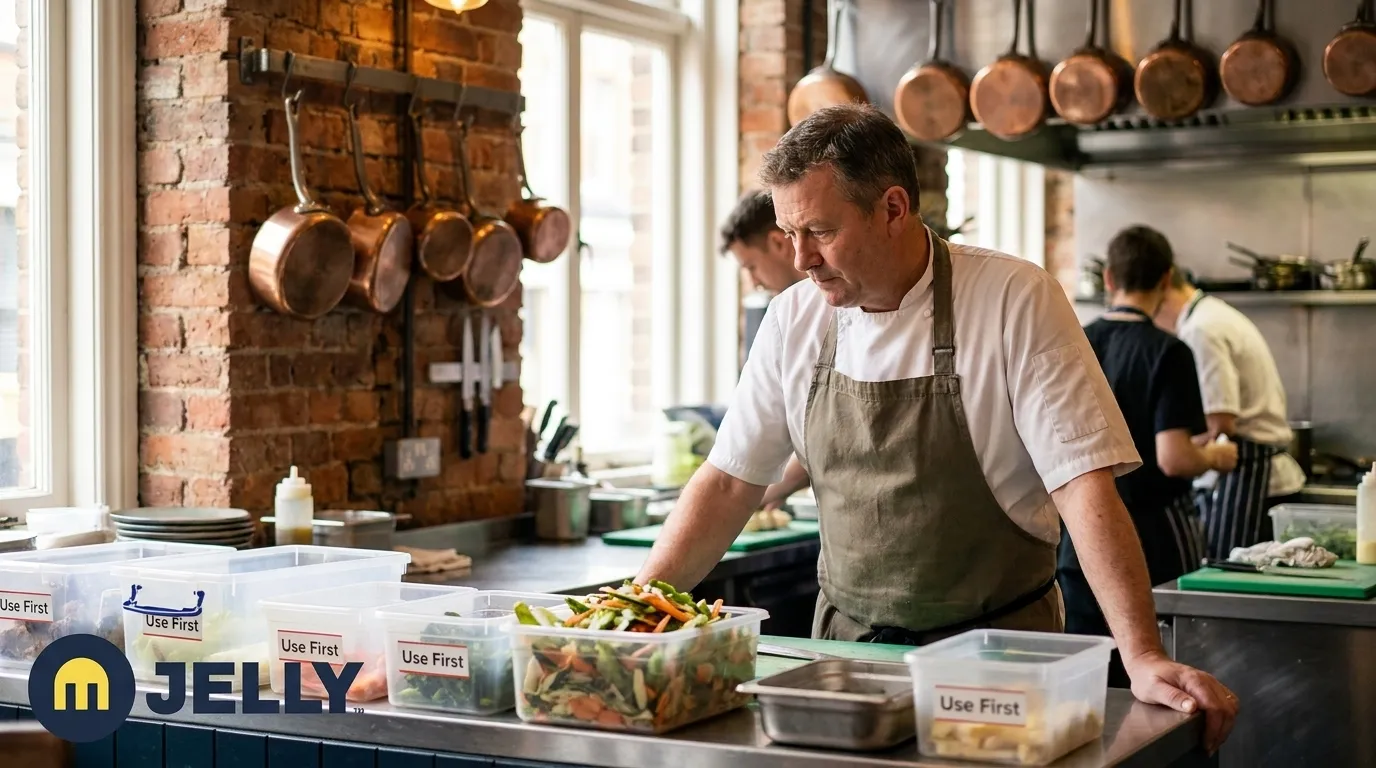
Action: Assign a colour to each day of the week and label every item on delivery with the delivery date and its colour dot. Brief all kitchen staff that the oldest colour always moves first, so everyone follows the same rule on every shift. Implementing a structured FIFO system can reduce kitchen waste by 30–50% within one month.
Inputs: Coloured dot labels, marker pens, a posted rotation guide in each fridge and dry-store.
Success metric: Zero items discarded due to expiry within 30 days of implementation.
Step 3: Audit Temperature and Humidity Controls
Objective: Prevent spoilage caused by poor storage conditions rather than over-ordering.
Action: Check fridge and cold-store temperatures twice daily for one week and log readings against the recommended range for each product category. Replace or recalibrate any unit that runs above safe thresholds, and repeat spot checks weekly to confirm the fix holds.
Inputs: Calibrated thermometer, temperature log, manufacturer specs for each storage unit.
Success metric: All storage units consistently sit within safe temperature bands, and spoilage incidents attributable to temperature fall to zero.
Step 4: Link POS Data to Demand Forecasting
Objective: Order and prep only what sales history supports.
Action: Connect your POS system to Jelly so data flows automatically. Jelly's Sales Mix report shows which dishes sell and when, so prep quantities track actual demand rather than chef intuition. Use this data to set daily prep targets by dish and adjust them weekly based on trends.
Inputs: Jelly account, POS login with admin access, dish-to-ingredient recipe cards built in Jelly's Cookbook.
Success metric: Overproduction waste logged in Step 1 falls by 20% within 30 days. Operators using real-time inventory tracking report food cost reductions of 2–5 percentage points within the first 90 days.
Step 5: Build a Daily “Use-It-Up” Specials List
Objective: Turn near-expiry stock into revenue before it becomes waste.
Action: Each morning, the head chef reviews items approaching their use-by date and creates one or two specials or staff meal options that use them. Post the list on the pass and brief front-of-house to recommend these dishes so they move quickly.
Inputs: Daily stock check, specials board or digital menu update.
Success metric: Near-expiry write-offs fall to under 1% of weekly food purchases within 60 days.
Step 6: Standardise Portions and Introduce Flexible Sizing
Objective: Cut plate waste and over-portioning at the same time.
Action: Weigh and document the standard portion for every dish in Jelly's Cookbook, including a declared wastage percentage. This data reveals which dishes generate the most plate waste, so you can introduce a smaller or half-portion option for those specific items. Much of restaurant food waste stems from food that is prepared, served and never eaten, and tiered portion pricing has been linked to measurable reductions in plate waste.
Inputs: Portion scale, recipe cards, Jelly Cookbook with wastage % field.
Success metric: Given the 17% plate-waste baseline mentioned earlier, target a reduction to under 10% through portion adjustment within 90 days.
Step 7: Train Staff and Set Weekly Waste KPIs
Objective: Embed waste reduction as a daily kitchen habit rather than a one-off initiative.
Action: Run a 20-minute briefing that covers FIFO, portion weights, the specials process and waste logging so everyone understands the system. Post weekly waste targets in kilograms and pounds on the kitchen noticeboard and review actuals at each weekly team meeting. Educating staff on proper food handling, shelf life and portion control makes a measurable difference to kitchen waste levels.
Inputs: Weekly waste log from Step 1, posted KPI targets, 20-minute briefing script.
Success metric: All kitchen staff can state the current week's waste target and the kitchen's actual figure to date.
Step 8: Negotiate with Suppliers Using Price-Alert Data
Objective: Recover margin lost to unnoticed ingredient price increases.
Action: Use Jelly's Price Alert feature, which flags every line-item price change the moment a new invoice is scanned. Bring this data to supplier calls to request credit notes, challenge unjustified increases or switch to an alternative supplier when needed. Amber restaurant saves £3,000–£4,000 per month through credits, better buying and tighter menu controls enabled by Jelly's price change alerts.
Inputs: Jelly Price Alert report, supplier contact list, last three months of invoice history.
Success metric: At least one credit note or renegotiated price secured within the first 30 days.
See Price Alerts in action and discover how Jelly surfaces every supplier price movement in real time.
Step 9: Create a Secondary “Last-Day” Menu
Objective: Generate revenue from stock that would otherwise be written off at end of service.
Action: Designate a weekly slot, typically a Tuesday or Wednesday lunch, as a reduced-price or staff-meal service built entirely from stock in its final day of use. You can also use Jelly's Delivery Menu Creation tool to build a separate delivery menu from these items, factoring in platform commission so you maintain GP.
Inputs: End-of-day stock count, Jelly Cookbook for delivery menu costing.
Success metric: End-of-week write-offs fall by 30% within 60 days.
Step 10: Redistribute Surplus via UK Donation Channels
Objective: Divert edible surplus up the waste hierarchy before it reaches disposal.
Action: Register with a UK food redistribution scheme such as OLIO or a local food bank network. Surplus redistribution sits higher in the UK waste hierarchy than recycling or disposal and provides a compliant route for safe, edible surplus food. Ensure all transfers include a Waste Transfer Note as required under the Waste (England and Wales) Regulations 2011.
Inputs: Redistribution scheme registration, Waste Transfer Note template, food safety records.
Success metric: At least one redistribution transfer completed per week, with zero edible surplus going to landfill.
Step 11: Log Unavoidable Waste and Calculate True Cost
Objective: Separate controllable waste from genuine trim loss so targets stay realistic.
Action: Record unavoidable waste such as bones, peelings and coffee grounds separately in Jelly's waste log, tagged by category. Jelly's automated invoice scanning keeps every ingredient cost current, so the true cost of unavoidable waste is calculated without manual effort. Since 31 March 2025, most workplaces in England with 10 or more employees must present food waste separately under the Simpler Recycling rules, and unavoidable waste logged in Jelly supports compliance documentation.
Inputs: Jelly waste log, segregated food waste bin, Waste Transfer Notes for collection.
Success metric: Unavoidable waste cost expressed as a fixed percentage of food spend, with controllable waste tracked separately and trending downward.
Step 12: Review Results Monthly and Refine
Objective: Close the loop and compound savings month after month.
Action: At the end of each month, pull Jelly's Flash Report to compare actual food cost percentage against the prior month and against your GP target. Review waste log totals by category, then identify the single largest remaining waste driver and assign a corrective action for the following month so progress continues.
Inputs: Jelly Flash Report, monthly waste log summary, GP target.
Success metric: Food cost percentage falls by at least 0.5 points per month for the first three months, reaching the cumulative 2–3 point target.
Common Mistakes and How to Fix Them
- Inconsistent units: Mixing kilograms and portions in the waste log makes trend analysis impossible, so standardise on weight in kilograms for all raw ingredient waste from day one.
- Missing invoice line items: Partial invoices create inaccurate cost calculations. Jelly's automated scanning captures every line item, so ensure all suppliers send invoices to your Jelly email address or that staff photograph them on delivery.
- Chef resistance: Present waste reduction as margin protection rather than a criticism of kitchen skill to reduce friction. Share the weekly pound figure saved with the kitchen team, because that number converts sceptics faster than any policy document.
How to Track Food Waste Results
The primary success indicator is achieving the 2–3 percentage point drop in food cost within 90 days that you set as the target, visible on Jelly's Flash Report. Secondary indicators include a reduction in total weekly waste weight against the Step 1 baseline, a decline in spoilage write-offs as a percentage of purchases and at least one supplier credit note secured via Price Alert data. Sushi Revolution achieved gross profits 2–3% higher on average after implementing Jelly's live costing and separate delivery menu GP targets. The 2–5 point reduction cited earlier is consistent with results from operators who implement the full system.
Advanced Jelly Features to Grow Your Savings
Once the 12-step system is running, the next lever is tightening the feedback loop between invoice costs and menu pricing. Jelly's live dish costing updates every GP margin the moment a new invoice is scanned, so you avoid manual re-entry and stale data. When a supplier increases the price of a key ingredient, the affected dishes turn red in the Jelly dashboard, which prompts an immediate decision to renegotiate, substitute or reprice.
Jelly's Price Changes feature provides real-time pricing decisions, ingredient substitutions and supplier switches that build on the savings delivered by the operational steps above. For multi-site operators, Jelly's flat-rate £129 per month per location pricing means the system scales without variable cost surprises.
See the full automation layer in action across invoices, live costing and the Flash Report.
Frequently Asked Questions
How often should we run a formal waste audit?
The 7-day audit in Step 1 acts as a one-time baseline exercise that shows where you stand. After that, waste logging should become a daily habit, handled as a 5-minute end-of-service task, with a formal monthly review using the Flash Report. Operators who move to daily logging with automated cost data usually identify new waste drivers within the first two weeks because the data is granular enough to pinpoint specific dishes, prep sessions or delivery days rather than just a monthly total.
How do we roll this system out across multiple sites?
Begin with your highest-revenue or highest-waste site so you generate a proof of concept with measurable results. Once the 12 steps are embedded and the team is familiar with Jelly's workflow, replication to additional sites becomes straightforward, because each new location connects its own supplier invoices and POS system while using the same recipe library and GP targets. Jelly charges a flat rate per location, so the cost structure scales predictably. The main multi-site risk is inconsistent units and recipe standards across kitchens, and standardising these centrally in Jelly's Cookbook before rollout removes the most common source of variance.
What happens when a supplier changes pack sizes rather than prices?
Pack-size changes are one of the most common ways ingredient costs rise without triggering an obvious price alert. When a supplier reduces a pack from 5kg to 4kg at the same unit price, the effective cost per kilogram rises by 25%. Jelly's automated invoice scanning captures quantity and unit data on every line item, so a pack-size change appears as a cost-per-unit movement in the Price Alert report. The corrective action matches a direct price increase, so you challenge the supplier, request a credit note or source an alternative. Building this check into the monthly review in Step 12 prevents pack-size creep from eroding margins silently over time.
Are there legal obligations around how we dispose of food waste in England?
Yes. Under the Waste (England and Wales) Regulations 2011, all businesses must apply the waste hierarchy of prevent, reuse, recycle, recover and dispose, and must be able to justify any departure from it. Since 31 March 2025, most workplaces in England with 10 or more employees must present food waste separately from dry recyclables and residual waste under the Simpler Recycling rules. Every transfer of food waste to a collector must include a Waste Transfer Note, and a copy must be retained for two years. Edible surplus should move to redistribution schemes before any disposal route, because redistribution sits higher in the hierarchy than anaerobic digestion or composting.
How quickly can we expect to see results?
Visibility-driven behaviour change, which comes from simply measuring waste, usually produces a 2–6% reduction in waste within the first month. Structural improvements from FIFO, portion standardisation and POS-linked forecasting build on this over 60–90 days. Jelly users cut food costs by about 3% on average in the first three months, and on a £500,000 annual food spend that improvement delivers £15,000 in recovered gross profit within a quarter without changing a single recipe or adding a cover.
Conclusion: Turn Food Waste Control into a Habit
This 12-step system converts food waste from an uncontrolled cost into a managed, measurable line item. Each step builds on the last, as the audit creates the baseline, FIFO and storage controls stop avoidable spoilage, POS-linked forecasting aligns prep to demand and the monthly review compounds the gains. Jelly automates the data layer that makes every step repeatable, including invoice scanning, price alerts, live GP and the Flash Report, so the system runs without adding hours to your team's week. The system delivers the 2–3 point improvement outlined at the start, recovering £10,000–£15,000 in gross profit within a quarter.
See how Jelly makes this system effortless and turn the 12 steps into a low-admin, high-margin habit for your kitchen.