
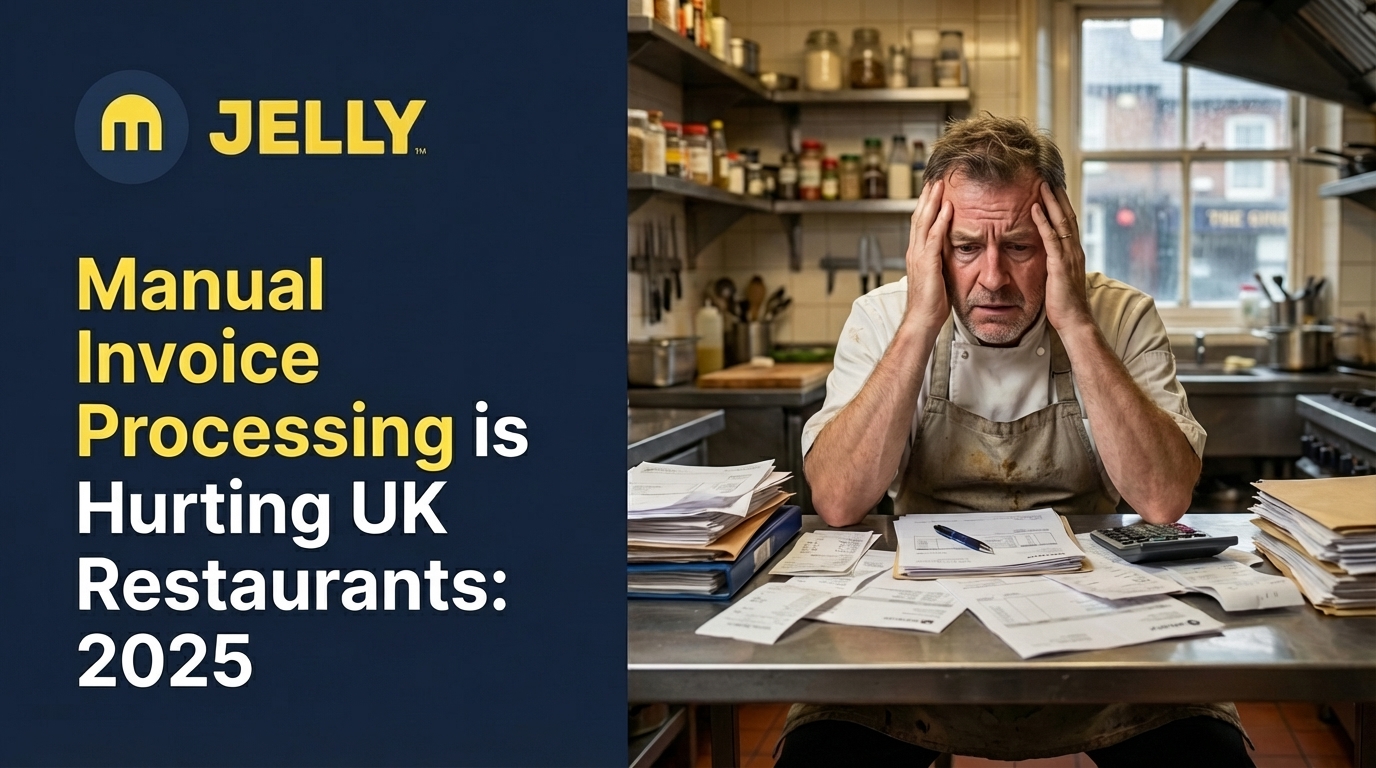
Manual management of supplier invoices drains money and time from UK restaurants, pubs, and boutique hotels. Each week, many sites across Britain lose thousands of pounds through slow invoice handling, delayed financial insight, and error-prone manual systems. This guide explains how traditional methods create hidden costs and missed opportunities, and sets out how automated supplier invoice processing can improve profitability and control. It also shows how platforms like Jelly support this shift for growing UK hospitality businesses.
The Problem: How Manual Supplier Invoice Processing Erodes Restaurant Profitability in the UK
Profitable restaurants depend on tight control of supplier relationships, ingredient costs, and financial reconciliation. Many UK operators still rely on manual back-of-house processes that quietly undermine those efforts. Manual supplier invoice processing acts as a financial risk that grows as the business scales.
Time Sink and Staffing Strain: Draining Resources with Tedious Data Entry
Manual processing of 400 supplier invoices per month at £15/hour results in an average direct labour cost of over £5,000 yearly for a single site. For many UK restaurants, this equates to 10 to 20 hours per week spent on manual data entry, price checking, and invoice reconciliation.
Typical workflows demand that suppliers deliver goods with paper invoices, kitchen staff type data into spreadsheets, managers cross-check prices against contracts, and accounts teams reconcile discrepancies weeks later. This routine pulls skilled staff away from work that grows revenue, such as menu development, guest experience, and strategic planning.
Administrative pressure rises sharply as a business grows. A single-site venue might cope with basic spreadsheets, yet multi-site groups see manual workload multiply quickly. What once felt manageable becomes difficult, so owners either hire extra accounts staff or accept less accurate financial reporting.
Error-Riddled Data, Distorted Profits: The Cost of Human Error in Food Cost Tracking
Manual data entry introduces human error into every stage of cost tracking. Tired staff misread quantities, transpose price digits, or misclassify ingredients. Individual mistakes seem small but often add up to significant margin loss.
These errors affect more than single invoices. Inaccurate cost data pushes menu pricing decisions in the wrong direction. Dishes can look profitable on spreadsheets while losing money in practice. Chefs may continue serving items that underperform while overlooking dishes that generate stronger returns. This lack of clarity makes it harder to optimise the menu mix or increase revenue per cover.
Manual processes also weaken inventory control. When invoice data does not link reliably to stock systems, teams struggle to spot theft, waste, or supplier overcharging. Gaps in visibility allow profit leaks to continue for months and often require time-consuming investigation to correct.
Delayed Insights and Missed Opportunities: Why Monthly Reports Are Too Late for UK Restaurants
Restaurants operate on narrow margins and need fast information to act early. Many UK operators still rely on monthly accountant reports to understand their financial position. By the time those reports arrive, key chances to protect profit have already passed.
Supplier prices change regularly with seasons, inflation, and market shifts. A dish that worked last week may lose money this week, yet teams keep serving it when they lack live cost data. Slow reporting delays menu changes, supplier negotiations, and portion adjustments that could protect profit.
Delays become particularly damaging during rapid inflation or supply disruption. When ingredient costs jump, restaurants that rely on old cost data continue to price dishes on historic figures. Losses build until the next monthly report finally shows the impact.
Critical Risks: Damaged Supplier Relationships and Audit Complications
Manual invoice processing also introduces external risks. Payment errors, duplicate payments, and missed deadlines strain supplier relationships. Reliable suppliers are crucial for service quality, and inconsistent payments can damage trust built over years.
Poor documentation and limited audit trails create compliance issues. Paper invoices can be lost or damaged, which complicates purchase verification during audits or tax inspections. Weak record-keeping also slows insurance claims and regulatory checks, exposing businesses to additional financial and legal risk.
Manual systems also make fraud detection harder. Without automated checks, restaurants may pay incorrect or duplicate invoices for long periods. These issues can remove thousands of pounds from the bottom line before anyone notices.
To reduce these manual risks and costs, book a chat to see how Jelly can automate your supplier invoice processing and improve financial control.
The Solution: Automation for Supplier Invoice Processing in Restaurants
Automation replaces reactive, spreadsheet-based invoice management with structured, proactive financial control. Automated supplier invoice processing turns back-of-house tasks into consistent, accurate, and insight-driven workflows that support stronger margins.
Streamlined Operations and Reduced Labour Costs: Improving Efficiency with Automated Processes
Automation delivers fast and measurable efficiency gains. Invoice processing that previously took weeks of manual effort can often be completed in days or hours. Staff time then shifts from administration to guest service and business development.
Automated systems capture invoice data through several channels, including email inboxes, mobile photo uploads, and direct supplier connections. Every line item is extracted in seconds, without repeated typing. Teams that once spent full shifts on invoices can instead focus on service standards, menu ideas, and expansion plans.
Scalability becomes a practical reality. Manual processes often require extra admin staff as invoice volumes increase. Automated systems handle growth without matching increases in headcount, which supports expansion without a heavy rise in back-office costs.
Pinpoint Accuracy and Real-time Financial Visibility: Reducing Errors and Gaining Control
Automation reduces the human error that affects manual processing. Systems scan and digitise each invoice line, capturing quantities, SKUs, prices, and tax details with a level of accuracy that is difficult to match manually. Reliable data then feeds cost analysis and margin reporting.
Real-time processing keeps financial information current and useful. Managers gain daily or even live visibility of spending, cost trends, and profit margins instead of waiting weeks for formal reports. This visibility supports quick responses to supplier price changes and menu performance.
Modern automation platforms also integrate with other restaurant systems. Invoice data feeds inventory tools, POS systems, and accounting software, so all teams work from the same information. This joined-up view reduces duplication and improves decision-making.
Data-Driven Decision Making and Enhanced Profit Margins: Using Insights to Improve P&L
Automated invoice processing converts raw figures into practical insight. Automated invoice data extraction can decrease costs by approximately 3% of total spend and save £3,000 to £4,000 monthly for UK restaurants through better visibility and control.
Price alerts highlight supplier increases immediately, so managers can negotiate or switch products before losses grow. Historical spending data reveals seasonal patterns, which helps with contract negotiations and stock planning. Menu engineering then relies on live profitability data instead of guesswork, with clear insight into which dishes to promote, reprice, or remove.
Stronger visibility shifts management from reactive to proactive. Owners can spot margin pressure early, adjust pricing strategies to match cost changes, and shape supplier partnerships based on performance data rather than assumptions.
Jelly: Automated Supplier Invoice Processing for UK Restaurants
Jelly focuses on restaurant financial management for growing UK restaurants, pubs, and boutique hotels. The platform offers invoice automation that suits busy hospitality teams and supports accurate, timely financial insight.
Here is how Jelly supports supplier invoice processing for UK operators:
• Automated Invoice Scanning: Capture invoices via email or photo uploads to Jelly’s web platform. The system digitises every line item, including quantity, SKU, price, and tax, so teams gain full visibility without manual input. Kitchen staff can photograph invoices in seconds, and suppliers can email directly to dedicated addresses for straightforward processing.
• Real-Time Price Alerts: Identify ingredient price changes as they happen, including the value of the change and the supplier involved. This feature supports evidence-based supplier conversations and helps protect cost prices.
• Live Dish Costing and GP Margins: Ingredient costs update automatically with each new invoice, so dish costs and gross profit margins stay current. Simple visual indicators show improving or declining margins, which supports quick menu decisions.
• Accounting Integration: Push digitised invoices into Xero and other accounting software with a single click, and reduce bookkeeping time significantly. Integration keeps financial data consistent across systems and cuts repeated admin work.
• Insights Dashboard and Flash Reports: Access real-time spending reports by supplier, plus daily, weekly, or monthly gross profit margin views based on invoice costs and POS sales data. These reports provide regular visibility of financial performance without relying solely on month-end accountant reports.
Jelly users often see clear gains, including 10 to 20 hours of saved admin time per month, up to 2 percentage point improvements in gross margins within three months, and stronger financial visibility for decision-making. The platform turns a previously time-consuming task into a structured process that supports growth.
To improve financial management and uncover hidden savings, book a chat to see how Jelly can automate your supplier invoice processing and support margin control.
Case Study: How Amber Saved Thousands Monthly with Supplier Invoice Processing Automation
Amber, a Mediterranean restaurant in East London, faced common invoice processing issues seen across the UK market. Despite a distinctive concept inspired by the historic Amber Road trade route, manual supplier invoice management created hidden costs and operational friction.
The Challenge: Volatile supplier pricing and manual invoice work eroded margins. Spreadsheet-based dish costing made it difficult to track price changes in time, negotiate effectively, or adjust menu pricing before gross profit slipped.
The Solution: Amber introduced Jelly’s automated invoice processing, which captured supplier invoices digitally, extracted line-item data, and delivered real-time financial visibility. Features such as invoice automation, price change alerts, and live costing for recipes and menus played a central role.
The Results: With Jelly, Amber saved £3,000 to £4,000 per month through credits, improved purchasing, and tighter menu controls. Faster responses to price swings kept gross profit on target, and reduced admin created more time for kitchen work and guest service. Chef-Owner Murat Kilic said, “Jelly keeps my business alive.”
This case shows that automation influences more than labour costs. Amber strengthened supplier management, improved cash flow via faster processing, and gained the financial visibility required for confident decisions in a competitive local market.
The Jelly Advantage: Comparing Automation Solutions for UK Restaurants
Automation platforms differ in scope and ease of use. The comparison below highlights how Jelly supports growing UK restaurants:
|
Feature/Benefit |
Manual Processes |
Legacy Systems |
Jelly |
|
Invoice Data Entry |
Fully manual |
Semi-automated (templates) |
Fully automated (photo/email capture) |
|
Real-time Price Alerts |
None |
Limited or delayed |
Live alerts |
|
Dish Costing Updates |
Manual and infrequent |
Static |
Live and automatic |
|
Setup Time |
Not applicable |
Long, often months |
Fast, often operational in days |
|
Ease of Use |
Basic spreadsheets |
Requires training |
Simple, chef-friendly interface |
|
Admin Time Savings |
None |
Some |
10 to 20 hours monthly |
|
Margin Improvement |
Unpredictable |
Moderate |
Up to 2 percentage points |
This comparison shows how Jelly combines automation depth with straightforward daily use. Legacy systems may offer similar features but often involve long implementation cycles and complex training. Jelly focuses on rapid setup so restaurants see value within their first weeks of use.
5 Ways Automated Supplier Invoice Processing Supports Better Restaurant Operations
1. Eliminate Price Blindness with Real-Time Cost Intelligence
Manual systems can leave teams unaware of current ingredient costs. Automated invoice processing gives immediate price visibility and highlights supplier increases as soon as they happen. Managers can then negotiate, adjust menu prices, or switch products before margins suffer.
2. Shift Menu Engineering from Guesswork to Evidence
Automated platforms connect invoice costs with POS sales data, revealing which dishes deliver the best returns and which weaken margins. This approach replaces intuition with clear profitability analysis. Accurate invoice data also reduces supplier overcharges and pricing errors, which supports more confident menu planning and review.
3. Move Financial Reporting from Monthly to Daily
Traditional monthly financial reports often arrive too late to influence day-to-day choices. Automated invoice processing provides daily visibility of costs and margins. Managers can respond quickly to changes in ingredient prices, sales mix, or performance trends and avoid end-of-month surprises.
4. Strengthen Supplier Relationships with Data-Backed Negotiations
Automation provides the figures needed for constructive supplier conversations. Price alerts, spend history, and comparative cost tracking give restaurants a clear view of supplier performance. Managers can use this data to address unjustified increases, secure volume deals, and focus spend on the most reliable partners.
5. Scale Operations Without Matching Administrative Growth
Manual invoice processing usually demands more staff as a group grows. Automated systems manage higher invoice volumes without equal increases in admin hours. This scalability helps multi-site operators grow profitably while keeping back-office headcount under control.
Implementing Automated Invoice Processing: A Strategic Roadmap for UK Restaurants
Structured implementation helps restaurants capture the benefits of invoice automation while limiting disruption. The roadmap below outlines a practical approach.
Phase 1: Assessment and Preparation
First, audit current invoice workflows and identify problem areas. Measure manual labour hours, list supplier relationships, track invoice volumes, and note common errors. These baseline figures make it easier to evaluate the impact of automation and often reveal hidden costs.
Phase 2: Platform Selection and Setup
Next, select an automation platform that matches the size, complexity, and growth plans of the business. Jelly offers rapid onboarding, so sites can become operational in days rather than months. Suppliers can email invoices directly to unique addresses, and kitchen teams can use the mobile app to capture photos of invoices, which reduces friction during rollout.
Phase 3: Staff Training and Adoption
Modern automation tools typically require limited training, especially when interfaces are built for busy kitchens. Adoption increases when staff see that the system removes work from their day. Training should emphasise clear benefits such as faster processing, less typing, and more useful insights.
Phase 4: Integration and Optimisation
After the core workflow is in place, link automated invoice processing with existing POS and accounting systems to form a single financial view. Integration strengthens the value of automation and reduces duplicate work. Ongoing review of alerts, settings, and reports ensures the system stays aligned with operational goals.
To explore a structured move to automation, book a chat to discuss your requirements and see how quickly Jelly can improve invoice processing.
The Hidden ROI: Calculating the True Value of Automated Invoice Processing
The return on investment from automated supplier invoice processing covers more than visible labour savings. A clear view of total value helps teams make informed adoption decisions.
Direct Cost Savings
AI automation produces an annual ROI exceeding £15,000, combining reduced labour, waste, and improved reporting speed. These savings come from lower manual data entry costs, fewer admin hours, and faster processing that supports better cash flow.
Indirect Profit Improvements
Automated systems support margin improvement through tighter cost control, quicker reactions to price changes, and evidence-based menu decisions. Growyze clients report up to 90% time savings on invoice validation, 60% on stocktaking, and 50% on supplier management. These gains translate into higher profitability through reduced waste and more efficient operations.
Risk Mitigation Value
Automation reduces errors, payment delays, and compliance issues linked to manual work. Avoiding supplier disputes, audit complications, and regulatory penalties often represents a significant part of the financial benefit.
Strategic Growth Enablement
Automation also creates more time for strategic work. When managers spend less time on routine admin, they can focus on menu development, team leadership, marketing, and expansion. These activities can generate returns that exceed the direct cost savings from automation.
Overcoming Common Automation Implementation Challenges
Clear planning and communication help restaurants address common hurdles during automation projects.
Staff Resistance and Change Management
Some kitchen or admin staff may feel cautious about new technology, especially if they have used difficult systems in the past. Success often depends on showing quick wins such as less typing, faster processing, and fewer repetitive tasks. Jelly’s chef-focused design supports this by fitting into existing workflows and keeping screens simple.
Supplier Cooperation and Integration
Certain suppliers may hesitate to adjust their invoicing habits. Many suppliers, however, see benefits from faster payments and fewer queries. Clear explanation of the process and emphasis on mutual gains usually help secure cooperation.
Data Quality and System Integration
Inconsistent supplier invoice formats can challenge older systems. Modern AI-based platforms such as Jelly handle varied layouts and still extract accurate data. Integration with existing accounting and POS software then keeps information consistent across the wider business.
Cost Justification and ROI Measurement
Some owners initially struggle to justify automation spend. A thorough ROI review should include hidden manual costs, time spent on corrections, delays in decision-making, and missed optimisation opportunities. This fuller view often shows that manual processes cost more than expected.
Future-Proofing Your Restaurant with Automated Invoice Processing
The hospitality sector continues to face rising costs, labour shortages, and high guest expectations. Automated supplier invoice processing helps restaurants adapt to these pressures and prepare for future shifts.
Labour costs continue to rise, which makes manual administration harder to sustain. Supply chains remain volatile, so real-time cost visibility becomes essential. Guests expect value, which demands accurate cost control and consistent margin management that manual systems struggle to provide.
Restaurants that invest in automation now place themselves in a stronger position for the years ahead. As competition increases, efficient operations and clear financial insight become core requirements rather than optional extras.
Frequently Asked Questions About Supplier Invoice Processing Automation
How much time can automated invoice processing realistically save my restaurant in the UK?
Automated invoice processing often removes most of the time spent on manual data entry, checking, and reconciliation. Many UK restaurants currently spend 10 to 20 hours each week on these tasks. Automation allows staff to redirect that time to customer service, menu development, and growth projects. Jelly customers typically reclaim 10 to 20 hours of admin time every month, which reduces cost and improves focus.
Can automation truly help me negotiate better prices with my food and beverage suppliers?
Automation supports stronger supplier negotiations by providing clear data. Jelly’s Price Alert feature records every price change and shows when and where costs increase or decrease. Managers can use this evidence, along with volume and history data, to challenge unjustified rises and secure better terms.
Is automated supplier invoice processing only for large restaurant chains, or can independent establishments benefit?
Automation benefits single-site venues, independent operators, and multi-site groups. Jelly is designed for growing establishments with annual revenues over £500,000 and offers automation in a format suitable for smaller teams. Even one-site restaurants often see a clear case for automation through labour savings, fewer errors, and better margin control.
How does automated invoice scanning ensure data accuracy and help with P&L for a restaurant?
Automated invoice scanning uses advanced recognition technology to read each line item on an invoice. Jelly captures quantities, SKUs, prices, and tax details directly from the document, which reduces manual keying errors. Accurate and current ingredient costs feed into profit and loss reports and dish profitability analysis, so financial decisions reflect real prices rather than estimates.
What happens to my existing accounting processes when I implement automated invoice processing?
Automated invoice processing supports and enhances existing accounting workflows. Jelly integrates with accounting tools such as Xero so that digitised invoice data flows into current systems without duplicate entry. This approach can reduce bookkeeping time by up to 90 percent while improving accuracy and speed.
Conclusion: Master Your Margins with Automated Supplier Invoice Processing
The UK restaurant sector rewards precise cost control and fast decision-making. Manual supplier invoice processing consumes time, hides errors, and delays insight, which all work against these goals. Each day spent on manual entry is a day with less focus on guests, teams, and growth.
Automation has become a practical necessity for restaurants, pubs, and boutique hotels aiming to protect and grow margins. Automated systems reduce admin costs, cut errors, deliver real-time financial visibility, and support data-driven choices that improve profitability.
Jelly offers an invoice automation platform tailored to the needs of growing UK hospitality businesses. With automated invoice capture, real-time price alerts, live dish costing, and accounting integrations, Jelly provides the tools required to manage costs, protect margins, and scale with confidence.
Restaurants that adopt automation now will operate with clearer financial data, respond faster to market changes, and make decisions based on facts rather than outdated figures. They can focus management attention on guests and growth instead of spreadsheets and paper.
To strengthen your restaurant’s financial management and uncover hidden profitability, book a chat to see how Jelly can automate your supplier invoice processing and support more confident margin control.