
Written by: JJ Tan, Founder, Jelly
Key Takeaways
- Over-portioning quietly erodes margin. An extra 20 g of protein on 80 nightly covers wastes 1.6 kg of product every day.
- Five practical techniques, including standardised recipe scaling and post-service leftover tracking, cut plate waste and stabilise food-cost percentages.
- Accurate data capture underpins every improvement. Collect supplier invoices, recipe cards, and POS access before you start.
- Operators using Jelly’s live dish costing and Flash Report see measurable food-cost reductions and GP gains within the first 90 days.
- Ready to turn portion control into a measurable profit advantage? Book a demo with Jelly and automate the data flow from invoice to GP margin.
Before You Begin: Set Your Portion Control Baseline
Gather a clear baseline before you change any process so you can prove the impact later.
Collect the following so every change is measurable from day one:
- Current supplier invoices (last 4 weeks minimum) with line-item pricing
- Existing recipe cards or any informal prep notes used by the kitchen team
- POS login credentials with admin access for integration
- A baseline food-cost percentage from your most recent management accounts
Without a baseline, you cannot prove ROI to owners, finance managers, or investors. That is why collecting these inputs before moving to Technique 1 is essential, because they set the starting point for every improvement you measure.
See how Jelly turns your invoices and recipe cards into a live GP dashboard from day one.
Technique 1: Standardised Recipe Scaling for Every Dish
Objective: Lock every dish to a fixed ingredient weight so portion size stays identical regardless of who is on the pass.
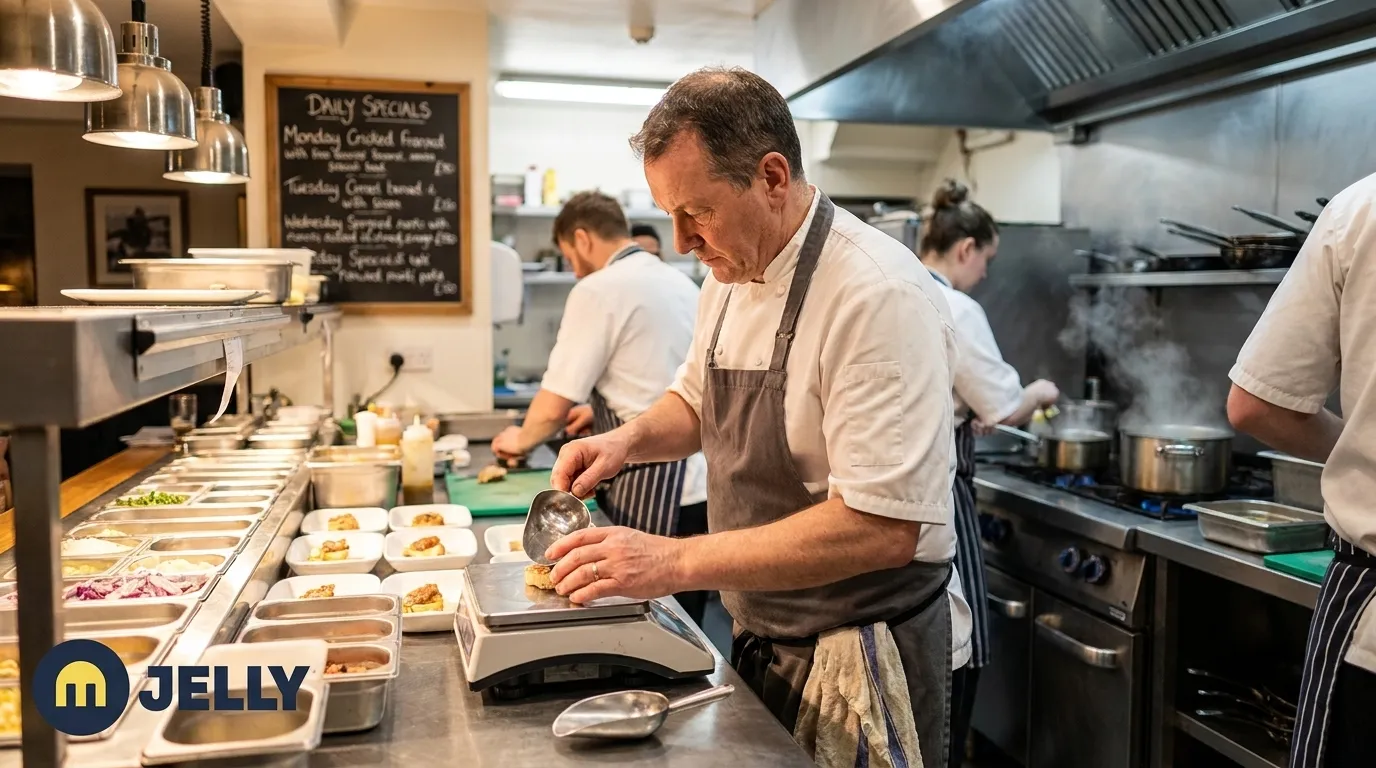
Write or digitise a recipe card for every menu item that specifies ingredient quantities in grams, not cups or “handfuls”. Weigh each component during a controlled test cook, record the exact yield, and publish the card as the single source of truth for the kitchen. Use calibrated digital scales accurate to 1 g, a recipe card template, and a central storage location that every chef can access.
Tight protein portions recover significant ingredient costs per service. The exact saving depends on protein type and supplier price.
Track in your inventory system: In Jelly’s Kitchen section, build each dish by clicking on ingredients already populated from scanned invoices. Jelly handles all unit conversions and calculates the live cost per portion automatically. A costing task that once took 28 minutes per dish now takes under 3 minutes.
Technique 2: Visual Portion Tools and Plating Guides at the Pass
Objective: Remove reliance on chef judgement at the pass by giving every station a clear physical or visual reference for each component.
Issue standardised portion scoops, ladles, and spoodles sized to the gram weights defined in Technique 1. Photograph a correctly plated dish from above and from the side, print the images, laminate them, and mount them at the relevant station. Use portion scoops from catering suppliers such as Nisbets or Alliance Online, a laminator, and the plating photographs.
Visual guides cut over-portioning variance by stripping out subjective plating decisions. They produce more consistent plate weights and lower the risk of customer-driven waste from portions that feel too large.
Track in your inventory system: When Jelly’s live dish costing flags a margin drop on a specific item, cross-reference it with the scoop size in use at that station. A red GP percentage in Jelly often signals that a visual standard has slipped.
Technique 3: Batch-Prep Controls Linked to Forecasted Covers
Objective: Standardise batch quantities so prep waste and over-production are controlled before service starts.
Set a daily or session-level prep quantity for each batch item, such as stocks, sauces, proteins, and sides, based on forecasted covers from POS historical data. Label every batch container with the prep date, batch weight, and expected yield. Log actual yield against target in a batch log using a sheet or digital tool, tare-weight labels, and cover forecasts from your POS.
Operators who align batch quantities with forecasted covers consistently reduce end-of-service surplus. They cut the volume of food that moves from prep waste into bin waste.
Track in your inventory system: Jelly’s Flash Report shows daily GP movement. A sudden dip on a high-batch item, such as a soup or sauce, without a matching drop in covers, reliably indicates that batch quantities are running over target.
Technique 4: Service-Time Portion Monitoring During Live Service
Objective: Pinpoint which dishes and service periods create the highest portion variance by linking POS sales data to ingredient use in real time.
During service, a senior chef or floor manager spot-checks three to five dishes per session by weighing a plated portion before it leaves the pass. Record the actual weight against the recipe-card standard. At the end of service, compare ingredient usage against the number of covers sold for each dish using POS data. Use a pocket digital scale at the pass, a service checklist, and POS item-level sales data.
Consistent spot-checking during peak service, especially on Friday and Saturday evenings, creates accountability at the pass. It does this without requiring full-time supervision.
Track in your inventory system: Jelly integrates with its partners via real-time API, pulling item-level sales data the moment a transaction completes. Ingredient consumption per dish can then be compared against actual sales volume without manual calculation.
Technique 5: Post-Service Leftover Tracking by Dish
Objective: Quantify end-of-service surplus by dish and service period so over-production patterns become visible and fixable.
At the end of every service, weigh and record all unsold prepared food by category. Log it against the number of covers served and the batch quantity prepared. Review the waste log weekly to identify recurring surplus items. Use a digital or paper waste log, a scale, and a consistent recording routine from the closing chef.
A waste log that runs for four consecutive weeks produces enough data to adjust batch quantities and prep schedules with confidence. You can then move away from decisions based on chef intuition alone.
Track in your inventory system: Recurring surplus on a specific dish, combined with Jelly’s live margin data, builds a clear case to reduce batch size, reprice the dish, or remove it from the menu. The decision rests on data rather than preference.
Connect your waste logs, recipe costs, and POS sales into one live view with Jelly.
Common Portion Control Mistakes to Avoid
- Chef resistance to new standards: Chefs who have plated dishes intuitively for years often view portion tools as a challenge to their skill. Frame standardisation as a quality guarantee rather than a constraint. Consistent portions protect the dish’s integrity and the kitchen’s reputation across every cover.
- Inconsistent scoop usage: Portion scoops left in the wrong container or swapped for a spoon during a busy service break the standard immediately. Colour-code scoops by station and add scoop checks to the opening mise-en-place checklist.
- Missing variance logs: Without a written or digital record of actual versus target portion weights, the team has no data to act on. Make variance logging a non-negotiable close-of-service task, and require the head chef to sign off the log before the kitchen is cleared.
How to Measure Portion Control Success
| KPI | Measurement Method | 90-Day Benchmark | Jelly Feature |
|---|---|---|---|
| Weekly plate-waste weight (kg) | End-of-service waste log, weighed and recorded per session | 15–20% reduction versus baseline week | Flash Report (cost vs. covers) |
| Monthly food-cost percentage | Total ingredient spend ÷ total food revenue × 100 | 2–3 percentage point reduction; Jelly users cut food costs by 3% on average in the first 3 months | Live Dish Costing + Invoice Scanning |
| Gross-profit margin movement | GP% per dish tracked against recipe-card standard cost | 2 percentage point GP improvement; one operator moved from 65% to 72% GP within 12 weeks on ~£500k revenue | Flash Report + Price Alert |
| Portion variance rate | Number of out-of-spec portions recorded during spot-checks ÷ total spot-checks | Variance rate below 5% by week 8 | Kitchen (live recipe costing) |
Advanced Multi-Site Portion Control Tips
Scaling portion standards to a second site introduces a new risk, which is assuming that what works in site one will transfer automatically. It rarely does. Each site needs its own opening audit, with recipe cards reprinted and laminated on-site, scoops physically present at each station, and a local chef named as the portion-control lead. The standard stays the same, while the implementation must be owned locally.
Once standards are embedded, Jelly’s Kitchen section allows recipe costs to be replicated across sites so a price change from a shared supplier updates dish costs at every location simultaneously. Jelly’s Price Alert feature flags every ingredient price movement by supplier, giving head chefs and operations managers the data they need to negotiate credits, switch suppliers, or adjust menu pricing before margin erosion compounds. Amber restaurant in East London uses this approach and saves £3,000–£4,000 per month through faster reactions to price changes and tighter menu controls.
Frequently Asked Questions
How often should a restaurant audit its portion standards?
Run a full portion audit, weighing every dish component against the recipe card standard, at least once a month. High-volume or high-margin dishes deserve a weekly spot-check during service. Every quarter, review the entire recipe card library against current supplier prices so the standard cost per portion still matches what you pay on invoices.
Who should own portion control in a commercial kitchen?
The head chef or executive chef holds primary accountability for setting and maintaining portion standards. Day-to-day enforcement sits with the senior chef on each section. In multi-site operations, an operations manager or group executive chef should own the standard across sites, while each site’s head chef manages local compliance. Finance managers and owners should see the GP data that portion control produces, which Jelly provides directly without asking a chef to create a separate report.
Where can UK operators source portion control tools?
Calibrated digital scales, portion scoops, ladles, and spoodles are available from UK catering equipment suppliers including Nisbets, Alliance Online, and Russums. Scales accurate to 1 g are sufficient for most kitchen applications. Portion scoops are usually sized by volume, such as a No. 16 scoop at approximately 60 ml, and should be checked against the gram weight in the recipe card to confirm the correct size for each use.
How do you maintain consistent portions across multiple sites?
Consistency across sites depends on three elements. You need a single, centralised recipe card library that all sites use, physical portion tools that match across every site, and a shared data system that makes GP performance visible at both site and group level. Jelly’s multi-site capability means that recipe costs, invoice prices, and GP margins are visible across all locations in one platform, so an operations manager can see which site is drifting from standard without waiting for monthly accounts.
Can Jelly integrate with accounting software to close the loop on food costs?
Yes. Jelly integrates directly with Xero, pushing digitised invoice data with a single click and cutting bookkeeping time by about 90%. Sage integration is in development. Ingredient costs captured through Jelly’s invoice scanning then flow straight into the accounting system, which removes the manual reconciliation step that often delays financial reporting by weeks and creates the data lag that hides margin erosion.
Conclusion: Turn Portion Control into Reliable Margin
Portion control is not a blunt cost-cutting exercise. It is a margin-protection discipline. Applied consistently across all five techniques, it reduces plate waste, stabilises food-cost percentage, and gives finance leads and owners the visibility they need to act in real time instead of after the fact.
Operators who sustain these gains remove manual data entry from the process so the discipline does not depend on a chef finding time for paperwork during a busy service. Jelly automates the data flow from supplier invoice to live dish cost to GP margin, connecting your portion standards directly to the financial outcomes they protect. Book a demo and see how Jelly helps your kitchen turn portion control into a measurable, repeatable profit advantage.