
Written by: JJ Tan, Founder, Jelly
Key Takeaways
- Portion creep silently erodes gross profit, and consistent grammage across every cover keeps food cost percentage predictable.
- Measurement reveals the variance between theoretical and actual usage, which is where margin disappears.
- Five practical methods, including recipe cards and calibrated tools, create an enforceable portion-control system any UK kitchen can adopt quickly.
- Live dish costing that updates with every invoice keeps portion costs accurate, while static spreadsheets fall behind when supplier prices move.
- Connect your POS and invoices to Jelly to automate variance tracking and close the portion-control loop without spreadsheets.
How Portion Control Protects Food Cost
Portion control defines an exact gram weight, volume, or unit count for every ingredient in every dish and serves that standard consistently across every cover. This consistency directly affects food cost percentage, which is the ratio of ingredient cost to selling price, because reliable grammage makes that percentage predictable and manageable. When portions drift, gross profit erodes silently, cover by cover.
Why Portion Control Fails Without Measurement
Understanding what portion control is only gets you so far, because the real challenge is why it so often fails in practice. Theoretical usage is what your recipes say you should have consumed across the week’s covers. Actual usage is what your invoices and stock counts say you did consume. The gap between the two is the combined effect of portion creep, waste, over-serving, and unrecorded giveaways. Portioning errors are typically the biggest single driver of food cost variance, and portion drift is invisible on the line because generous plates get complimented, and it only appears in the gap between theoretical and actual usage.
Here is a worked UK example. As of 3 August 2026, the wholesale price of halal chicken breast in the UK was approximately £6.92 per kilogram, in line with its 12-month average (range £6.84–£7.55). Your recipe specifies a 180g portion. A chef consistently plates 210g, which is an extra 30g per cover. Across 100 covers a week, that is 3kg of unplanned chicken usage, which at Nigel’s Butchers’ listed price of £8.50 per kg for skin-on, bone-in chicken breast costs £25.50 per week. Across 52 weeks, that is £1,326 lost on a single ingredient from a single dish.
To apply this to your own kitchen, substitute your own numbers. Multiply the overage in grams by your weekly covers, divide by 1,000 to get kilograms, and multiply by your wholesale price per kilogram. Ten grams over on a protein costing £30 per kilogram costs £0.30 per plate, which becomes over £1,200 a year on a dish selling 80 times a week. An extra 20g per plate across 300 plates becomes 6kg of unexplained usage, while the POS still records one standard serving. This same pattern appears across ingredients and menu sections.
Portions drift for structural reasons that have nothing to do with staff care: a supplier switch changing sauce density so the same ladle carries more, protein arriving in a slightly larger average size, or a wider plate causing garnish to grow to fill it. You cannot fix what you do not measure.
See how Jelly surfaces the gap between theoretical and actual usage automatically.
Five Practical Methods Of Portion Control
The following five methods form a practical toolkit for any UK kitchen that wants enforceable portion control.
- Standard Recipe Cards With Exact Grammage, Yield, And Plating Notes. Every dish has a written specification covering ingredient weights, trim and cooking yield, and a plating photograph. This standard forms the foundation for every other method, because without a written reference there is nothing to enforce.
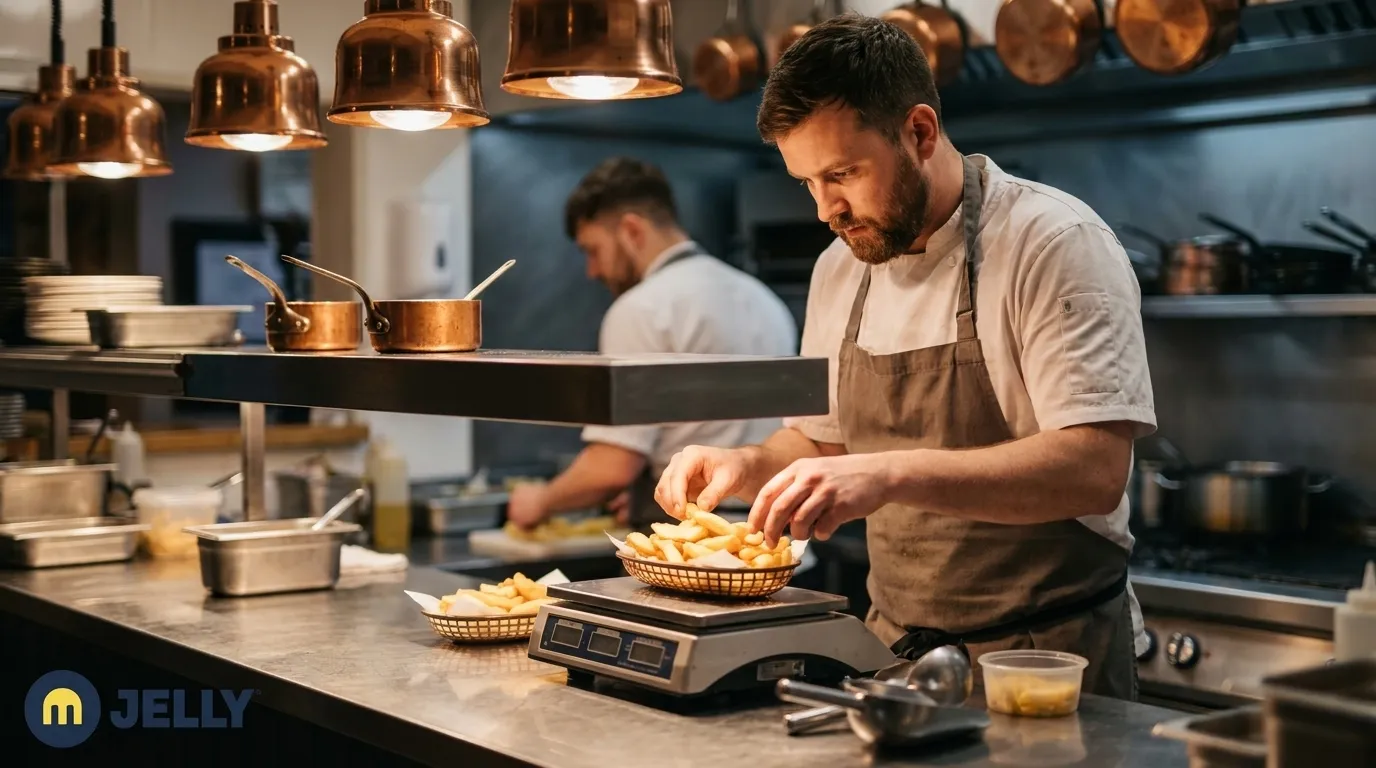
- Calibrated Scales At Every Station, Checked Weekly. Digital scales accurate to one gram are the most reliable enforcement tool for proteins, starches, and high-cost garnishes. They work best for any ingredient portioned from bulk during service.
- Pre-Portioning During Prep With Bagged, Labelled Components. Proteins, cheeses, and other high-cost items are weighed and portioned during prep so the correct amount is the easy amount at the pass. This approach reduces decision-making under service pressure.
- Fixed Serving Tools Such As Ladles, Scoops, Portion Cups, Ring Moulds, And Measured Pumps. These tools remove the need to weigh during service for sauces, dressings, grains, and garnishes. They suit high-volume, lower-cost ingredients where speed matters.
- Plate-Waste Review And Spot Checks During Service. Weighing two random portions per service, mid-rush, on the three most expensive products has the best effort-to-recovery ratio of any loss-control measure. This works best as an ongoing monitoring habit rather than a one-off audit.
How To Set A Standard Portion For Every Dish
Start with the ten highest-volume dishes and ignore the rest of the menu for now. Many kitchens abandon the exercise when they try to build recipe cards for every item at once. For each priority dish, record every ingredient by gram weight, the yield percentage after trim and cooking loss, and a plating photograph. Yield testing for meat cutting and cooking losses, including yield percentages, edible product costs, and cost per usable kilogram, forms the technical foundation of accurate portion costing.
The critical operational requirement is that a dish cost updates when supplier prices change, rather than once a quarter. A recipe card built on last quarter’s chicken price becomes fiction if the price has moved. Jelly’s Cookbook and live dish costing remove this manual burden entirely. Ingredients populate automatically from scanned invoices, unit conversions and wastage percentages are handled by the system, and dish GP margins update in real time whenever a new invoice arrives. What previously took 28 minutes per dish in a spreadsheet takes approximately three minutes in Jelly. Before using Jelly, Chef Murat Kilic of Amber restaurant used tedious manual costing and pricing with spreadsheets, and after switching, the restaurant saves £3,000–£4,000 per month.
See how Jelly’s Cookbook builds and maintains live portion standards from your own invoices.
The Tools That Actually Enforce Portions
The right physical tools make the correct portion the easy portion. Calibrated digital scales, checked weekly against a known weight, are non-negotiable for proteins and starches portioned during service. Pre-portioning during prep removes the weighing decision from the pass entirely. A chef bagging 180g chicken portions at 10am cannot over-serve at 7pm. For sauces and grains, fixed ladles and scoops in specific sizes enforce portions without slowing service. Where speed is critical, measured pumps suit high-volume sauces and oils. Portion cups and ring moulds work for garnishes, cheese, and plated components where visual consistency is as important as weight.
The list below maps each ingredient category to the tools that enforce its portion most effectively.
- Proteins and starches: scales and pre-portioned prep bags
- Sauces, dressings, and oils: measured pumps and fixed ladles
- Garnishes and cheese: portion cups and ring moulds
- Grains and sides: fixed scoops in specific volumes
Small overpouring or over-plating adds up across hundreds of covers, and a bartender free-pouring by eye can average a 10–15% overpour across every drink sold in a busy month. The same principle applies to every free-poured sauce or garnish in the kitchen.
How To Calculate Portion Cost And Food Cost Percentage
Once you have the right tools in place, the next step is to quantify the cost of each portion. Two formulas underpin every portion cost and food cost percentage calculation.
- Portion cost = (purchase price of pack ÷ usable yield after trim and wastage) × portion weight
- Food cost percentage = (portion cost ÷ selling price) × 100
A worked UK example illustrates this. A 5kg bag of chicken breast typically costs between £23.99 and £37.99, with Musclefood’s 5kg Premium Chicken Breasts priced at £37.99. After trim and cooking loss, the usable yield of chicken breast is approximately 80% when poached, giving about 4kg of usable meat from a 5kg bag, though yields vary by cooking method, with baked at about 75% and grilled about 72%. Cost per usable kilogram is £37.99 ÷ 4 = £9.50. A 180g portion costs £9.50 × 0.18 = £1.71. If the dish sells at £16.00 (VAT-exclusive, and food cost percentage should always be calculated against VAT-exclusive revenue rather than the VAT-inclusive sticker price), food cost percentage is (£1.71 ÷ £16.00) × 100 = 10.7% for that ingredient alone.
Dividing the supplier purchase price by the number of servings ignores trim, yield loss, and price changes between deliveries. Food cost percentage is only meaningful when both the portion weight and the ingredient price are current. Jelly’s invoice scanning keeps ingredient prices current line by line, so the formula above stays accurate without manual intervention. Sushi Revolution uses Jelly to set separate target gross profits on dine-in and delivery menus, accounting for 30% delivery commissions, which results in actual gross profits 2–3% higher on average.
See how Jelly keeps your dish costs accurate with every invoice, automatically.
How To Train And Monitor Staff Without A Mutiny
Accurate cost calculations are only useful if your team follows the portion standards consistently. That is easier said than done, because chefs resist being told what to do, particularly when the instruction feels like an accusation. Frame portion standards around quality and consistency for the guest, and avoid framing them as pure cost-cutting. A 180g chicken portion ensures every table gets the same dish the chef intended. That framing lands differently on a busy pass.
For new kitchen staff, a short induction covering the three or four highest-cost dishes, with a physical demonstration using scales and the correct tools, works better than a folder of recipe cards. Spot checks during service, not after, catch drift before it compounds. The Saturday problem, where the most experienced chef is off and the junior team eyeballs everything, is solved by pre-portioning during prep rather than a lecture on Monday morning. For the chef who insists on eyeballing it, give them the scales and the variance data. A positive variance on chicken, translated into pounds lost per week, is a more persuasive argument than any management directive.
How To Track Theoretical Vs Actual Food Usage
Training and monitoring keep portions consistent day to day, but to know whether those efforts are working, you need to measure the gap between what you should have used and what you actually used. This is the section that separates kitchens that control costs from those that guess at them. The variance calculation requires three inputs: a recipe portion weight, item-level sales data from the POS, and accurate stock counts.
- Theoretical usage = recipe portion weight × number of covers sold (from POS)
- Actual usage = opening stock + deliveries − closing stock
- Variance = actual usage − theoretical usage
- Variance % = (variance ÷ theoretical usage) × 100
A worked example using the Rosuii chicken stock model shows how this plays out. Opening stock is 25kg, purchases are 40kg, and closing stock is 18kg, so actual usage is 47kg. With 120 dishes sold at a 350g standard portion, theoretical usage is 42kg. Variance is 5kg, or 11.9%. Before concluding there is a problem, subtract recorded spoilage, such as 1.5kg, and documented staff meals. The unexplained remainder is what requires investigation.
A well-run multi-site operation targets a food cost variance of 2–3%, and above 5% suggests something structural, such as bad recipe data, unreliable counts, or consistent portioning problems. On a restaurant doing $100,000 in monthly sales, a 4 percentage-point gap between theoretical and actual food cost equals $48,000 a year lost on a single location.
This calculation is only possible with item-level sales data and invoice-level purchase data. Jelly automates exactly this by integrating with POS systems including Square, EPOS Now, Lightspeed, and Toast, which delivers item-level sales data in real time, and by scanning every invoice line item so purchase costs are always current. Sushi Revolution’s monthly stocktake using Jelly takes 5–20 minutes, down from 2–3 hours previously.
See how Jelly runs theoretical vs actual variance without spreadsheets.
How To Track Plate Waste And Close The Loop
Variance tracking tells you what disappeared between delivery and the pass, but it does not tell you whether the food that left the kitchen was actually eaten. A weekly plate-waste review answers a different question from the variance calculation. Variance tells you what disappeared between delivery and the pass. Plate waste tells you what left the pass but did not get eaten. WRAP’s research on UK hospitality food waste found that 34% of waste comes from customer plates, which is a significant share that points to portion size or dish design rather than kitchen process.
Differentiating plate waste from spoilage is essential: customer leftovers point to portion size or dish design issues, while spoilage in the walk-in points to ordering or rotation failures, and they require completely different responses. Plate waste is also one of the causes of a positive variance, because food that leaves the kitchen but is not consumed still counts as actual usage. Portion adjustments should be evidence-led. If a specific dish consistently generates plate waste, the evidence supports a portion reduction. If the variance is high but plates come back clean, the problem sits in the kitchen rather than in the portion size.
How To Connect Portion Control To POS And Invoice Data
The closed loop works as follows. POS sales mix tells you what is selling and in what volume. Invoice data tells you what ingredients cost this week rather than last quarter. Portion standards tell you what should have been used. When all three are live and connected, portion control stops being a one-off instruction and becomes a continuous feedback cycle.
Menu mix moves food cost percentage more than purchasing does. Two kitchens buying equally well can post food costs six percentage points apart simply because one sells steak and the other sells pasta. Without POS-connected sales mix data, you cannot know whether a rising food cost percentage comes from a portioning problem or a sales mix shift.
Jelly is the simplest way for growing restaurants, pubs, and boutique hotels to automate this loop. Invoice scanning keeps ingredient prices current line by line, and its live dish costing updates GP margins in real time. The Sales Mix report, powered by real-time API integrations with Square, EPOS Now, Lightspeed, and Toast, shows which dishes are selling and which are most profitable. The Flash Report gives a daily, weekly, or monthly view of gross profit margin calculated from live costs and live sales. These POS systems are complementary tools that Jelly works alongside, and connecting them takes approximately five minutes per system. Many operators see a 2–4% improvement in food cost percentage within the first three months of switching to a dedicated platform.
Connect your POS and invoices to Jelly and close the portion control loop.
What Is The 30/30/30/10 Rule In Restaurants?
The 30/30/30/10 rule is a widely used restaurant benchmark heuristic. It allocates roughly 30% of revenue to food cost, 30% to labour cost, 30% to overheads, and 10% to net profit. However, it is a teaching model and shorthand rather than a target most restaurants actually achieve. Real cost mixes vary widely by concept, and net margins are often in the low single digits. The commonly quoted UK food cost benchmark is 28–35% of sales depending on concept, calculated against VAT-exclusive revenue, though this is a trade convention rather than a measured survey average, with the UKHospitality/Christie & Co Benchmarking Report recording an average food gross profit of 66% for UK pubs, which implies food cost percentages of roughly 31–35% depending on segment. Portion control protects the food cost element of the ratio, because every gram of uncontrolled over-portioning compresses the 10% profit margin directly.
Should Restaurants Reduce Portion Size?
Reducing portions without measurement risks customer dissatisfaction and fails to fix the underlying variance. The correct sequence is to standardise grammage first, measure the gap between theoretical and actual usage, and adjust portion sizes only where the evidence supports it. Evidence comes either from plate waste data that shows consistent leftovers or from a dish cost calculation that shows the current portion is structurally unprofitable at the current selling price. A portion reduction imposed without evidence is a guess. A portion adjustment supported by four weeks of variance data and plate-waste observation is a decision.
FAQ
How Often Should Portion Standards Be Reviewed?
Portion standards should be reviewed at least quarterly and whenever supplier prices or recipes change materially. In practice, a kitchen using live dish costing, where ingredient prices update automatically with every invoice, will see the cost impact of a portion standard immediately when a supplier price moves, which turns the review into a continuous process rather than a quarterly event. A formal review of the top ten dishes by volume remains a sensible quarterly habit regardless of the costing system in use.
Who Owns Portion Control In A Kitchen?
The head chef owns the standards, sets the grammage, writes the recipe cards, and is responsible for training the team to the standard. The owner or finance manager owns the measurement and reporting, and they ensure that theoretical versus actual variance is calculated regularly and that the results are acted on. In practice, these two roles need to share the same data. When the head chef can see the variance report and the owner can see the recipe costs, the conversation about margin becomes factual rather than adversarial.
What If Different Chefs Portion Differently Across Sites?
Multi-site consistency depends on shared standards rather than individual judgement. Standard recipe cards with exact grammage, plating photographs, and pre-portioned prep protocols form the foundation. Spot checks during service, ideally by a senior chef or operations manager visiting each site, catch drift before it compounds. Variance reports by site quickly identify which location is running above theoretical usage, which makes the conversation with the site chef specific and evidence-based rather than general and defensive.
Can Portion Control Work Without POS Data?
Portion control can function without POS data, but the theoretical versus actual usage calculation becomes an estimate rather than a precise figure. Without item-level sales data from a POS, you cannot calculate exactly how much of each ingredient should have been used across the week’s covers, and you can only estimate based on total covers and an assumed sales mix. That estimate is often inaccurate enough to make the variance calculation misleading. POS integration is not a prerequisite for starting portion control, but it is a prerequisite for running the closed-loop measurement system that makes portion control provably effective on the GP line.
Conclusion
The five-step loop is simple and repeatable. Set standard grammage for every dish. Enforce it with the right physical tools. Calculate portion cost and food cost percentage accurately using current ingredient prices. Train and monitor staff with evidence rather than instruction. Measure theoretical versus actual usage variance weekly to find and close the gap.
Portion control is a measurement problem. The kitchens that win are the ones that can see the gap between what the recipe says and what actually leaves the pass, between what the invoice costs and what the dish is priced at, and between what the POS says sold and what the stock count says was used.
Jelly automates the measurement layer with invoice scanning, live dish costing, POS-integrated sales mix, and real-time GP margins in one platform, built for UK restaurants, pubs, and boutique hotels turning over £500k and above.
See the gap in your kitchen before month end with Jelly.