
Written by: JJ Tan
Key Takeaways
- UK restaurants lose 10 to 20 hours weekly and 3 to 5% margins to manual PO invoice matching, while automation cuts processing time by 40 to 60%.
- Three way matching of purchase orders, receipts, and invoices prevents errors from partial deliveries and price changes using AI and OCR.
- Jelly offers photo scan invoices, Xero integration, and price alerts with 24 hour setup at £129 per location, outperforming competitors.
- Follow seven steps to automate: trial signup, connect sources, digitise invoices, integrate POS and Xero, activate alerts, and monitor live costing.
- UK restaurants like Amber save £3,000 to £4,000 monthly with Jelly; book a demo with Jelly to achieve similar ROI.
Why UK Restaurants Are Moving to Automated PO Invoice Matching
Three way matching, which compares purchase orders, invoices, and delivery receipts, forms the backbone of restaurant financial control. Manual processes create a perfect storm of inefficiency and missed savings. Chefs spend an average of 28 minutes costing a single dish in spreadsheets. Finance teams then wrestle with discrepancies from multiple suppliers delivering at different times and prices.
|
Process |
Manual Method |
Automated (Jelly) |
Impact |
|
Dish Costing Time |
28 minutes |
3 minutes |
90% reduction |
|
Error Rate |
High variance |
Near zero |
Accurate margins |
|
Margin Impact |
3 to 5% erosion |
2% improvement |
5 to 7% swing |
The UK restaurant sector’s reliance on Xero accounting software adds another layer of complexity. 35% of consumers noted higher menu prices, yet dining frequency remains strong despite economic pressures. Margin protection through automated PO matching now plays a central role in staying competitive while preserving profitability.
How 3 Way PO Matching Works in a Restaurant
Three way purchase order matching in restaurants follows a clear, repeatable three step verification process.
- Create Purchase Order: Generate purchase orders with specific quantities, prices, and delivery dates for each supplier.
- Receive Goods: Record actual deliveries and note any variances in quantity or quality.
- Match Invoice Lines: Use AI and OCR technology to automatically compare invoice details against purchase orders and receipts.
Modern restaurants face unique challenges with this process. Invoice matching challenges include overpayments from unvalidated price changes, quantity variances, or partial receipts. These issues become especially painful with fresh produce suppliers who frequently adjust quantities based on availability.
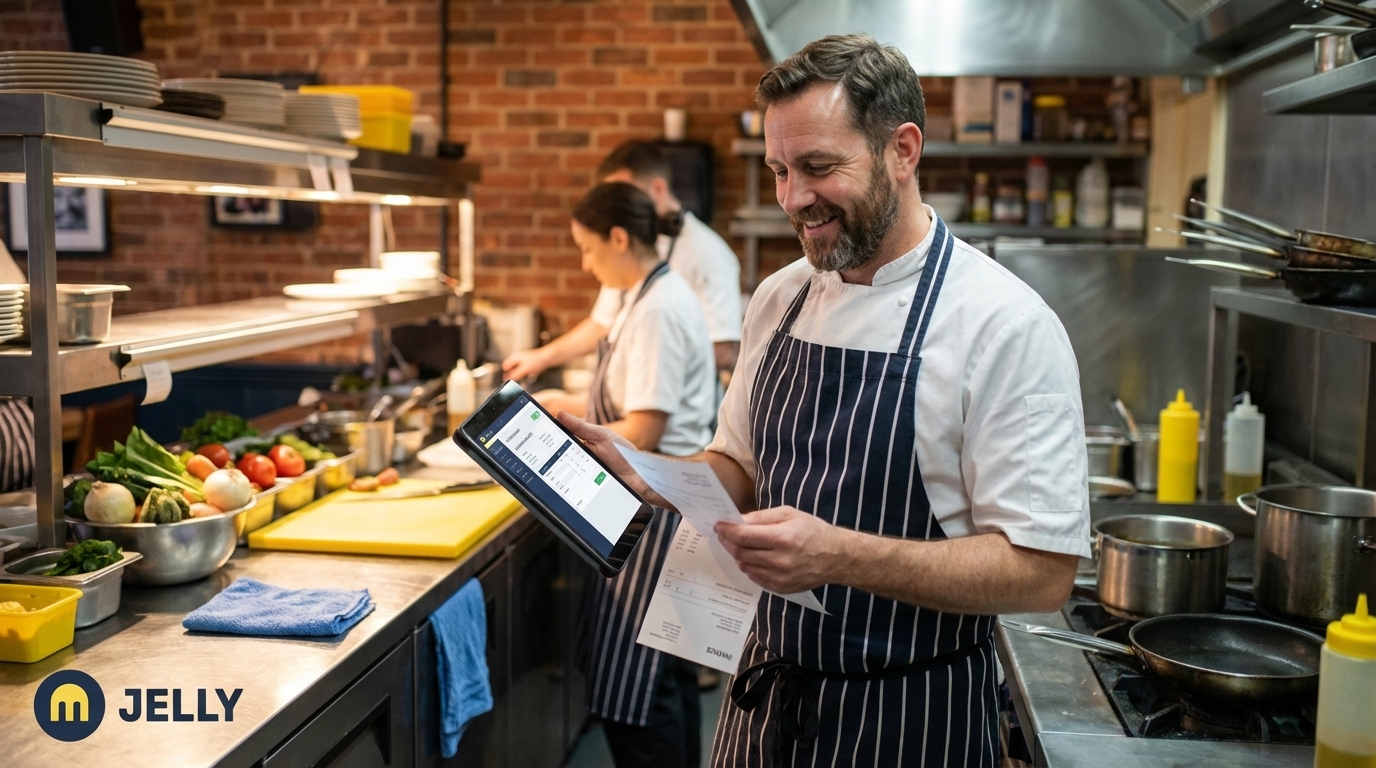
Jelly’s photo scan technology turns invoice processing into a chef friendly workflow. You photograph invoices or forward supplier emails, and AI instantly digitises every line item to provide real time insights.
Why Jelly Is the Strongest Choice for Restaurant PO Matching
Restaurant teams need PO matching software built around hospitality workflows, not generic accounts payable processes. Many tools on the market overlook the day to day realities of kitchens and multi site operations.
|
Solution |
Monthly Cost |
Setup Time |
Key Features |
|
Excel/Manual |
£0 |
Ongoing |
Error prone, time consuming |
|
MarketMan/Nory |
Per user pricing |
2 to 3 months |
Complex, template heavy |
|
Kitchen Cut |
Enterprise pricing |
6+ months |
Expensive, chain focused |
|
Jelly |
£129/location |
24 hours |
Photo scan, Xero sync, Price Alerts |
Jelly’s restaurant focused approach targets the specific pain points that generic accounts payable tools miss. Live Price Alerts support immediate supplier negotiations by flagging changes as they happen. POS integration then provides Flash GP reports that show real time profitability impacts on every menu item. Customers cited administrative reductions of more than 100 hours per month from AI driven management tools, which highlights the impact of purpose built restaurant automation.
Seven Steps to Automate Invoice Processing with Jelly
Automating invoice processing with Jelly follows a simple seven step rollout that fits around live service.
- Sign Up for Free Trial: Schedule a chat to start your automation journey and gain immediate access to core features.
- Connect Invoice Sources: Forward supplier emails to your dedicated Jelly address or photograph invoices directly through the mobile app.
- Auto Digitise: AI extracts every line item, including quantity, SKU, price, and tax, to create real time insights.
- Integrate POS and Accounting: Connect Jelly with POS systems and Xero to streamline sales and payables processing.
- Enable Xero Integration: Xero automates PO invoice matching by pulling data from POS systems and banks, speeding reconciliation and highlighting discrepancies. One click posting then keeps your books up to date.
- Activate Price Alerts: Receive instant notifications when supplier prices increase or decrease so you can negotiate quickly.
- Monitor Live Dish Costing: Track real time profitability as ingredient costs update automatically with each new invoice.
Pro Tip: Jelly automatically processes invoices and creates evidence trails for supplier negotiations. The system saves 10 to 20 hours of admin every month and delivers an average 2 percentage point gross profit improvement.
Managing Discrepancies and Partial Deliveries with Jelly
Restaurant suppliers frequently deliver partial orders because of stock limitations or quality issues. Restaurants face PO invoice matching issues like partial deliveries, missing credits, and price discrepancies, which 3 way matching flags instantly to prevent disputes.
Jelly’s AI automatically identifies these variances, such as receiving only 80% of ordered fish because of supplier shortages, and generates documented evidence for credit claims. The system maintains detailed audit trails that strengthen supplier negotiations and support accurate financial reporting.
Real UK Restaurant Case Studies Using Jelly
Amber, a Mediterranean restaurant in East London, shows the impact of automated PO matching in practice. Chef Owner Murat Kilic reports consistent savings of £3,000 to £4,000 monthly, which delivers approximately 68 times return on investment. “Jelly keeps my business alive,” Kilic explains, because automated invoice processing freed his team to focus on service rather than admin.
Other success stories reinforce this pattern. Stuart Noble at Cairn Lodge Hotel cut food costs by 5% within one month. Ruth Seggie at The Howard Arms improved gross profit margins from 60% to 80% through real time cost visibility. These results show the concrete benefits of moving from manual spreadsheets to intelligent automation.
Book a demo to replicate these results and join the growing community of UK restaurants achieving measurable ROI through automated PO matching.
Next Steps for Automating PO Invoice Matching
Automating purchase order invoice matching shifts restaurant operations from reactive firefighting to proactive control. AI powered invoice processing, real time discrepancy flagging, and seamless Xero integration work together to improve efficiency and profitability. Setup times measured in hours rather than months keep the barrier to implementation low.
The next step is clear for restaurant operators who want tighter margins and less admin. Embrace automation to protect profit, reduce paperwork, and scale operations with confidence. Book a demo and schedule a chat to automate your PO matching today and see how leading UK restaurants build sustainable advantages with intelligent financial automation.
Frequently Asked Questions
How does Jelly handle invoices without corresponding purchase orders?
Jelly’s AI extracts line items from invoices and adds them to your inventory and insights dashboard. The system provides real time price alerts and costing updates while maintaining complete audit trails. This approach keeps financial control tight across all purchases, even when a purchase order is missing.
How quickly can Jelly integrate with Xero accounting software?
Xero integration activates with a single click and posts matched invoices instantly. AI processes invoices with 99% accuracy in under 10 minutes, automating data extraction and bank reconciliation. This automation removes traditional delays from manual data entry and cuts month end closing time significantly.
What happens when purchase orders do not match invoice details?
Jelly’s Price Alert feature flags price changes and discrepancies automatically. The system notifies you of increases or decreases by supplier and ingredient so you can resolve issues and negotiate quickly. This approach ensures exceptions receive attention without slowing routine processing.
Which software provides the highest accuracy for 3 way matching?
Jelly delivers high accuracy through purpose built AI trained specifically on restaurant invoices. The system recognises common supplier formats and handles unit conversions automatically. It also learns from usage over time, which improves performance and accuracy compared to generic accounts payable solutions.
How does automated matching handle partial deliveries?
The system uses invoice data to update inventory and costs accurately for each delivery. When deliveries differ from expectations, Jelly’s insights and Price Alerts provide clear documentation for supplier discussions. This process streamlines negotiations and keeps inventory records reliable.