
Written by: JJ Tan, Founder, Jelly
Key Takeaways for Busy UK Kitchens
- Automated supplier price alerts notify kitchen operators instantly when ingredient prices change on invoices, protecting tight UK restaurant margins in real time.
- Manual spreadsheet tracking creates dangerous delays, and by the time price hikes are spotted, margin has already been lost across multiple dishes and services.
- Jelly digitises every invoice line item, flags price movements the same day, recalculates live dish costs and updates gross profit margins without manual intervention.
- Users report reclaiming 10–20 admin hours monthly, achieving 2–7 percentage point GP gains and saving £3,000–£4,000 per month through faster supplier negotiations.
- Experience these benefits yourself and book a demo with Jelly to see automated price alerts working in a live kitchen.
The Problem: Manual Supplier Price Tracking Drains Time and Margin
Supplier pricing from distributors such as Bidfood and Sysco changes constantly. Seasonal availability, energy costs and logistics surcharges push line-item prices up or down each week, often without formal notification. A kitchen that relies on spreadsheets to track those movements faces a structural lag, because by the time a price change is noticed, it has already eroded margin across every service it went undetected.
The admin burden compounds the problem. A typical independent UK restaurant can process a substantial number of supplier invoices per month, and manual entry plus updating recipe costs to reflect price changes can take several hours of admin time.
Picture a head chef at a busy gastropub who costs a new seasonal dish on a Monday. By the following Friday, two key ingredients have increased in price, yet the spreadsheet has not been updated, the dish is still priced at the original margin, and the kitchen is selling it at a loss. That scenario repeats across dozens of dishes, every week, at every site.
On top of the time cost, a recipe costed in October 2025 may be significantly less profitable by January 2026 due to unmonitored supplier price hikes, as ingredient prices are no longer static for UK hospitality operators. Margin erosion of this kind remains invisible until it appears in a monthly P&L, and at that point the damage has already been done.
The Problem: Manual Reports Versus Automated Price Tracking Outcomes
The contrast between manual and automated price tracking is not a matter of preference, it is a measurable operational gap. The table below shows that automation removes detection delays, reclaims several hours of admin time each month and keeps dish costings live, three advantages that directly protect margin.
| Outcome Area | Manual (Spreadsheets / Accountant Reports) | Automated (Jelly) | Difference |
|---|---|---|---|
| Time to detect a supplier price change | Days to weeks (next invoice review or monthly report) | Same day the invoice is received | Faster reaction, margin protected sooner |
| Monthly admin hours on invoices | Several hours | Near zero (automated scanning) | Several hours reclaimed per month |
| Dish costing accuracy | Static until manually updated; recipes costed months earlier may no longer reflect current prices | Live, updates automatically with every new invoice | Always-current GP per dish |
| Xero / accounting sync | Manual export or accountant data entry | One-click push from Jelly to Xero | 90% reduction in bookkeeping time |
That operational gap, including the delay, the admin burden and the static costing, is exactly what automated price alert systems remove. The next section explains how these systems work in practice.
The Solution: How Automated Supplier Price Alerts Work
Automated supplier price alert systems work by digitising every incoming invoice at line-item level, capturing supplier name, SKU, quantity, unit price and tax, then comparing each price against the previously recorded value for that ingredient. When a variance appears, the system flags it immediately, recalculates the cost of every dish that uses that ingredient and updates the live gross profit margin. No manual intervention is required between invoice receipt and margin update.
For multi-site operators, this setup means a finance manager can monitor price movements across all locations from a single dashboard, instead of chasing individual site managers for spreadsheet updates. For head chefs, it means the data needed to challenge a supplier or justify a menu price change appears the same day, not three weeks later.
The Solution: Core Jelly Features Kitchens Use Daily
Automated Invoice Digitisation for Every Supplier
Jelly captures invoices through two simple routes. Suppliers email invoices directly to a dedicated Jelly address, or kitchen staff photograph paper invoices through the app. Every line item, including quantity, SKU, unit price and tax, is extracted automatically. Teams avoid manual data entry, and the process works from the first invoice received.
Real-Time Price Increase Alerts for Every Ingredient
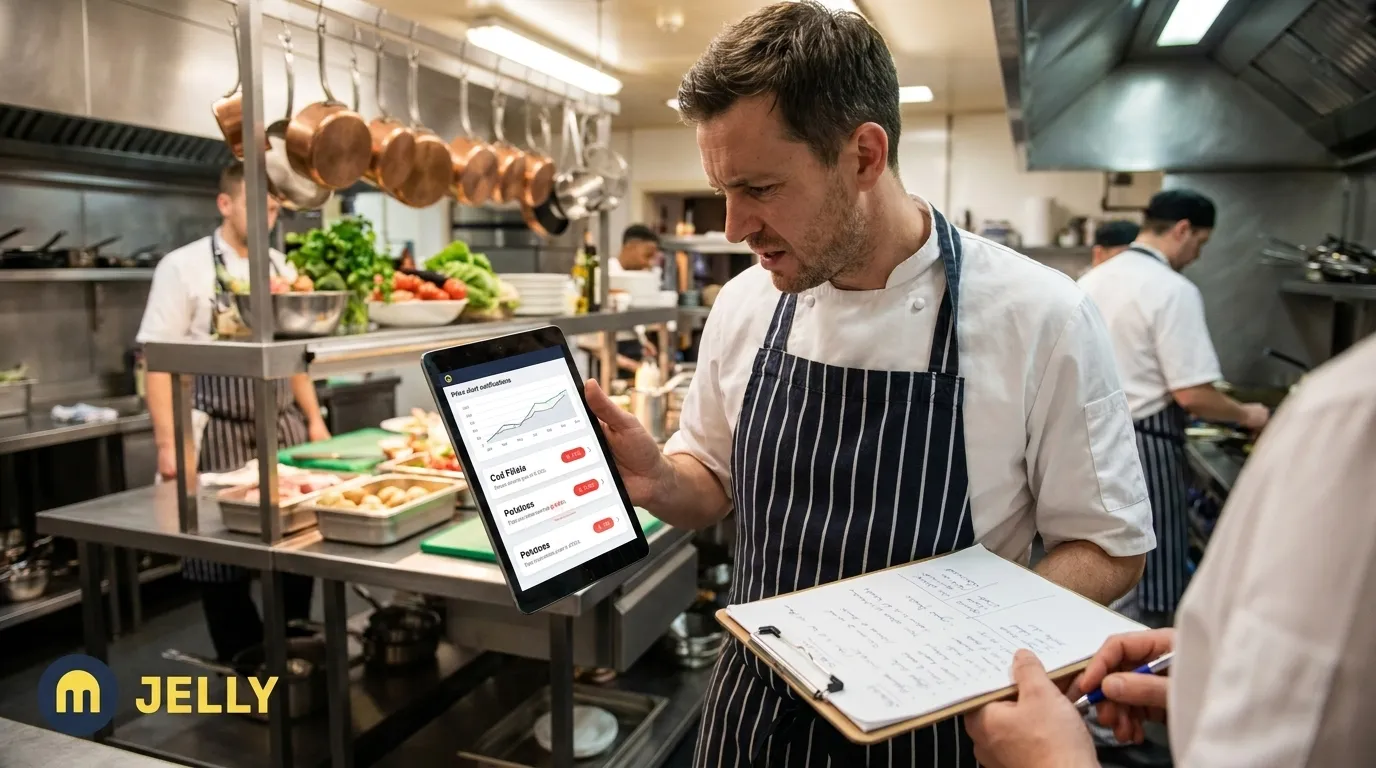
Jelly's Price Alert feature flags every price movement the moment a new invoice is processed. The alert shows which ingredient changed, which supplier raised or lowered the price and by exactly how much. Amber restaurant uses this feature to make real-time pricing decisions, identify ingredient substitutions, switch suppliers and negotiate better deals. Chef-Owner Murat Kilic credits Jelly with saving Amber £3,000–£4,000 per month through faster reactions to price movements.
Live Dish Costing with Instant GP Signals
In Jelly's Kitchen section, chefs build recipes by selecting ingredients already populated from scanned invoices. Unit conversions and wastage calculations are handled automatically. Because ingredient costs update with every new invoice, the gross profit margin for every dish stays live. A red indicator appears when a dish drops below its target margin, and a green indicator appears when it improves. Tasks that previously took 28 minutes per dish in a spreadsheet now take approximately three minutes in Jelly.
POS Integration with Square, EPOS Now, Lightspeed and Toast
Jelly integrates natively with Square, EPOS Now, Lightspeed and Toast through real-time API connections. Each integration delivers item-level sales data the moment a transaction completes, which allows Jelly to calculate live gross profit by dish. Connecting any of these POS systems takes approximately five minutes, using a simple sequence of opening Jelly, clicking Integrations, signing in to the POS, granting permissions and selecting which categories to sync. Sushi Revolution uses Jelly's POS integration to set separate target gross profits on dine-in and delivery menus, accounting for 30% delivery platform commissions, which results in actual gross profits 2–3% higher on average.
One-Click Xero Push for Bookkeeping
Every digitised invoice can be pushed to Xero in a single click, which removes manual bookkeeping entry. Sage integration is in development. Operators report a 90% reduction in bookkeeping time after connecting Jelly to Xero.
Fast Onboarding That Shows Value in Days
Unlike platforms that require weeks of configuration, Jelly generates initial value within the first week. Price alerts and spending insights appear as soon as suppliers begin sending invoices to the dedicated Jelly email address, or within 24 hours of the first photographed invoice.
The Solution: Time and Margin Gains for Single- and Multi-Site Kitchens
Jelly customers consistently report two categories of measurable benefit, which are time recovered and margin protected.
On time, the automation of invoice scanning and dish costing removes 10–20 hours of monthly admin. That time returns to service, menu development and supplier management.
On margin, Amber saves £3,000–£4,000 per month and operates at approximately 68× ROI on its Jelly subscription. One operator improved gross profit from 65% to 72% within 12 weeks on approximately £500,000 in revenue. Populu lifted GP from 68% to 72% across 16 locations. Stuart Noble, Head Chef at Cairn Lodge Hotel, cut food costs by 5% within a month of using Jelly's price alert capability. Ruth Seggie, Owner of The Howard Arms, reached 80% gross profit after her accountant had suggested 60% was the ceiling.
For multi-site operators, the data-driven negotiation benefit is equally significant. Price Alert gives chefs documented evidence of every price increase, including the date, the SKU and the percentage change, which turns supplier conversations from subjective disputes into factual negotiations.
Book a demo to see how Jelly's price alert and live costing features perform in a kitchen like yours.
The Solution: Evaluation Framework and Competitor Comparison
When selecting an automated price alert tool, four criteria determine whether the platform will actually be used by kitchen staff rather than abandoned after onboarding. The comparison below shows that Jelly delivers faster onboarding, simpler operation for non-technical staff and transparent flat pricing, three factors that explain why independent operators adopt it more readily than feature-heavy enterprise platforms.
| Evaluation Criterion | Jelly | MarketMan / Nory | Legacy Platforms (e.g. Kitchen Cut) |
|---|---|---|---|
| Ease of use for non-tech staff | Clean UI, designed for chefs with no tech background | Feature-rich but complex, steeper learning curve | Static interfaces, typically requires dedicated admin staff |
| Onboarding speed | Value within first week, POS connected in 5 minutes | Weeks to months of configuration | Months, often requires vendor-led implementation |
| UK accounting integration | Xero (live), Sage (coming soon) | Varies by platform and plan | Limited or manual export only |
| Real-time GP visibility | Live per dish, updated on every invoice | Available but requires more setup | Periodic, not live |
| Pricing | Flat £129/site/month | Higher, variable by user or feature tier | High, typically enterprise pricing |
Best for independent and growing operators: Jelly. Flat pricing, fast onboarding and a UI that requires no training make it the practical choice for kitchens at the £500k to multi-site growth stage.
Frequently Asked Questions
How long does it take to set up Jelly and start receiving price alerts?
Most kitchens receive their first price alerts within 24 hours of uploading their first invoice. If suppliers are directed to email invoices to a dedicated Jelly address, alerts begin arriving as soon as the first invoice is processed, which typically happens the same day. POS integration with Square, EPOS Now, Lightspeed or Toast follows the same quick process described earlier. There is no lengthy onboarding process, and no technical background is required from kitchen staff.
Does Jelly work with Xero, and how does the integration function?
Yes. Jelly integrates directly with Xero. Once invoices are digitised within Jelly, they can be pushed to Xero in a single click, with all line-item data, including supplier, SKU, quantity, price and tax, transferred accurately. This setup removes manual bookkeeping entry and reduces bookkeeping time by approximately 90%. Sage integration is in development and will be available in a future release.
Is Jelly suitable for pubs and boutique hotels, or only for restaurants?
Jelly is built for any commercial kitchen generating over £500,000 in annual revenue, including restaurants, pubs, bars, boutique hotels and catering operations. The platform handles food and beverage invoices from any supplier, supports separate costing for dine-in and delivery menus and scales across multiple sites under a single account. The flat £129 per site per month pricing applies equally regardless of venue type.
How does Jelly protect sensitive financial and supplier data?
Jelly processes invoice and pricing data through a secure web platform. Invoice capture via email or photograph is handled within the Jelly environment, and all data is stored and transmitted securely. Access is role-based, so owners and finance managers can grant kitchen staff the level of visibility appropriate to their role without exposing full financial data across the team.
Can Jelly help with supplier negotiations, or does it only track prices passively?
Jelly's Price Alert feature provides the documented evidence needed for active supplier negotiations. Every price change is recorded with the date, the specific SKU, the previous price, the new price and the percentage variance. This data can be presented directly to a supplier account manager to request a credit note, challenge an unjustified increase or benchmark pricing against alternative suppliers. Kitchens using this feature consistently report recovering costs through credits and renegotiated rates, and Amber restaurant's savings, mentioned earlier, stem directly from this documented-evidence approach.
Conclusion: Why UK Kitchens Move to Automated Price Alerts
Manual supplier price tracking is not a minor inefficiency, it is a structural margin leak. Between several hours of monthly invoice admin, 28-minute per-dish costing in spreadsheets and the inevitable lag between a price change and its detection, UK kitchens are routinely operating with outdated cost data. The consequence is GP erosion that only becomes visible in a monthly report, and by that point weeks of margin have already been lost.
Jelly closes that gap. Automated invoice scanning, real-time price alerts, live dish costing, native POS integration with Square, EPOS Now, Lightspeed and Toast and one-click Xero sync combine into a single platform that requires no technical expertise, costs the flat monthly rate per site and delivers measurable results, typically 2 percentage points of GP improvement and £3,000–£4,000 in monthly savings, within the first three months.
For UK restaurants, pubs and boutique hotels ready to move from reactive to proactive margin management, Jelly provides a direct route. Schedule a chat with the Jelly team and see the platform running on a live kitchen's data.