
Written by: JJ Tan, Founder, Jelly
Key Takeaways for Busy Café Operators
- Manual supplier-invoice entry in cafés consumes 10–20 hours per month and erodes gross-profit margins through delayed price-change detection.
- Xero excels at bookkeeping and reconciliation but lacks café-specific tools such as live dish costing, ingredient-level price alerts, and daily GP visibility.
- An automated invoice-to-Xero platform captures every line item instantly, pushes clean coded bills into Xero, and updates recipe costs in real time.
- Operators using Jelly report monthly savings of £3,000–£4,000, a 90% reduction in bookkeeping time, and 2–3% higher gross profits within weeks.
- See Jelly in action to remove manual entry and start protecting your café’s margins from day one.
The Problem: Manual Xero Invoice Entry Drains Time and Margin
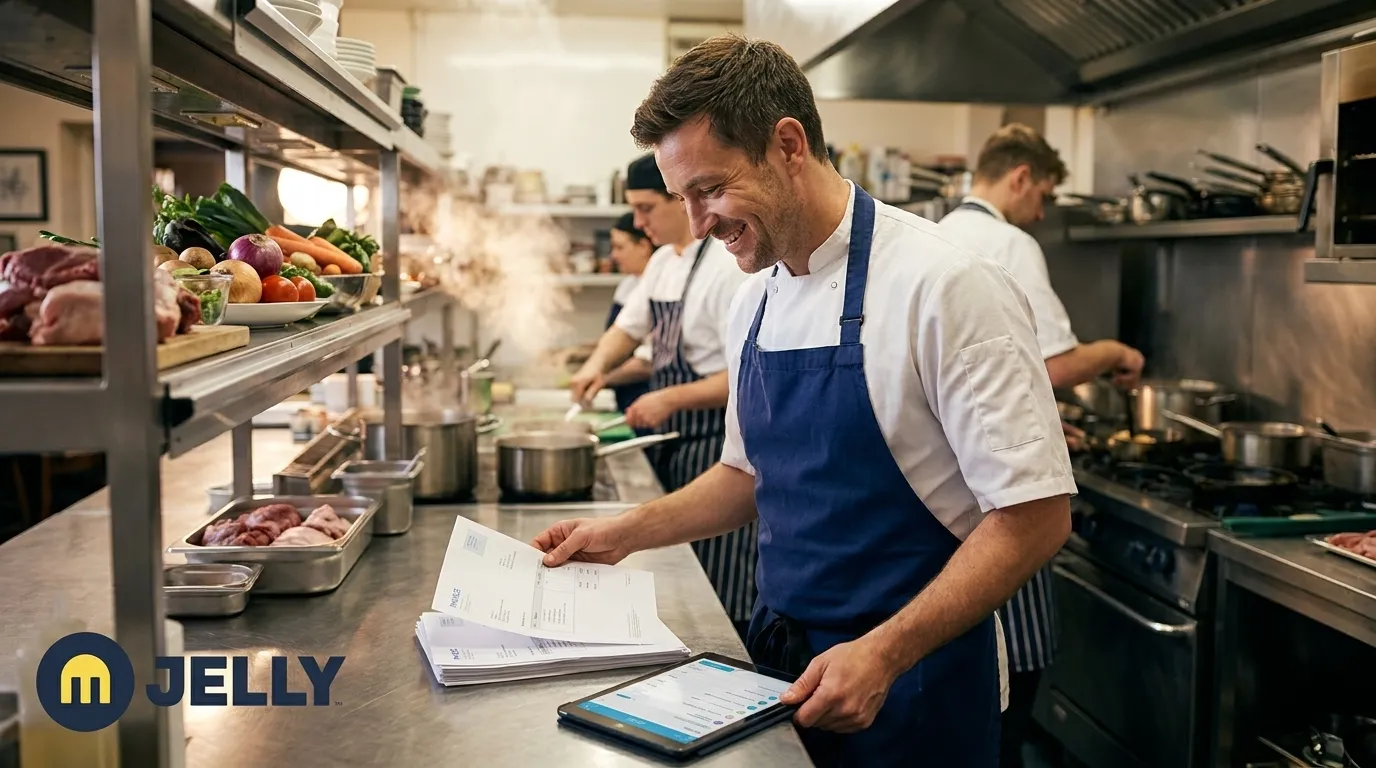
A typical café morning follows a familiar pattern. A delivery arrives, the invoice is photographed or filed in a drawer, a manager re-keys line items into a spreadsheet or directly into Xero later that day, and the daily card and cash takings are reconciled separately at the end of the week. The same cycle repeats across every supplier, every day.
A restaurant manager can spend many hours per month manually keying supplier invoices into Excel one by one. That time should go into analysing dish margins or negotiating better rates instead. Manual entry frequently produces typos, wrong amounts, incorrect dates, duplicate entries, and VAT or coding errors, especially under high volumes. These data-quality issues compound over time and quietly weaken profitability.
The financial impact escalates quickly. Full-service restaurants typically operate with net profit margins of 3% to 5%. A 2% increase in food cost on £10 million in annual food sales produces a £200,000 annual loss. For a café, the arithmetic is identical on a smaller base. When invoices are processed days or weeks late, price increases from suppliers go unnoticed, credit notes are missed, and menu prices stay wrong long after the cost base has shifted.
UK businesses are collectively owed £26 billion in late payments at any given time, which reflects how broken manual AP workflows are across the economy. Cafés sit at the sharp end of that problem, with thin margins and high invoice volumes amplifying every delay.
Where Xero Stops and Café Operations Begin
Xero is a powerful accounting platform, but it does not replace a café-specific operations layer. The table below contrasts what Xero provides natively with what a growing café actually needs day to day.
| Capability | Xero-only workflow | Required café workflow |
|---|---|---|
| Invoice capture | AI document capture via app, email or upload, which reduces prep time from up to 24 hours to about 30 seconds | Instant capture at point of delivery via photo or supplier email, with no manual follow-up required |
| Line-item extraction | Hubdoc extraction is mainly header-level. Line-item extraction is limited to certain document types, with many documents capturing only totals. | Every SKU, quantity, unit price and VAT extracted from every supplier invoice automatically |
| Gross-profit visibility | Strong for general mobile receipt capture, but no native hospitality-specific gross-profit margin dashboards from supplier invoices | Live dish-level GP updated the moment a new invoice arrives, with clear red/green margin indicators |
| Supplier price alerts | No native feature, so price changes are visible only after manual review of coded bills | Automatic flag on every ingredient price increase or decrease, with supplier and percentage shown |
| POS-to-margin integration | POS integration syncs daily sales data and payment types for reconciliation | Item-level sales mapped to dish recipes in real time, producing a daily GP and sales-mix report |
| Dish costing | Not available natively and still requires manual spreadsheet work | Recipe builder populated from scanned invoices, with dish cost recalculated automatically on every price change |
How Automated Invoice-to-Xero Platforms Close the Gap
An automated invoice-to-Xero platform sits between the supplier and the accounting ledger. It captures invoices the moment they arrive by email or photograph, extracts every line item without manual input, maps those items to dish recipes, and then pushes clean, coded bills into Xero for reconciliation. The operator gains three outcomes that Xero alone cannot deliver: speed with invoices processed in seconds rather than days, accuracy with no re-keying errors, and real-time margin control with GP updated with every new price.
Modern AP automation solutions integrate with accounting platforms like Xero to create a connected workflow that eliminates manual re-keying of supplier invoice data. For cafés, the requirement goes further. The platform must also connect ingredient costs to dish recipes and POS sales so that GP is visible daily, not monthly.
Five Connected Components of a Café-Ready Xero Workflow
An effective café invoice-to-Xero solution relies on five capabilities that feed each other. Invoice capture supplies line-item data, which powers live dish costing and price alerts. POS integration then links those recipes to sales, and fast setup ensures the whole loop runs within days, not months.
- Automated supplier-invoice capture via email or photo. Suppliers email invoices to a dedicated address, and staff photograph paper invoices on arrival. The system then digitises every line item, including quantity, SKU, price, and tax, without manual effort. Jelly processes both channels and makes the data available promptly so costing and alerts stay current.
- Line-item digitisation and Xero sync. Clean, coded bills move into Xero with one click, delivering a 90% reduction in bookkeeping time. Reliable duplicate prevention requires normalising supplier names and invoice numbers before data reaches Xero, a safeguard that manual workflows routinely skip.
- Live dish costing and price alerts. Ingredient costs update with every new invoice, so the gross-profit margin for every dish stays current. Jelly’s Price Alert feature flags every price increase or decrease instantly and shows the impact on recipes. Cairn Lodge Hotel’s head chef cut food costs by 5% in a single month using this capability.
- POS integration for daily sales mix and GP. Jelly integrates natively with complementary POS systems via real-time API and delivers item-level sales data the moment a transaction completes. The Flash Report shows daily, weekly, or monthly GP calculated from live costs and live sales, which removes the need for spreadsheet-based reporting.
- Fast setup with no technical expertise required. Connecting a supported POS takes about five minutes. Operators open Jelly, click Integrations, sign in to the POS, grant permissions, and select which categories to sync. Suppliers then begin sending invoices to a dedicated email address, and price alerts usually go live within the first week.
Real Café Results: Time Saved and Margins Recovered
The operational case for automation becomes clearest when viewed through a real café. Amber, a Mediterranean restaurant in East London run by Chef-Owner Murat Kilic, saves £3,000–£4,000 every month using Jelly, which equates to roughly 68 times the platform cost.
Before Jelly, Amber relied on manual spreadsheet costing. Volatile supplier pricing eroded margins before the team could react, and invoice work consumed hours that belonged in the kitchen. After implementing Jelly’s invoice automation, price-change alerts, and real-time recipe costing, the results were immediate.
- Consistent £3,000–£4,000 monthly cash saving through supplier credits, better buying decisions, and tighter menu controls
- Faster reaction to price swings, keeping GP on target without waiting for month-end accountant reports
- Less admin and more time for the kitchen and guests
“Jelly keeps my business alive.” — Murat Kilic, Chef-Owner, Amber
The pattern holds across other operators. Sushi Revolution’s monthly stocktake using Jelly takes 5–20 minutes, down from 2–3 hours previously, and gross profits are 2–3% higher on average. One operator improved gross profit from 65% to 72% within 12 weeks on approximately £500,000 in revenue. Many Jelly users cut food costs by about 3% in the first three months.
At £129 per month per location, with a flat rate and no per-user charges, the platform often pays for itself within the first week of supplier price alerts alone.
Walk through your own numbers and see how Amber-style savings could apply to your café’s revenue.
How to Evaluate a Café Xero Invoice App
Before committing to any platform, it helps to understand what separates an effective solution from a basic invoice scanner. When assessing any café Xero invoice app, apply the following checklist.
- Onboarding speed: The platform should generate value, such as price alerts and spending insights, within the first week without a long implementation project.
- Line-item accuracy: The tool needs to extract every SKU, quantity, unit price, and VAT line, not just header-level totals. Header-only extraction requires manual follow-up for accurate categorisation on supplier invoices.
- Xero two-way sync: Coded bills should move cleanly into Xero with duplicate prevention, so operators do not spend time reviewing and correcting entries before reconciliation.
- Mobile capture: Kitchen staff should be able to photograph a paper invoice on arrival without any technical training, and the platform should process it automatically.
- Margin alerts: The platform must flag ingredient price changes in real time and show the immediate impact on dish-level GP, instead of leaving operators to calculate this manually.
FAQ
Is Xero invoicing free?
Xero is a paid subscription platform. Plans in the UK start at a monthly fee for the Early plan and increase through Growing and Established tiers. Hubdoc, Xero’s document capture tool, is included with all plans at no extra cost. AI-powered data capture was rolled out to UK customers on all business edition plans in March 2026 at no additional charge. Xero does not offer a permanently free plan for businesses, although trial periods appear occasionally for new customers.
What are the downsides of using Xero for a café?
Xero is an excellent general-purpose accounting platform, but it was not designed for café-specific operations. Its native invoice capture extracts mainly header-level data, such as supplier name, total amount, and due date, rather than individual ingredient line items. It provides no live dish-costing tool, no supplier price-change alerts, and no daily GP report linked to POS sales. Café operators using Xero alone still need to manually cost recipes, track price changes, and wait for month-end accountant reports to understand their margins. A dedicated layer such as Jelly fills these gaps while feeding clean, coded bills back into Xero for reconciliation.
Is there a Xero invoice app free download?
The Xero Accounting app is available as a free download on iOS and Android for existing Xero subscribers. It supports invoice creation, receipt capture, bank reconciliation, and expense tracking on mobile. However, the app requires an active paid Xero subscription to function, so the download itself is free but access to the platform is not. For café operators seeking automated supplier-invoice capture and live margin visibility beyond what the Xero app provides, Jelly integrates directly with Xero and is available at a flat rate of £129 per month per location.
What is the Xero iOS app and what does it do?
The Xero Accounting app for iOS is Xero’s official mobile application, available on the Apple App Store. It allows users to create and send invoices, capture receipts by photographing them, reconcile bank transactions, approve bills, and view cash-flow summaries from an iPhone or iPad. The iOS app is designed for general accounting workflows and does not include hospitality-specific features such as dish costing, ingredient-level price alerts, or a daily GP dashboard linked to POS sales data.
How long does Jelly’s Xero integration take to set up?
Jelly’s Xero integration is a one-click process. Once connected, digitised invoices move into Xero as coded draft bills ready for approval and reconciliation. Suppliers can begin emailing invoices to a dedicated Jelly address immediately, and price alerts are typically live within the first week. POS integration, which connects complementary POS systems, takes about five minutes following a consistent flow across all supported systems. Most cafés generate actionable insights within their first week on the platform.
Can non-tech-savvy baristas or chefs use Jelly?
Yes. Jelly’s interface is deliberately stripped of complexity. Kitchen staff photograph a paper invoice on arrival using their phone, and the platform handles all extraction and processing automatically. No data entry, spreadsheets, or accounting knowledge is required from the team on the ground. The owner or finance manager receives accurate, real-time data without depending on chefs to complete paperwork. Holly, Operations Director at Social Pantry, describes Jelly as “so simple to use, I can’t see myself running the business without it.”
Conclusion: Turn Xero into a Café-Ready Margin Engine
Xero is the right accounting platform for many UK cafés, but it is not a complete café operations solution on its own. It does not extract ingredient-level line items from supplier invoices, does not alert operators to price changes in real time, and does not produce a daily GP report linked to POS sales. Those gaps create the admin burden described earlier and, more importantly, remove the margin visibility needed to react before a profitable dish becomes a loss-maker.
An effective café Xero invoice app closes those gaps with automated capture at the point of delivery, full line-item digitisation, live dish costing updated with every new invoice, supplier price alerts, and a clean one-click push into Xero. Amber’s £3,000–£4,000 monthly saving and 68× ROI show what that combination delivers in practice.
Ready to reclaim time and protect your margins? Start the conversation with Jelly today.