
Written by: JJ Tan | Last updated: 30 December 2025
Key Takeaways
- Manual invoice handling reduces profitability for UK restaurants, pubs, and boutique hotels by consuming staff time and increasing the risk of errors and late fees.
- Intelligent Document Processing (IDP) automates invoice capture, data extraction, approvals, and reporting so teams can focus on guests, food quality, and service.
- Simple digital basics, clear automation goals, and buy-in from kitchen and finance staff create a solid foundation for a successful IDP rollout.
- Jelly links invoices with accounting and POS systems to provide up-to-date views of dish costs, supplier price changes, and gross profit across one or multiple locations.
- Hospitality businesses that want to start IDP quickly can book a chat with Jelly at https://www.getjelly.co.uk/chat and have a practical plan in place within days.
Why Manual Invoice Management is a Recipe for Disaster in UK Hospitality
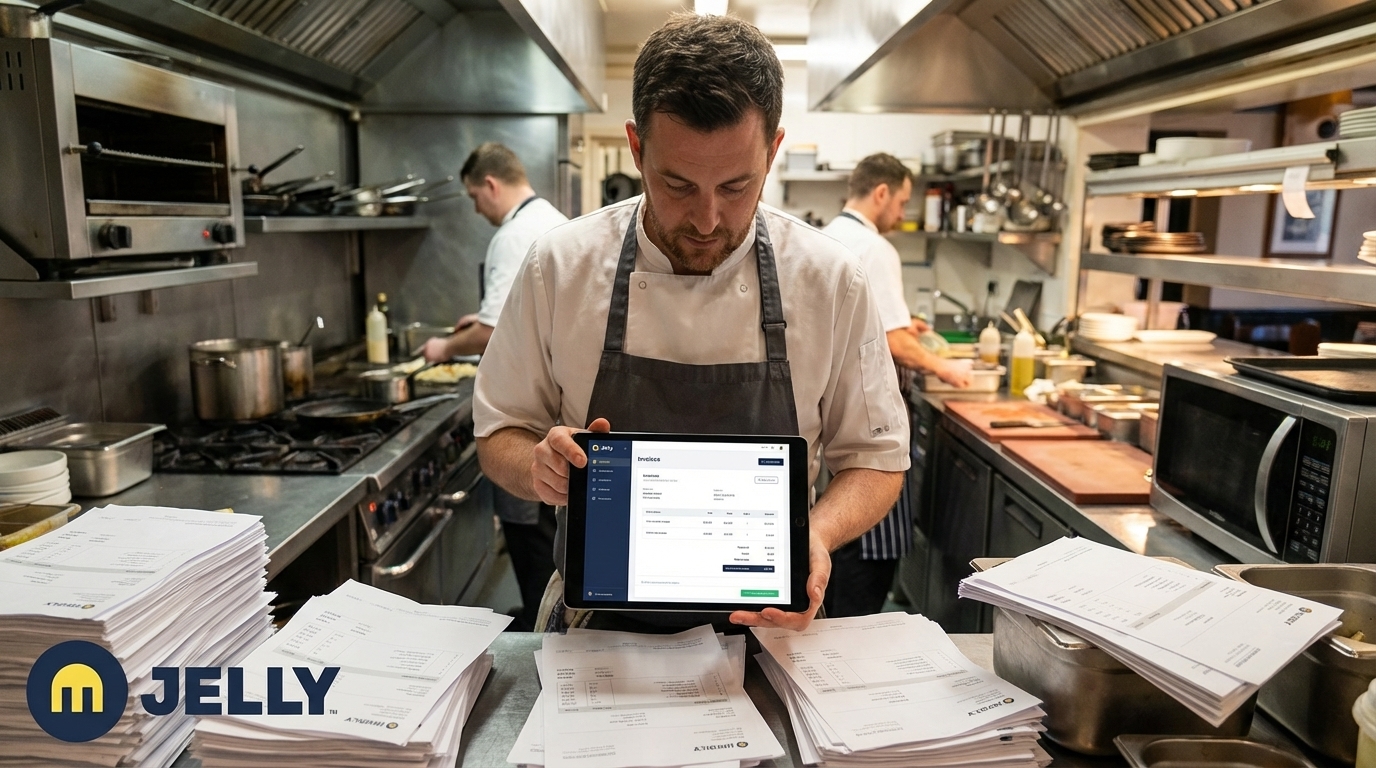
Manual invoice management reduces profitability for many UK hospitality businesses. Many growing restaurant groups spend over 100 hours per week on manual invoice processing, time that could support menu development, training, and guest experience.
High cost of traditional methods: Staff often spend 10–20 hours a week re-keying data from supplier invoices, with human error at every step. Repetitive entry creates errors, delays, late fees, and risks such as duplicate payments. When chefs or managers handle paperwork instead of operations, overall performance suffers.
Limited real-time control and insight: Without automation, finance and kitchen teams work from delayed information. Supplier price changes can sit unnoticed for weeks, margins on best-selling dishes stay unclear, and key decisions rely on outdated spreadsheets.
Need for automation: Intelligent Document Processing automates invoice capture, extraction, approval, and posting. Businesses that introduce invoice automation can reduce processing cost per invoice by up to 80 percent, while gaining earlier visibility of spend and margin.
Prerequisites for Successful Intelligent Document Processing in Your Kitchen
Digital basics in place: A reliable internet connection, shared smartphones or tablets for capturing invoices, and a dedicated supplier email inbox give any IDP tool a stable base.
Team alignment and buy-in: Managers, chefs, and admin staff need a clear picture of what will change. When teams see that automation reduces admin and provides instant cost visibility, adoption becomes much easier.
Clear automation goals: Specific objectives guide configuration and help track results. Examples include cutting invoice admin hours by half, improving stock accuracy, or closing each period faster with clearer gross profit data.
Jelly as the chosen platform: Jelly focuses on growing UK hospitality businesses and provides intelligent document processing without lengthy enterprise-style projects. The platform is designed so chefs, GMs, and bookkeepers can all use it with minimal training.
Hospitality teams that want to move away from manual invoice processing can book a chat with Jelly at https://www.getjelly.co.uk/chat and plan the switch on a realistic timeline.
Step-by-Step Guide to Implementing Intelligent Document Processing with Jelly
Step 1: Centralise and Digitise Your Invoices
Action: Move all supplier invoices into a digital format so they no longer sit in folders, boxes, or on clipboards across the site.
Jelly’s role: Jelly captures invoices through photos on smartphones or tablets and through a dedicated email address that suppliers can use. This flexible capture method ensures each invoice reaches one central inbox, regardless of supplier preference.
Expected outcome: All invoices sit in one digital location, ready for processing. Your kitchen shifts from paper clutter to a clear, auditable record of every purchase.
Pro tip: Ask key suppliers to send invoices to your Jelly email on a set schedule, such as daily or weekly, to create consistent, predictable data flow.
Step 2: Automate Data Extraction Using AI and OCR
Action: Use AI and Optical Character Recognition (OCR) to pull key data from invoices automatically, instead of entering it line by line.
Jelly’s role: Jelly’s human-AI technology scans every line item, including quantity, SKU, price, and tax, using advanced OCR and machine learning. This detailed extraction builds the data layer required for accurate costing and reporting.
Expected outcome: Invoice data becomes available in minutes rather than hours, with accuracy that improves over time as your team reviews and confirms entries.
Common mistake: Many teams expect 100 percent OCR accuracy from day one. Jelly learns from real corrections, so each week of use makes the system more accurate and efficient.
Step 3: Streamline Approval Workflows and Reconciliation
Action: Put structured approval flows in place so invoices reach the right person quickly and discrepancies are flagged before payment.
Configurable approval workflows help route invoices by type and priority and highlight mismatches between invoices, purchase orders, and delivery notes. Jelly applies this approach by supporting mobile approvals for chefs and owners, while automatically surfacing any irregularities.
Expected outcome: Invoices move through a clear process instead of sitting on desks or in inboxes. Exceptions appear early, which supports better cash-flow control and healthier supplier relationships.
Step 4: Gain Real-Time Financial Visibility and Control
Action: Turn invoice data into clear, timely insight so teams can respond to supplier price movements, menu performance, and margin changes.
Jelly’s role: This step is where Jelly has the greatest impact on kitchen operations through intelligent document processing.
- Price alerts: Jelly flags each price increase or decrease from suppliers so teams can review invoices, query issues, or adjust menus quickly.
- Live dish costing: As ingredient prices update, Jelly’s Kitchen section refreshes gross profit for every recipe, making it easy to spot dishes that no longer meet margin targets.
- Insights dashboard: Simple reports show total spend by supplier and category, supporting better purchasing decisions.
- Flash report: Daily, weekly, or monthly GP summaries combine invoice costs with POS sales for a concise profitability view.
Expected outcome: Decision-makers gain fast access to cost and margin data and can act sooner on pricing, supplier choice, and menu strategy.
Pro tip: Use price alerts to challenge unexpected increases and to support conversations about volume discounts or revised terms.
Step 5: Integrate IDP With Accounting and POS Systems
Action: Link your IDP tool with your accounting platform and POS so all key financial data aligns without duplicate entry.
Jelly’s role: Jelly offers one-click integration with Xero and other accounting platforms, and connects with POS systems such as Square and ePOSnow. Integrated invoice automation can reduce time spent on invoice validation by up to 90 percent, while consolidating data for deeper analysis.
Expected outcome: Bookkeeping time falls, period-end becomes simpler, and management reports draw from one consistent set of figures.
Measurable success: Many Jelly customers report sharp reductions in manual entry and a clearer view of gross margin within the first few months.
Why Jelly Excels in Intelligent Document Processing for UK Hospitality
Designed for simplicity: Jelly’s interface is built for busy kitchens, so chefs, managers, and finance staff can capture and review invoices without specialist training.
Rapid time to value: Jelly provides early value, including price alerts and spend insight, within the first week of use, rather than after long projects and rollouts.
Data accuracy and control: Automated line-item capture and continuous learning give reliable, current information that supports average food cost reductions of around 3 percent within a few months.
Cost-effective transparency: Flat-rate pricing of £129 per month per location keeps costs predictable and avoids per-user fees.
Jelly vs the alternatives: A comparison of Intelligent Document Processing solutions
|
Feature/Metric |
Manual Processes |
Legacy Systems |
Jelly (IDP) |
|
Invoice Data Entry |
Manual, hours per week |
Semi-automated |
Fully automated capture and extraction |
|
Real-Time Costing |
Not available |
Delayed updates |
Live updates with every invoice |
|
Price Change Alerts |
No visibility |
Basic notifications |
Instant alerts for each change |
|
Onboarding Time |
Not applicable |
Weeks to months |
Days to one week |
Advanced Strategies for Optimising Your Kitchen with IDP and Jelly
Menu engineering with live costs: Use Jelly’s Cookbook feature to build recipes with live ingredient costs, then review sales mix to identify star dishes, low-margin items, and candidates for recipe or price changes.
Multi-location management: As you open new sites, centralised IDP data supports consistent menu costing, shared supplier terms, and standard controls across all locations.
Data-driven supplier negotiations: Use historic price data and alerts to support structured reviews with suppliers, focusing on volume, substitutions, or contract changes that protect margin.
Hospitality operators who want to apply these strategies in practice can book a chat with Jelly at https://www.getjelly.co.uk/chat and map the steps that fit their current operation.
Frequently Asked Questions About Intelligent Document Processing
What types of invoices can Jelly handle with Intelligent Document Processing?
Jelly’s IDP technology processes photographed invoices, PDFs, and email attachments. The human-AI system reads line-item data from a wide range of supplier formats used in UK hospitality, including varied layouts and styles, without forcing suppliers to change their templates.
How quickly can I see results from implementing Intelligent Document Processing with Jelly?
Most sites see practical benefits within the first week, once suppliers send invoices to the Jelly email address or staff start capturing images. Price alerts and spend visibility appear quickly, and many businesses report measurable efficiency gains and margin improvements within the first three months.
Is Intelligent Document Processing with Jelly suitable for smaller growing businesses?
Jelly is designed for growing restaurants, pubs, and boutique hotels with annual revenue above roughly £500,000. These businesses have enough invoice volume to benefit from automation but often find large enterprise tools too complex or costly. Jelly scales from a single high-performing site to several locations.
How secure is my financial data when processed by an IDP solution like Jelly?
Jelly encrypts financial data using industry-standard methods and applies multiple security layers throughout capture, processing, and storage. The platform follows UK data protection requirements, protecting supplier details, invoice data, and reporting outputs.
Can Jelly integrate with existing accounting software and POS systems?
Jelly integrates with leading accounting platforms such as Xero and supports POS systems like Square and ePOSnow. These integrations reduce duplicate entry while combining cost data from invoices with sales data from the POS to give a full view of profitability.
Conclusion: Reclaim Control and Boost Profitability with Intelligent Document Processing
Manual invoice management has become a clear disadvantage in the 2026 UK hospitality market. Intelligent Document Processing with Jelly helps restaurants, pubs, and boutique hotels move from reactive paperwork to more proactive control over costs and margins.
By centralising invoices, automating extraction, structuring approvals, integrating with accounting and POS, and using live reporting, operators can reclaim time and gain clearer insight into profitability. Many Jelly customers report time savings, improved gross margin, and faster responses to supplier price changes.
Teams that want a structured, practical route into intelligent document processing can book a chat with Jelly at https://www.getjelly.co.uk/chat and begin planning a more efficient, insight-led kitchen operation.