
Written by: JJ Tan, Founder, Jelly | Last updated: 21 July 2026
Key takeaways for UK hospitality operators
- Manual invoice processing consumes 10–20 hours per week for UK hospitality operators, cutting gross profit and increasing MTD compliance risk.
- OCR invoice automation converts paper and PDF invoices into structured line-item data in seconds, which supports live dish costing and real-time margin visibility.
- Accurate line-item extraction with VAT codes, combined with POS integration, creates MTD-compliant digital links and instant price-change alerts.
- Jelly customers typically see a 2 percentage-point gross profit improvement within three months, which quickly covers the £129-per-month platform cost.
- Operators who want to remove invoice admin and protect margins can book a demo with Jelly today.
OCR invoice processing explained for restaurants and pubs
Optical Character Recognition (OCR) reads printed or handwritten text on an invoice, whether photographed on a phone or received as an emailed PDF, and converts it into machine-readable structured data. In a hospitality context, that means every line item on a supplier delivery note, including ingredient description, SKU, pack size, quantity, unit price, VAT rate, and line total, is captured digitally without manual keying. AI-based OCR achieves 95–99% accuracy on clean digital invoices, which makes it reliable enough to feed live dish costing and real-time margin reporting.
Four-step OCR invoice automation workflow
The end-to-end workflow from paper invoice to live gross profit figure follows four clear steps.
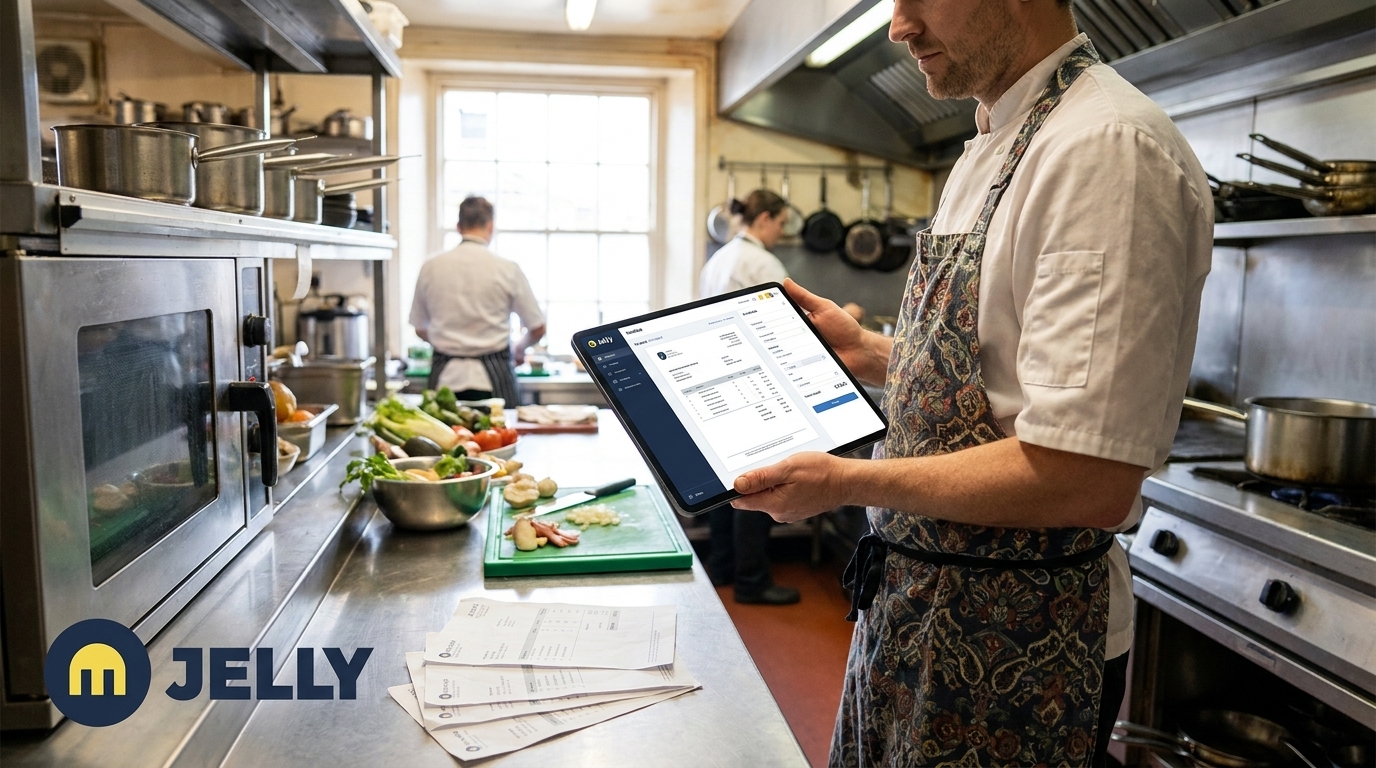
- Capture. A chef photographs a delivery note on their phone, or a supplier emails a PDF invoice to a dedicated inbox. Both routes feed directly into the platform, so no one needs to sort or file paperwork.
- AI extraction. The OCR engine reads every line item and pulls ingredient descriptions, quantities, unit prices, VAT codes, and SKUs. A single invoice is processed in 2–10 seconds, while manual invoice data entry typically takes 3 minutes on average for simple cases and 9–12 minutes when verification and full processing steps are included.
- Validation against POS data. Extracted ingredient costs are matched against the recipe database and cross-referenced with live sales data from the POS system. Any supplier price movement triggers an immediate alert, so operators can negotiate credits or switch ingredients before margin damage builds up.
- Export to Xero or Sage with live dish costing. Validated invoice data is pushed directly into the accounting platform through a digital link, which satisfies MTD requirements. At the same time, every recipe that uses the updated ingredient reflects the new cost, and gross profit percentages update in real time across the entire menu.
This four-step workflow turns invoice processing from a manual, error-prone task into an automated system that updates your margins in real time. Ready to see it running in your kitchen? Book a demo with Jelly today.
AI capabilities that matter most for invoice processing
For UK hospitality, the critical capability is accurate line-item extraction, not just header fields like invoice total and supplier name. Food supplier invoices contain dozens of SKUs per page, mixed VAT rates, handwritten adjustment codes, and pack-size variations that generic accounts-payable tools often misread. Processing a 4-page Sysco invoice with 45 line items, including handwritten adjustment codes, takes approximately 30 seconds with a well-configured AI OCR system, while manual entry of the same document takes 5–10 minutes.
The second requirement is native integration with hospitality POS systems. Extracting ingredient costs covers only half of the job. Those costs must flow into recipe calculations and be compared with actual sales to produce a meaningful gross profit figure. Platforms that integrate with POS partners such as Square, EPOS Now, Lightspeed, and Toast via real-time API deliver item-level sales data the moment a transaction completes. That connection enables the margin visibility that standalone OCR tools cannot provide.
Best-fit OCR software options for UK hospitality
The right tool depends on the size and complexity of the operation. The table below compares key attributes by business size, with Jelly highlighted as the recommended solution for growing kitchens.
| Business size | Onboarding speed | Pricing model | Hospitality-specific outcomes |
|---|---|---|---|
| Single-site (£500k+ revenue) | Jelly: value within first week, with price alerts live within 24 hours of the first invoice | Jelly: £129/month flat per location | Live dish costing, supplier price alerts, Xero export, POS gross profit visibility |
| 2–5 sites (growing groups) | Jelly: POS connection in under 5 minutes per site, with no lengthy implementation project | £129/month per location, with no per-user fees | Centralised margin control across sites and reported gross profit improvements by multi-site operators |
| Larger groups (6+ sites) | Enterprise AP suites: implementation timelines typically run from weeks to months | higher annual costs for mid-market AP suites | End-to-end workflow, audit trail, multi-entity reporting, but limited hospitality-specific recipe costing |
Meeting UK MTD and VAT rules with invoice automation
MTD for VAT has been mandatory for all VAT-registered businesses since April 2022, regardless of turnover. For restaurants, pubs, and hotels, that requirement means every invoice must be captured digitally, with VAT amounts recorded at the transaction level and submitted to HMRC via API-enabled software. Manual re-keying between systems is explicitly prohibited.
Invoice automation tools therefore need to maintain an unbroken digital link from invoice capture through to the VAT return. Acceptable methods include API connections, CSV imports, and automated data transfers. MTD-compatible accounting software, including Xero and Sage Business Cloud, connects directly to HMRC via API for VAT submissions. That connection satisfies the digital-link requirement when invoice data is pushed from the automation platform without manual intervention.
Accurate line-item VAT handling is non-negotiable. UK food invoices routinely mix standard-rated (20%), zero-rated, and VAT-exempt items on the same delivery note. An OCR system that captures only invoice totals, rather than per-line VAT codes, will produce incorrect VAT returns and expose the business to fines of £200 for each late VAT return after reaching the penalty point maximum under MTD. Jelly’s line-item extraction captures VAT at the SKU level and pushes correctly coded data directly into Xero, which maintains the digital link MTD requires.
From invoice capture to real-time margin control
In practice, the Jelly workflow removes every manual step between a supplier delivery and a live gross profit figure on the owner’s dashboard. A chef photographs a delivery note, and within seconds every ingredient price is updated across all recipes that use that ingredient. If a supplier increases the price of a key item, a Price Alert fires immediately and gives the chef clear data to call the supplier, request a credit note, or substitute an ingredient before the week’s margin is affected.
Sales data flows in from POS integration partners, including Square, EPOS Now, Lightspeed, and Toast, via real-time API. The Flash Report then shows actual gross profit against actual sales, not estimates. Amber restaurant in East London saves £3,000–£4,000 per month through this combination of automated invoice capture, price-change alerts, and real-time recipe costing, which delivers a 68× return on the platform cost.
Readiness checklist before adopting OCR invoice automation
Before onboarding, operators should confirm the following points.
- Suppliers can send invoices to a dedicated email address, or kitchen staff can photograph delivery notes consistently.
- The business has a Xero account, with Sage integration becoming available for Jelly users shortly.
- At least one team member has admin access to the POS system for the initial integration connection.
- Recipes exist or can be built from scanned invoice ingredients within the platform.
- The operator is VAT-registered and aware of MTD digital-link obligations.
Common invoice automation pitfalls to avoid
- Inconsistent capture. Restaurant supplier invoices arrive via multiple channels, including emailed PDFs, photographed delivery sheets, and handwritten paper notes. Any channel left outside the automated workflow creates gaps in cost data and monthly statement reconciliation failures.
- Header-only extraction. Capturing invoice totals without line items produces reconciled books that misstate food cost. Per-SKU extraction is required for accurate recipe costing and MTD-compliant VAT records.
- Delayed reporting. Disorganised invoice processes are one of the most common reasons restaurant groups struggle to close their books on time. That delay directly slows the margin data operators need to act on supplier price changes.
- Spreadsheet drift. Maintaining a parallel spreadsheet alongside an automation tool undermines the digital link required by MTD and reintroduces the manual errors the system was deployed to remove.
Operators who want to avoid these pitfalls from day one can schedule a chat with the Jelly team.
Quantified ROI from UK restaurants using OCR invoice automation
The financial case for automation is well documented across UK hospitality. High daily volumes of invoices require substantial manual labour, while AI OCR can process the same batch significantly faster with minimal human involvement. Time spent on invoice admin at typical labour costs represents a significant annual staff cost that automation can recover.
Margin gains are equally concrete. The margin gains mentioned earlier are well documented across UK hospitality, and Jelly customers consistently achieve the 2-point gross profit improvement within their first quarter. This pattern holds across different business models. One operator improved gross profit from 65% to 72% within 12 weeks on approximately £500,000 in revenue. Sushi Revolution achieved gross profits 2–3% higher by using automated invoice data to set separate target margins for dine-in and delivery menus, accounting for 30% delivery platform commissions. Even single-site operators see rapid results, as Stuart Noble, Head Chef at Cairn Lodge Hotel, cut food costs by 5% within a month of deploying Jelly’s price alert and live costing features.
Next steps for evaluating OCR invoice automation in the UK
The starting point for any evaluation is a clear view of current invoice volume and the existing accounting and POS stack. Operators processing hundreds of invoices per month, which is the threshold at which invoice automation typically delivers positive ROI within 3–9 months, and running Xero alongside a supported POS system, are positioned to generate value within the first week of onboarding Jelly.
Decision makers should confirm that any platform extracts at the line-item level, maintains the digital link MTD requires, and connects invoice costs directly to live dish gross profit. See Jelly in action to see how invoice automation, real-time dish costing, and POS-linked margin visibility work together in a live kitchen environment.
Frequently asked questions
Timeframe for seeing value from Jelly’s invoice automation
Jelly is designed to deliver value within the first week of onboarding. Once suppliers begin sending invoices to a dedicated Jelly email address, or kitchen staff start photographing delivery notes into the app, price alerts and spending insights are live within 24 hours. POS integration with Square, EPOS Now, Lightspeed, or Toast takes under five minutes to connect. After that step, the Flash Report begins showing real gross profit against real sales data. No lengthy implementation project or consultant-led setup is required.
Jelly’s compliance with Making Tax Digital for VAT
Jelly is fully aligned with MTD for VAT. The platform captures VAT at the line-item level for every invoice and preserves the per-transaction VAT data that MTD requires. Invoice data is pushed directly into Xero through a digital link, with no manual re-keying between systems. That approach satisfies HMRC’s requirement that data transfers between software are automated and unbroken. The VAT figures that reach the accounting platform are drawn directly from the original invoice lines, not from manually entered totals, which matches the standard MTD compliance requires for all VAT-registered businesses.
Handling supplier format changes and handwritten delivery notes
Jelly’s AI extraction handles varied supplier layouts without pre-configured templates for each supplier. Handwritten delivery notes can be photographed directly into the app. For any field where confidence is lower, such as an unusual layout or a partially legible handwritten price, the platform flags the item for a quick human review instead of passing potentially incorrect data downstream. This approach keeps accuracy high and ensures no invoice is silently misread.
How Jelly updates dish costing when ingredient prices change
Every time a new invoice is processed, the ingredient prices within that invoice update across every recipe that uses those ingredients. The gross profit margin for each dish then recalculates automatically, so no one needs to adjust spreadsheets. If a dish drops below a target margin, the percentage appears in red on the dashboard. The Price Alert feature simultaneously flags which specific ingredient increased, by how much, and from which supplier, which gives chefs the data they need to negotiate a credit note or switch to an alternative supplier before the margin impact accumulates across a full week of service.
Cost of Jelly compared with manual invoice management
Jelly charges a flat £129 per month per location, with no per-user fees or variable charges. Manual invoice processing in a busy kitchen, including data entry, price checking, and reconciliation, commonly consumes 10–20 hours of staff time per week. At UK hospitality labour rates, that time represents a significant ongoing cost that automation removes. Jelly customers report an average 2 percentage-point improvement in gross profit within three months, which on a £500,000 revenue site equates to £10,000 in additional annual margin. That uplift represents roughly 6.5 times the annual platform cost at a single location.