
Written by: JJ Tan, Founder, Jelly | Last updated: 22 June 2026
Key Takeaways for UK Hospitality Teams Using QuickBooks
- UK hospitality venues using QuickBooks often see a gap between recorded accounts and real kitchen costs because of manual invoice handling and missing line-item detail.
- Native QuickBooks tools and generic OCR solutions cannot reliably extract SKU-level data or give the real-time margin visibility needed for profitable menu decisions.
- Effective invoice automation for restaurants and pubs needs accurate line-item OCR, automatic price alerts, live dish costing, seamless accounting export and full MTD/VAT compliance.
- Operators using purpose-built hospitality platforms typically reclaim 10–20 hours of admin time monthly, lift gross profit by around 2 percentage points and cut food costs by about 3% in the first quarter.
- See how Jelly links invoices to live GP for your venue and close the gap between supplier costs and real-time gross profit.
The Daily Invoice Pressure on UK Restaurants, Pubs and Hotels
A busy independent restaurant or pub typically receives invoices from 15 to 40 suppliers each week. Each invoice contains multiple line items, with individual SKUs, quantities, units, prices and VAT rates that can change without warning. When teams process those invoices manually or upload them in bulk to a generic accounting tool at the end of the week, the financial picture that emerges is already out of date.
The 2026 compliance environment adds further pressure. VAT-registered UK businesses must keep digital records and submit returns via MTD-compatible software (using HMRC APIs), unless exempt (e.g. religious grounds or insolvency). Paper invoices do not meet MTD requirements, and copy-and-paste between systems is explicitly non-compliant, because only automated digital links qualify. Filing VAT returns without MTD-compatible software can incur penalties, and failure to maintain accurate digital records can also trigger penalties.
Beyond regulatory compliance, operators face a second pressure: ingredient price volatility is eroding margins in real time. A supplier quietly raising the price of a key protein by 8p per portion across 200 covers a week represents thousands of pounds of annual margin leakage. That loss remains invisible until the monthly accountant report arrives, which is too late to act on it.
The Scale of Invoice Complexity in High-Volume Kitchens
The complexity of hospitality invoicing is qualitatively different from standard business accounts payable. A single broadline supplier invoice may contain 60 or more line items across multiple VAT rates, including standard-rated alcohol, zero-rated fresh produce and reduced-rate items. Unit conversions between cases, kilograms and individual portions must be resolved before any costing calculation becomes meaningful.
Processing a single invoice manually typically takes between 10 and 20 minutes. For an operator receiving 200 invoices per month, that workload represents 33 to 67 hours of staff time before a single strategic decision can be made. Manual AP processes commonly incur error rates as high as 18%–40%, which generates duplicate payments, miscoded entries and reprocessing costs.
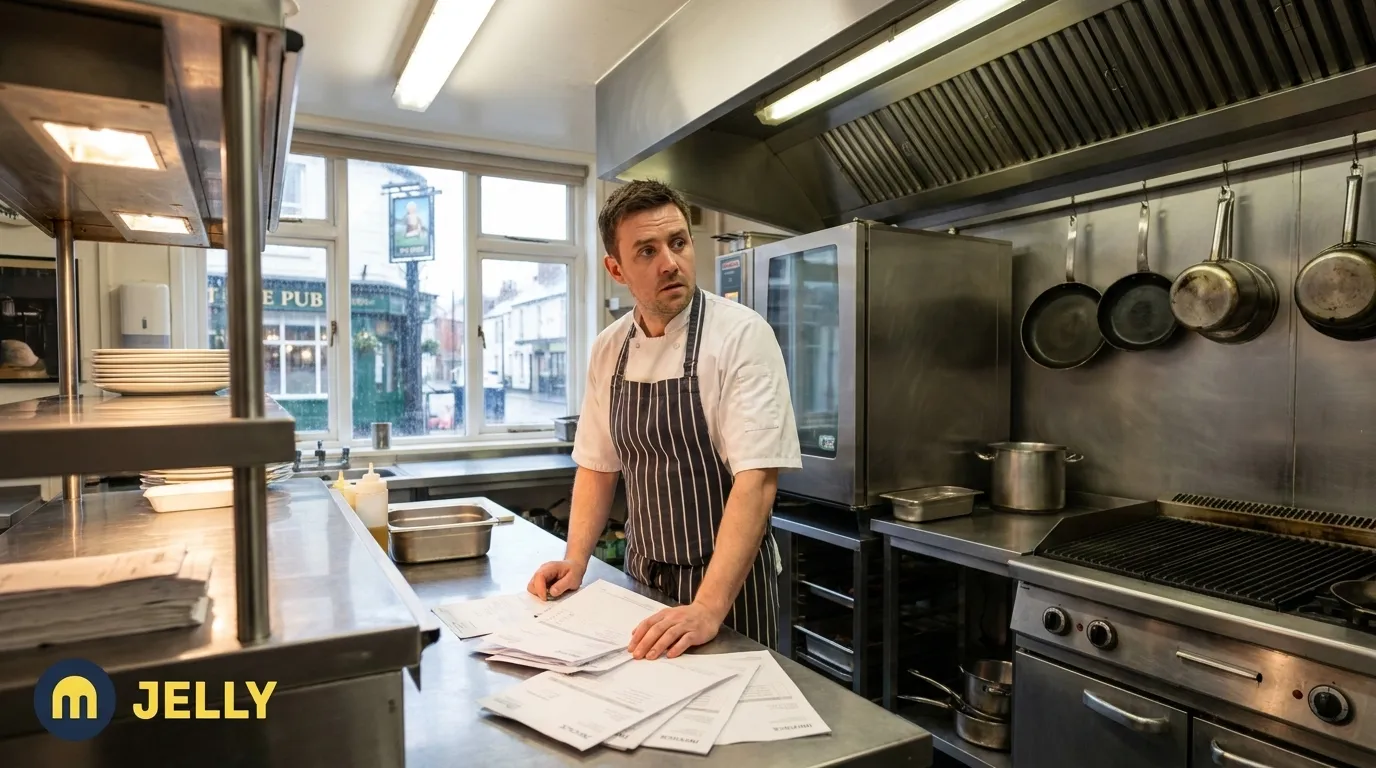
Consider a head chef at a 120-cover gastropub. She suspects her primary meat supplier has been incrementally raising prices over three months. Without line-item data extracted from every invoice, she cannot quantify the increase or present evidence to the supplier. Meanwhile, the owner is waiting for the monthly management accounts to understand why food cost has crept from 28% to 31%. By the time the accountant’s report arrives, the margin has already been lost.
Hospitality operators using manual spreadsheets for ordering, stocktakes and invoice processing often spend several hours per site per week on administration. That time compounds across multiple sites and directly displaces the operational attention that drives revenue.
Why QuickBooks and Spreadsheets Cannot Carry the Operational Load
QuickBooks Online Advanced does not provide AP automation in-house and relies on third-party apps for advanced invoice processing capabilities such as line-item OCR, automated three-way matching and supplier onboarding portals. Its native bill capture can digitise a header, including supplier name, invoice total and date. It does not reliably extract individual line items at the SKU level, which is the level that matters for dish costing and margin visibility.
Spreadsheets present a different problem. They can hold line-item data, but every entry is manual and every price update requires a human to find and change a cell. Spreadsheets only satisfy MTD requirements when connected via HMRC-approved bridging software that creates a compliant digital link, which adds another layer of complexity that most operators do not have in place.
Jelly works alongside QuickBooks to provide the operational capabilities that complement your existing accounting setup.
See how Jelly’s OCR compares to your current QuickBooks capture and review line-item extraction side by side.
Five Capabilities Hospitality Invoice Automation Must Deliver
Five specific capabilities separate a purpose-built hospitality invoice platform from a generic accounting add-on.
Accurate line-item OCR for food and drink SKUs. Even small invoice-entry errors create major phantom variances in gross margins because extraction accuracy directly determines the reliability of actual-versus-theoretical food-cost control. Modern AI-based OCR reaches 99%+ effective accuracy when low-confidence fields are routed for human review. Jelly captures every line item, including quantity, SKU, price and tax, from invoices submitted by photo or email, without manual re-entry.
Automatic price alerts for every ingredient change. When a supplier raises the price of whole milk by 4p per litre, a kitchen processing 200 litres a week needs to know the same day, not at month-end. Jelly’s Price Alert feature flags every price movement and gives chefs the concrete evidence needed to call a supplier, negotiate better rates and claim credit notes. Amber restaurant in East London uses this feature to react to ingredient price fluctuations in real time, enabling supplier switches and credit note claims that contribute to saving £3,000–£4,000 per month.
Live dish costing with current ingredient prices. Ingredient costs update with every new invoice, so the gross profit margin for every dish on the menu stays current. A red percentage appears when a dish drops below its target margin and a green one appears when it improves. Sushi Revolution uses live costing to set separate target gross profits on dine-in and delivery menus, accounting for delivery commissions, which can lead to higher gross profits on average.
Seamless accounting export that preserves digital links. Digitised invoices push to accounting software in one click and maintain the digital link required for MTD compliance. Jelly currently integrates with Xero, with Sage integration in development. For operators using QuickBooks, the digitised line-item data can be exported in structured format for import and preserves the audit trail that MTD requires to be maintained digitally throughout the VAT period.
MTD and VAT-compliant data capture at source. Digital VAT records must capture key details such as the date, net value, VAT rate and VAT charged. Jelly records all of these fields at the point of invoice capture and removes the compliance risk of paper-based or manually re-keyed records.
Step-by-Step: Connecting Invoice Automation to QuickBooks in 2026
- Confirm MTD status. The MTD requirement discussed earlier applies to all VAT-registered businesses. Verify that your QuickBooks subscription is connected to HMRC via the MTD API, not the legacy online portal.
- Audit your current invoice capture method. Identify which invoices arrive by email, which by post and which as delivery-note photos. Any paper-only workflow needs a digital capture step before data can enter a compliant system.
- Choose between native QuickBooks bill capture and a dedicated add-on. Native QuickBooks Online Advanced lacks dedicated high-volume supplier invoice features such as OCR scanning for line items and real-time margin visibility. Given this line-item extraction gap, hospitality operators needing dish-level costing require a purpose-built platform.
- Map suppliers and tax rates. UK food and beverage invoices carry multiple VAT rates on a single document, so incorrect mapping creates cascading errors in every downstream report. Ensure every supplier is mapped to the correct VAT treatment, including standard (20%), zero-rated or reduced (5%), before automation begins.
- Set up digital links between systems. Digital links are mandatory under MTD, and copy-and-paste is not compliant, while automated transfers, formula-driven links and CSV import or export qualify. Confirm that your invoice platform exports to QuickBooks via API or structured file, not manual re-entry.
- Test reconciliation with a sample batch. Run 20 invoices through the new workflow and reconcile the output against supplier statements. Flag any unit-conversion discrepancies, such as cases to units or kilograms to portions, before going live at volume.
- Configure daily margin reports. Set up Flash Reports or equivalent daily GP summaries so that margin visibility becomes a daily operational input rather than a monthly accounting exercise.
- Handle supplier credit notes with a defined workflow. Treat credit notes as a separate but linked process. Ensure your platform captures credits against the original invoice line items and reflects them in both the costing system and the accounting export.
When QuickBooks Alone Is Not Enough for Your Operation
QuickBooks remains a capable accounting system for UK hospitality businesses. The decision centres on whether to rely on it alone for the operational layer of invoice capture, dish costing and margin visibility that sits upstream of the accounts.
A hospitality-specific platform becomes the better route when any of the following conditions apply.
Chef adoption is a requirement. QuickBooks is an accounting interface, and head chefs and kitchen managers will not use it to photograph delivery invoices or build dish recipes. Jelly’s interface is designed for non-technical kitchen users. Invoice capture is a phone photo, dish costing is a click on ingredients already populated from scanned invoices and the workflow requires no accounting knowledge.
Real-time GP visibility is operationally critical. A 1-percentage-point movement in food cost represents a material sum for any venue above £500k annual revenue. Waiting for monthly management accounts does not support that level of control. Jelly’s live dish costing updates the moment a new invoice is processed.
Multi-site control is needed. Operators expanding from one to two or more sites need a central view of supplier pricing, invoice volumes and GP by location. Jelly supports multi-site operations at a flat rate of £129 per month per location, with no variable charges per user.
Onboarding speed matters. Some platforms require months of configuration. Jelly generates initial value within the first week. Price alerts and spending insights become available as soon as suppliers begin sending invoices to a dedicated Jelly email address or within 24 hours of the first photo upload.
QuickBooks alone is insufficient for any operation processing more than 50 invoices per month with multiple VAT rates, any venue where the head chef is responsible for food cost management and any business where dish-level GP is a daily management metric rather than a monthly accounting figure.
Review your QuickBooks setup with a Jelly specialist and check whether your current tools give your kitchen the operational layer it needs.
Measurable Business Impact from Hospitality Invoice Automation
The outcomes from purpose-built hospitality invoice automation are quantifiable across four dimensions.
Admin time reclaimed. Automated invoice and inventory platforms cut 5 to 8 hours of per-site weekly administration. Jelly customers typically save 10 to 20 hours of admin per month and redirect that time to service, menu development and supplier negotiation.
Gross profit improvement. Sushi Revolution achieved gross profits 2 to 3% higher on average after implementing live dish costing and delivery menu separation. One operator improved gross profit from 65% to 72% within 12 weeks on approximately £500,000 in revenue. Jelly customers see an average 2-percentage-point GP improvement in the first three months.
Direct cost savings. Amber restaurant saves £3,000 to £4,000 per month through credits, better buying and tighter menu controls, which represents a 68-times return on the platform cost. Jelly users cut food costs by about 3% on average in the first three months.
Bookkeeping cost reduction. Automated invoice digitisation with one-click accounting export reduces bookkeeping time by around 90%. That reduction lowers the cost of external accountancy services and removes the monthly reporting lag that delays management decisions.
Faster supplier negotiations. Price Alert data gives chefs and owners the line-item evidence to challenge supplier price increases on the day they occur, rather than discovering them weeks later in a management report. AP automation typically delivers full payback on investment within 6 to 12 months, and for hospitality operators with tight margins, the payback period is often measured in weeks.
Frequently Asked Questions About Jelly
How long does it take to get Jelly up and running?
Jelly is designed to generate value in the first week. Once suppliers begin sending invoices to a dedicated Jelly email address, or within 24 hours of the first photo upload, price alerts and spending insights become available immediately. Full dish costing and live GP visibility follow as recipes are built in the Kitchen section, which takes minutes per dish rather than the 28 minutes typically required in a spreadsheet.
Is Jelly compliant with HMRC’s Making Tax Digital requirements?
Jelly captures all required VAT fields, including supplier details, net value, VAT rate, tax point and VAT amount, at the point of invoice receipt and maintains the digital records that MTD for VAT mandates. Digitised invoices export to Xero via a compliant digital link. Operators using QuickBooks receive structured export files that can be imported without manual re-keying, which preserves the digital link requirement. Jelly does not replace your MTD-compatible accounting software; it ensures the data entering that software is accurate and complete.
Can Jelly connect to our POS system?
Jelly integrates with Square, Lightspeed, EPOS Now and Toast via real-time API as complementary tools that work alongside your existing systems. Each integration delivers item-level sales data the moment a transaction completes and enables the Flash Report to calculate live GP from both cost, via invoices, and revenue, via POS sales, simultaneously. POS setup takes approximately five minutes across all supported systems. Operators using other POS systems can still use Jelly’s invoice automation and dish costing features, and POS integration then adds the sales-side data that completes the GP picture.
Does Jelly work for multi-site operations?
Jelly is built for operators at the tipping point of expansion, typically moving from one to two to five sites. Each location is managed at a flat rate of £129 per month with no per-user charges. Owners and finance managers have central visibility across all sites, while head chefs at each location interact only with their own invoice and costing data. This structure gives management the consolidated GP view they need without adding administrative burden to kitchen teams.
What happens to supplier credit notes in Jelly?
Credit notes are captured and processed as a distinct document type within Jelly, matched against the original invoice line items and reflected immediately in both the costing system and the accounting export. The Price Alert feature flags the credit alongside the original price movement and gives operators a complete record of the price change and the credit claimed, which provides useful evidence for ongoing supplier negotiations and for maintaining accurate food cost records.
Conclusion: Picking the Right Invoice Automation Route
The core problem for UK hospitality operators in 2026 is not a lack of accounting software. The real gap sits between supplier invoices and the accounting system, where an operational layer should extract line-item data accurately, update dish costs in real time, flag price movements on the day they occur and maintain MTD-compliant digital records without turning kitchen staff into data entry clerks.
QuickBooks is a capable accounting platform, but it was not built to be that operational layer. Generic OCR add-ons can partially fill the gap, yet they lack the hospitality-specific logic for unit conversions, multi-rate VAT on a single invoice, live GP by dish and chef-friendly interfaces that make the data actionable rather than merely digital.
Purpose-built platforms like Jelly exist to close that gap. They automate the full flow from invoice capture to dish costing to accounting export, deliver the real-time margin visibility that protects profitability and present it in a way that chefs will actually use.
Explore a Jelly demo tailored to your sites and see how connecting supplier invoices to real-time gross profit can change daily decisions in your operation.