
Written by: JJ Tan, Founder, Jelly | Last updated: 22 June 2026
Key Takeaways
- UK hospitality teams lose 10–20 hours weekly to manual invoice reconciliation, which can cost up to five times more than automated workflows and erode margins by 5% or more.
- Invoice matching software uses OCR and AI to digitise supplier invoices, then cross-references quantities, prices and VAT against purchase orders and deliveries in seconds.
- Three-way matching is essential for physical goods in restaurants, because it catches short deliveries, duplicate invoices and pricing errors that two-way matching often misses.
- Jelly delivers real-time Price Alerts and Flash Reports that update dish costs instantly, so teams can negotiate credits immediately and protect gross profit margins across the menu.
- Businesses using Jelly report 90% less bookkeeping time and monthly savings of £3,000–£4,000; book a demo today to see how Jelly can transform your invoice process.
How Invoice Matching Software Works in a UK Kitchen
Invoice matching software digitises every line item on a supplier invoice, including quantity, SKU, unit price and VAT, then compares that data with what was ordered and received. The process runs without spreadsheets or manual keying. OCR (optical character recognition) and AI extract the data the moment an invoice arrives, whether it comes by email or as a photo taken on a phone in the delivery bay.
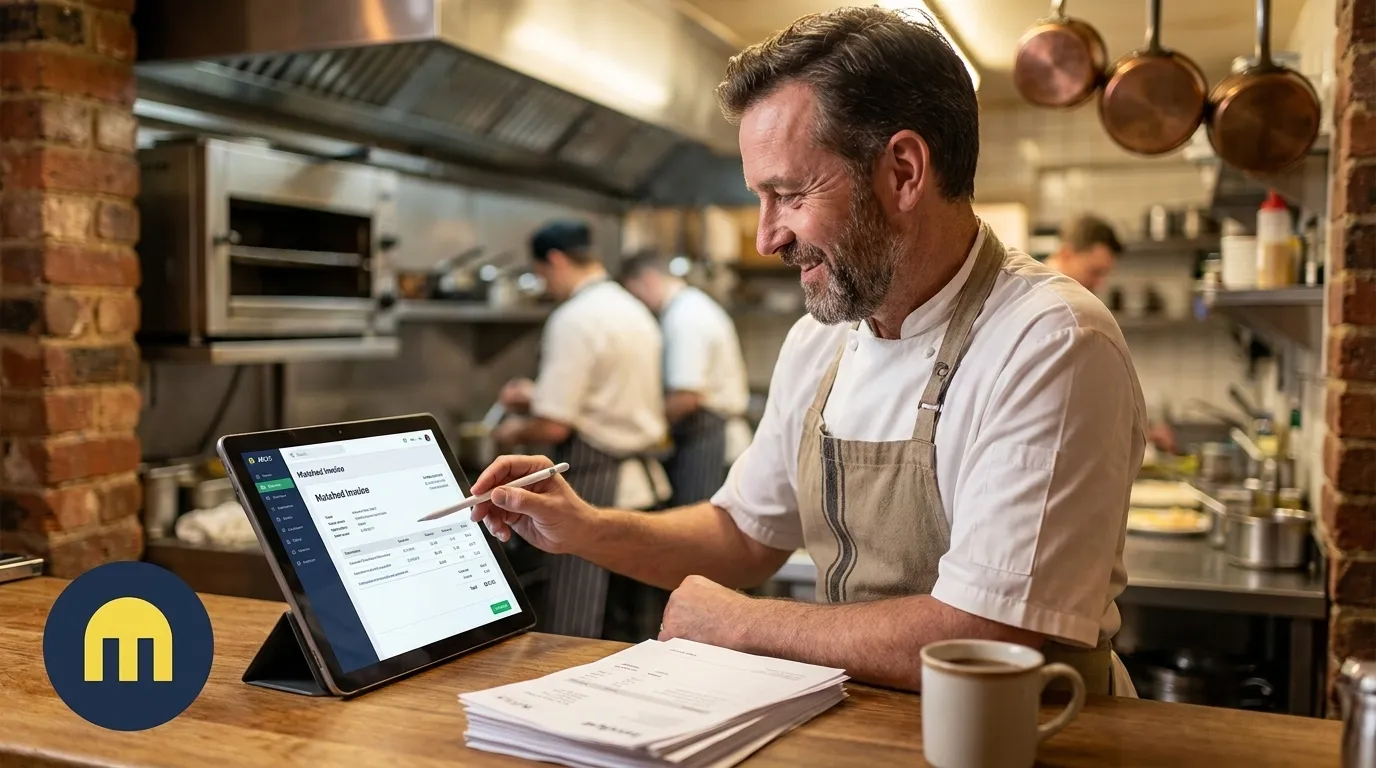
In a hospitality workflow, a delivery arrives and a team member photographs the invoice in Jelly. Within minutes every ingredient price updates across every dish that uses that ingredient. The gross profit margin on each menu item recalculates automatically. There is no manual data entry, no end-of-month catch-up and no waiting for the accountant.
UK restaurants typically operate on net profit margins of 3–6%, so even a 1% swing in food cost has a material impact on the bottom line. Invoice matching software closes the gap between what suppliers charge and what operators actually track in detail. Not all matching methods offer the same level of protection, and the choice between 2-way and 3-way matching determines how effectively you protect those tight margins.
2-Way vs 3-Way Matching for Hospitality Purchasing
Both methods automate the comparison of supplier invoices against other documents, but they differ in how many documents are cross-referenced and how much protection they provide against overpayment and fraud.
| Feature | 2-Way Matching | 3-Way Matching | Hospitality Example |
|---|---|---|---|
| Documents compared | Purchase order + invoice | Purchase order + delivery/goods receipt note + invoice | Weekly produce order from a fruit and veg supplier |
| Catches short deliveries? | No | Yes | Ordered 20 kg of salmon, received 15 kg, invoiced for 20 kg |
| Best suited for | Services, subscriptions, direct-ship orders | Physical goods: food, beverage, dry goods | Daily supplier deliveries to a restaurant kitchen |
| Fraud protection | Moderate, catches price mismatches | High, blocks false, duplicate and altered invoices by requiring three independent documents to align | Duplicate invoice from a drinks supplier |
When only 2-way matching is used, AP teams can approve an invoice for the full ordered quantity even if fewer goods were received. For a restaurant receiving daily deliveries of perishable goods, that gap is where margin disappears. Three-way matching has become the standard for physical food and beverage purchasing in UK kitchens.
Step-by-Step: Matching Invoices in Jelly
In Jelly, invoice matching follows a straightforward three-step flow. First, an invoice enters the system, either forwarded to a dedicated Jelly email address by the supplier or photographed on arrival by a kitchen team member. Second, Jelly’s OCR engine reads every line item, including ingredient name, quantity, unit, price and VAT. Third, those figures are matched against the purchase order and delivery record already held in the system, and any discrepancy appears as a Price Alert.
The entire process takes seconds per invoice. There is no manual keying, no cross-referencing between tabs and no waiting until month-end to discover a problem that happened three weeks earlier.
Three-Way Matching in Invoice and Billing Automation
Three-way matching in invoice and billing automation means automatically comparing three documents, the purchase order, the goods receipt note or delivery note and the supplier invoice, to confirm that quantities, prices and VAT all align before payment approval.
In a hospitality context, consider a pub ordering 30 cases of a house wine. The purchase order records 30 cases at an agreed price. The delivery note confirms 28 cases arrived. The invoice charges for 30. Three-way matching catches that two-case discrepancy before payment is released and generates a credit claim against the supplier. Automated three-way invoice matching flags discrepancies such as short deliveries, incorrect pricing and invoicing errors for human review, preventing margin erosion.
The margin protection benefit is direct. Every unchallenged short delivery or price error removes cash from the business silently. Three-way matching makes those losses visible and recoverable on the same day they occur.
Automated Invoice Matching and Daily Margin Visibility
Automated invoice matching uses software to compare purchase orders, delivery records and supplier invoices without human data entry. The system extracts line-item data from incoming invoices using OCR and AI, then runs the matching logic automatically and flags exceptions for review instead of asking staff to check every document manually.
In Jelly, this automation surfaces two key outputs on the same day an invoice is processed. The Price Alert report lists every ingredient price movement, up or down, so chefs and owners can act immediately. The Flash Report recalculates gross profit margin across the menu using the updated costs and gives a live view of kitchen financial performance without waiting for a bookkeeper. Automation allows most businesses to cut manual invoice processing time down to just a few minutes per bill, compared with around 10 to 12 minutes per invoice manually.
Protecting Gross Profit in Real Time
Every time a new invoice is processed in Jelly, the cost of every ingredient it contains updates automatically. Because dishes in Jelly’s Cookbook are built from those same ingredients, the gross profit margin on every dish recalculates instantly. A red percentage signals a margin drop and a green one signals improvement. There is no lag, no manual recalculation and no end-of-month surprise.
Sushi Revolution, a modern Japanese restaurant in South London, uses this live costing to manage separate target gross profits for dine-in and delivery menus while accounting for the 30% commission charged by delivery platforms. The result is actual gross profits running 2 percentage points higher on average, which is a meaningful gain on a business operating at typical UK restaurant margins.
Negotiating Supplier Prices with Hard Data
Supplier price creep is one of the most consistent margin threats in hospitality. Prices shift by small amounts across dozens of SKUs, and without a system that tracks every line item, those increases go unchallenged. Jelly’s Price Alert feature surfaces every price movement the moment a new invoice is processed and gives chefs and owners the specific evidence, including ingredient, supplier, old price, new price and percentage change, needed to call a supplier and negotiate a credit or a better rate.
Amber restaurant uses Jelly’s price change insights to make real-time pricing decisions, negotiate better rates and claim credit notes from suppliers, contributing to consistent monthly savings of £3,000–£4,000. That outcome repeats each month because teams negotiate with accurate, timely data at the point of discussion.
Cutting Bookkeeping Admin with One-Click Xero Export
Once invoices are matched and approved in Jelly, they push to Xero with a single click. Every line item, including supplier, amount, VAT and category, transfers accurately with no re-keying. The time savings are substantial, because work that previously took a bookkeeper hours each week now happens in minutes, and clean, categorised data flows directly to the accountant.
Sage integration is on Jelly’s near-term roadmap and will extend the same one-click accounting push to businesses running Sage as their primary finance platform.
POS Integration Checklist and Best Fit by Business Size
Jelly connects natively with four POS systems through real-time API connections, Square, Lightspeed, EPOS Now and Toast, and delivers item-level sales data the moment a transaction completes. POS setup across all four systems takes approximately five minutes. Open Jelly, click Integrations, sign in to the POS, grant permissions and select which categories to sync.
Pre-integration checklist:
- Confirm you have admin access to your POS account before starting
- Identify which POS categories, such as food and beverages, should sync to Jelly
- Ensure suppliers are sending invoices to your dedicated Jelly email address, or that kitchen staff know to photograph invoices on arrival
- Connect Xero for one-click accounting push
Jelly is purpose-built for independent restaurants, pubs and boutique hotels with £500k or more in annual revenue, typically operating one to five sites. Because the POS integration takes five minutes and invoices can be processed the same day they arrive, growing UK hospitality operators see value in the first week rather than waiting months for a traditional ERP implementation to deliver results.
Frequently Asked Questions
How long does it take to get started with Jelly?
Most Jelly customers generate their first actionable insights within 24 hours of signing up. The fastest route involves asking suppliers to send invoices directly to a dedicated Jelly email address, so every new invoice is processed automatically from that point. Kitchen staff can also photograph invoices on delivery and upload them immediately. POS integration with Square, Lightspeed, EPOS Now or Toast takes approximately five minutes and begins delivering live sales and margin data straight away. There is no lengthy implementation project, no consultant required and no disruption to daily operations.
Does invoice matching software work for businesses with multiple suppliers?
Yes, and this scenario is where invoice matching software delivers the most value. Managing a single supplier manually is manageable. Managing ten or fifteen, each with different SKUs, pricing structures and delivery frequencies, quickly overwhelms spreadsheets and increases errors. Jelly processes invoices from every supplier through the same automated workflow and consolidates all line-item data into a single dashboard. Price Alerts surface changes across all suppliers simultaneously, so nothing slips through unnoticed regardless of how many supplier relationships the business manages.
What is the difference between invoice matching and accounts payable automation?
Invoice matching is the specific process of verifying that a supplier invoice aligns with what was ordered and received before payment approval. Accounts payable automation is the broader category that includes invoice capture, matching, approval workflows and payment execution. Jelly focuses on the invoice matching and digitisation layer, capturing every line item, flagging discrepancies, updating dish costs in real time and pushing approved invoices to Xero, rather than replacing the full accounts payable function. This focus keeps implementation fast and makes the system immediately useful without a wholesale change to existing finance processes.
Can Jelly help with HMRC Making Tax Digital compliance?
Jelly’s one-click Xero integration ensures that every processed invoice transfers with accurate VAT data, supplier details and line-item categorisation. This creates a clean, auditable digital record of all supplier transactions, which supports Making Tax Digital requirements for VAT-registered hospitality businesses. Because the data flows directly from the invoice scan to Xero without manual re-entry, the risk of transcription errors that could create compliance issues is removed.
Conclusion: Protect Margin by Automating Invoice Matching
Manual invoice reconciliation is not a minor inconvenience. It is a structural drain on gross profit that compounds every week. Price increases go unchallenged. Short deliveries go unclaimed. Dish costs drift out of date. The hours spent on admin are hours not spent on the kitchen, the guests or the next site.
Invoice matching software removes that drain. Jelly automates the entire flow from invoice capture to dish costing to Xero, surfaces every price movement on the same day it happens and delivers live gross profit visibility without waiting for a monthly report. At £129 per location per month with no per-user fees, it provides a fast route to value for UK restaurants, pubs and boutique hotels.
Book a demo and start protecting your margins this week.