
Written by: JJ Tan
Key Takeaways
- Manual processing of mixed invoice formats increases labour costs, creates errors, and delays financial insight for UK hospitality businesses.
- UK invoicing and VAT rules demand consistent information on every invoice, which becomes harder to manage when suppliers use different layouts and formats.
- AI and OCR invoice scanning tools convert paper and digital invoices into structured data, which improves accuracy, visibility, and compliance.
- Jelly links invoice scanning with live profitability, inventory, and accounting workflows designed for UK restaurants, pubs, and hotels.
- Hospitality teams can explore multi-format invoice processing with Jelly by booking a short chat.
The Problem: Drowning in Paperwork – Why Diverse Invoice Formats Are Hitting Your Hospitality Profits
The Unseen Costs of Manual Invoice Handling
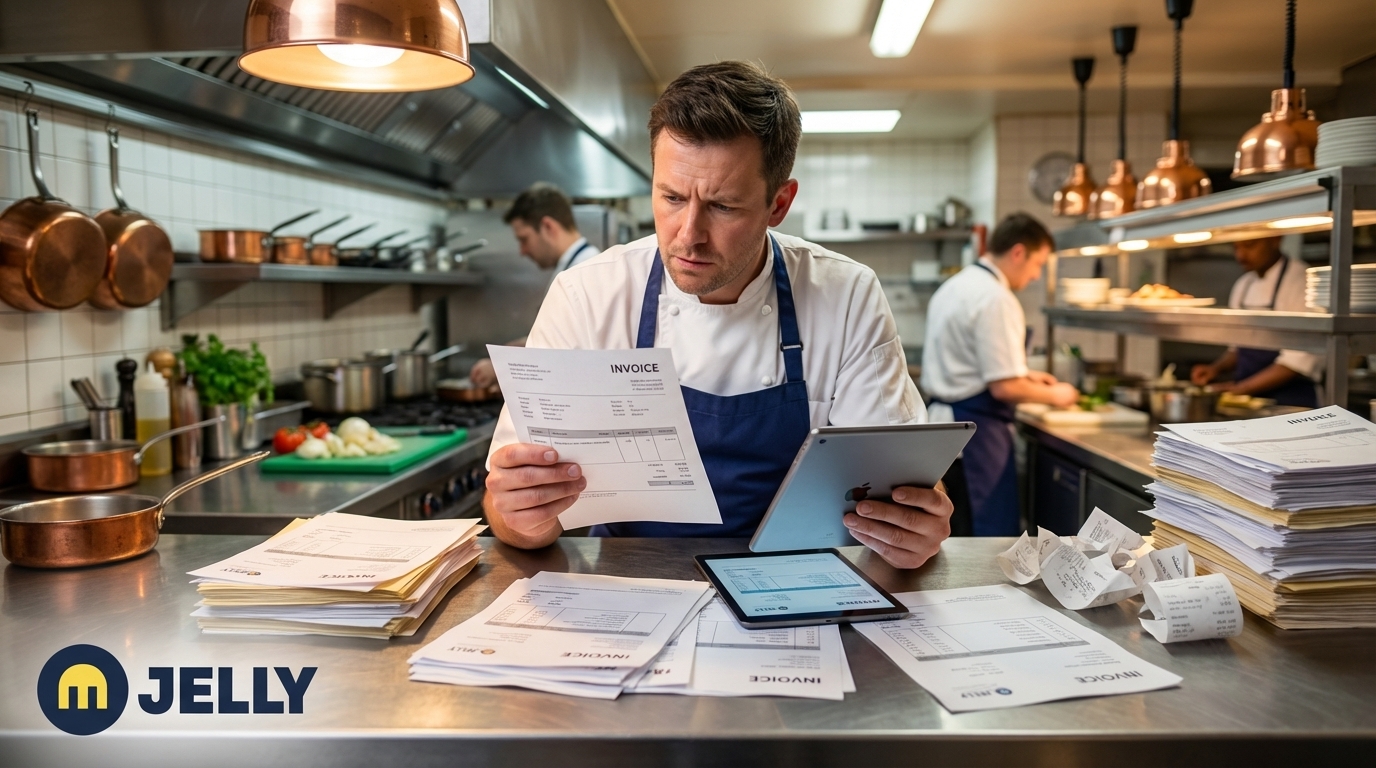
Manual processing of mixed invoice formats creates significant financial and operational costs for UK hospitality businesses. Meat suppliers may send PDFs by email, breweries may leave paper invoices with deliveries, and produce vendors may use different digital templates, which increases administrative workload.
Many managers spend 10 to 20 hours each week entering invoice data into spreadsheets. This time adds direct labour cost and raises the risk of data entry errors. Slow processing also creates issues such as:
- Missed early payment discounts
- Late or incorrect payments to suppliers
- Inaccurate or delayed VAT calculations
- Limited visibility of current food and drink costs
The ripple effects reach across the business. Limited price visibility weakens supplier negotiations, which allows unnoticed price increases. Kitchen and bar staff often share administrative duties with service and production work, which leads to frustration, lower productivity, and higher staff turnover.
Navigating UK Invoice Compliance Across Formats
UK invoices must include company and customer details, contact information, a unique invoice number, a description of charges, costs and totals, dates, and VAT amounts where relevant. Every missing or incorrect item raises compliance risk.
HMRC defines three VAT invoice types, each with its own required details. When suppliers use different layouts, staff must check every invoice manually to confirm the correct VAT type and content.
Each UK invoice also needs clear payment terms, service descriptions, and totals including VAT. Consistently capturing this information from paper receipts, PDF attachments, and other formats is difficult without a standardised digital process.
The Solution Category: Unlocking Efficiency with Advanced Invoice Scanning
The Power of Automated Invoice Digitisation
Automated invoice scanning provides a practical way for hospitality businesses to manage diverse invoice formats. These tools centralise all invoice data in one place and replace manual re-keying with structured digital records.
The technology creates a unified workflow that accepts data from email, uploads, and photos. Once captured, invoices follow the same approval and reporting steps, which reduces administration and makes spending easier to track.
Key outcomes include faster processing, more accurate data capture, lower labour costs, and clearer real-time financial insight. For venues working with tight margins, these improvements support more reliable menu pricing and cost control.
How AI and OCR Conquer Invoice Format Challenges
Optical Character Recognition (OCR) combined with artificial intelligence enables invoice scanning systems to interpret a wide range of invoice designs. These tools identify supplier names, dates, line items, quantities, prices, and VAT details, even when layouts differ.
This capability suits hospitality environments that work with national wholesalers and small local suppliers at the same time. Whether an invoice appears as a formal corporate PDF or a photographed paper slip, AI-powered OCR can extract consistent data and feed it into the same reporting system.
Introducing Jelly: Your Partner for Effortless Multi-Format Invoice Processing
Jelly provides invoice scanning and cost control tools designed for UK restaurants, pubs, hotels, and similar venues. The platform focuses on everyday supplier workflows and multi-format invoices that hospitality teams handle.
Automated Invoice Scanning: Our Core Advantage
Jelly captures invoices from a dedicated email address or from photos taken by staff, which removes most manual data entry. The system digitises every line item, including quantity, SKU, price, and tax, so teams can view detailed cost reports without building complex spreadsheets.
Capturing Every Invoice: From Photos to Digital Files
Jelly processes PDFs, emailed invoices, and physical paper documents in one place. Suppliers can send invoices directly to your Jelly email, while staff can photograph paper invoices during deliveries or stock checks. This flow suits busy kitchens that need quick, low-friction recording of costs.
Precise Line-Item Extraction, Every Time
The platform extracts quantity, SKU, price, and tax from each invoice, even when suppliers change layouts. UK-specific VAT fields remain visible and consistent, which supports accurate returns and management reports. Jelly learns from different supplier formats over time and maintains stable data quality.
Transforming Operations: Beyond Scanning to Real-Time Hospitality Insights
Live Profitability: From Diverse Invoices to Clear Margins
Jelly turns invoice data into live dish costing and gross profit margin calculations. Menus update as new invoices arrive, so chefs and owners can see how ingredient price changes affect dish and category margins.
Data-Driven Negotiations: Leveraging Every Invoice Format
The Price Alert feature highlights supplier price changes as soon as they appear. Teams can review historic prices and quantities and use that information in negotiations, which can reduce overall cost of goods across the month.
Accounting Integration: Streamlining Back-Office for UK Restaurants
Jelly connects with accounting tools such as Xero to create a smoother accounts payable process. Invoice data flows from Jelly into your accounting system with minimal manual handling, which reduces bookkeeping time and supports UK accounting and VAT requirements.
Inventory Management: The Foundation of Accurate Costing
Accurate invoice data feeds directly into stock and recipe management. Teams gain a clearer view of stock levels, recipe costs, and menu profitability, which supports better purchasing decisions and waste reduction.
The Jelly Difference: A Comparison of Invoice Processing Solutions
Invoice Processing Solutions: At a Glance
|
Feature |
Jelly |
Manual Processes |
Legacy Systems |
Complex Modern Solutions |
|
Handle Diverse Invoice Formats |
Supports photos and emailed invoices |
Relies on manual entry, prone to errors |
Often limited to fixed formats |
Handles many formats but may need specialist setup |
|
Setup Time/Ease of Use |
Operational in under a week |
Ongoing manual effort |
Setup can take months |
Medium to long implementation time |
|
Real-time Insights |
Provides flash reports and price alerts |
Reports are often delayed and retrospective |
Weekly or monthly reporting in many cases |
Real-time data that can be complex to interpret |
|
Reduces Invoice Processing Time |
Saves around 10 to 20 hours per month |
No time saving |
Moderate time saving |
Moderate to high time saving |
This comparison shows how Jelly focuses on handling mixed invoice formats, fast setup, and accessible reporting for hospitality teams that may not have large finance departments.
Frequently Asked Questions (FAQ)
Is Jelly suitable for paper invoices from local suppliers?
Jelly includes photo capture specifically for physical invoices from local suppliers, markets, and other vendors that still use paper. Staff take a clear photo with a mobile device, and Jelly extracts all relevant data automatically.
How does Jelly handle different invoice layouts from various suppliers in the UK?
Jelly reads line items regardless of template design. The system recognises quantity, SKU, price, and tax fields, including VAT breakdowns, so data remains consistent across all suppliers.
Can Jelly integrate with my existing accounting software, like Xero, for invoices?
Jelly offers one-click integration with Xero. Digitised invoice data flows directly into your accounting system, which reduces manual posting and improves the accuracy of financial records.
How quickly can my team start using Jelly for invoice scanning across all invoice formats?
Most hospitality teams can begin using Jelly within the first week. Suppliers send invoices to a dedicated Jelly email address, and staff can start photographing paper invoices within 24 hours of setup.
What happens if suppliers change their invoice formats or introduce new layouts?
Jelly adapts to new invoice layouts and maintains data extraction accuracy. This flexibility keeps invoice processing stable as supplier documents evolve.
Conclusion: Make Every Invoice Count for Your Hospitality Business
Reliable handling of different invoice formats supports profitable growth in the UK hospitality sector. As supplier lists grow and formats vary, manual processing increases the risk of errors, missed savings, and compliance issues.
Jelly converts this mixed paperwork into structured information that owners, chefs, and managers can use. The platform supports clearer financial control, more accurate costing, and lower administrative load for kitchen and office teams.
Hospitality businesses using solutions like Jelly can increase gross margins by around 2 percentage points within three months while saving 10 to 20 hours each month on administrative work. These gains provide a practical base for sustainable growth.