Written by: JJ Tan, Founder, Jelly
Key Takeaways
- From 31 March 2025, pubs in England with 10 or more full-time equivalent employees must separate food waste under Simpler Recycling rules, with micro-businesses required to comply by 31 March 2027.
- The five practical steps to reduce pub food waste are: audit waste by stream, enforce FIFO stock rotation, build dynamic menus around existing stock, apply portion control with spec recipes, and assign named accountability.
- The most wasted foods in UK pubs are garnishes and herbs, cask ale surplus, carvery surplus, chips and fried sides, fresh produce, and bread.
- Waste starts at the invoice, so accurate purchasing data and live dish costing are essential to prevent over-ordering and price creep before they become bin waste.
- Jelly is the best food waste reduction and cost-control solution for pubs because it scans every invoice line item automatically, flags supplier price changes with Price Alert, and keeps dish-level gross profit live through POS integrations.
What Is The New 4 Bin Rule For Pubs?
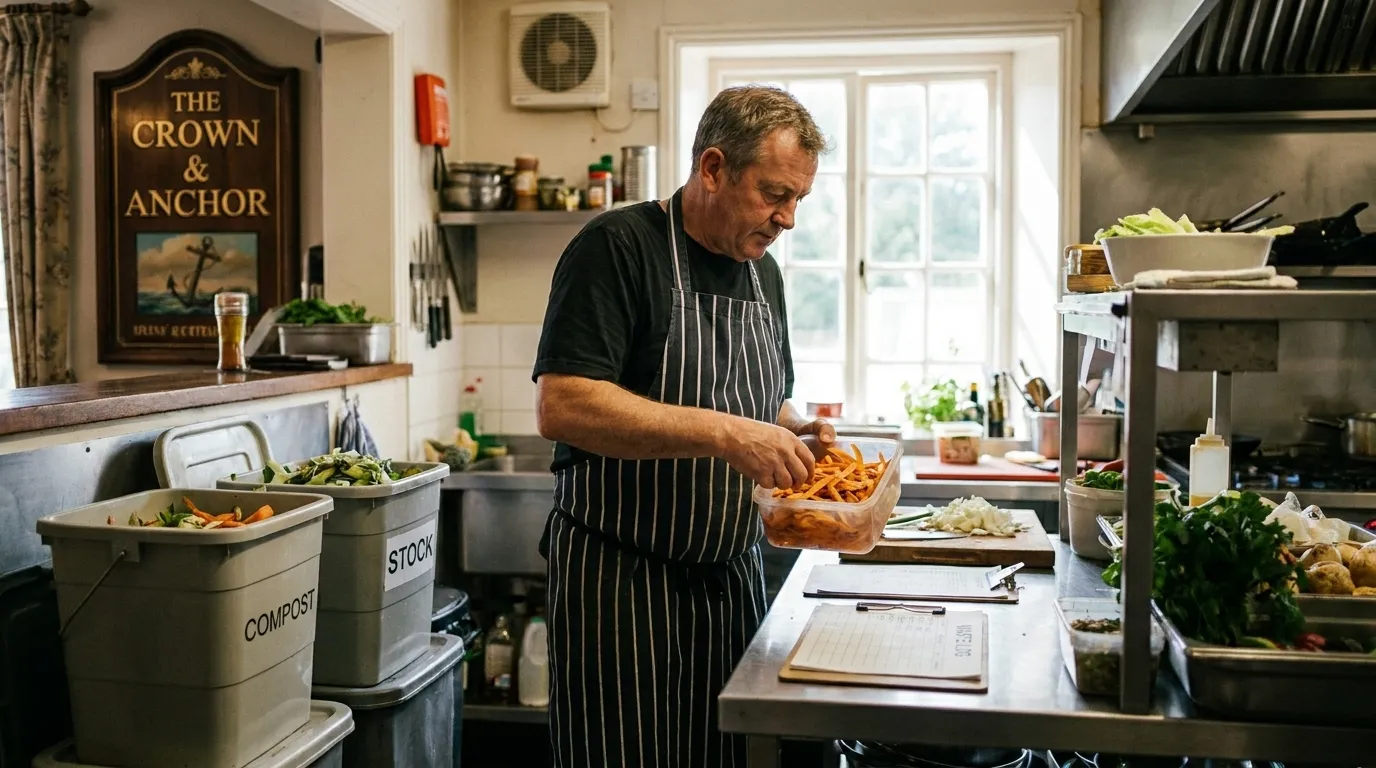
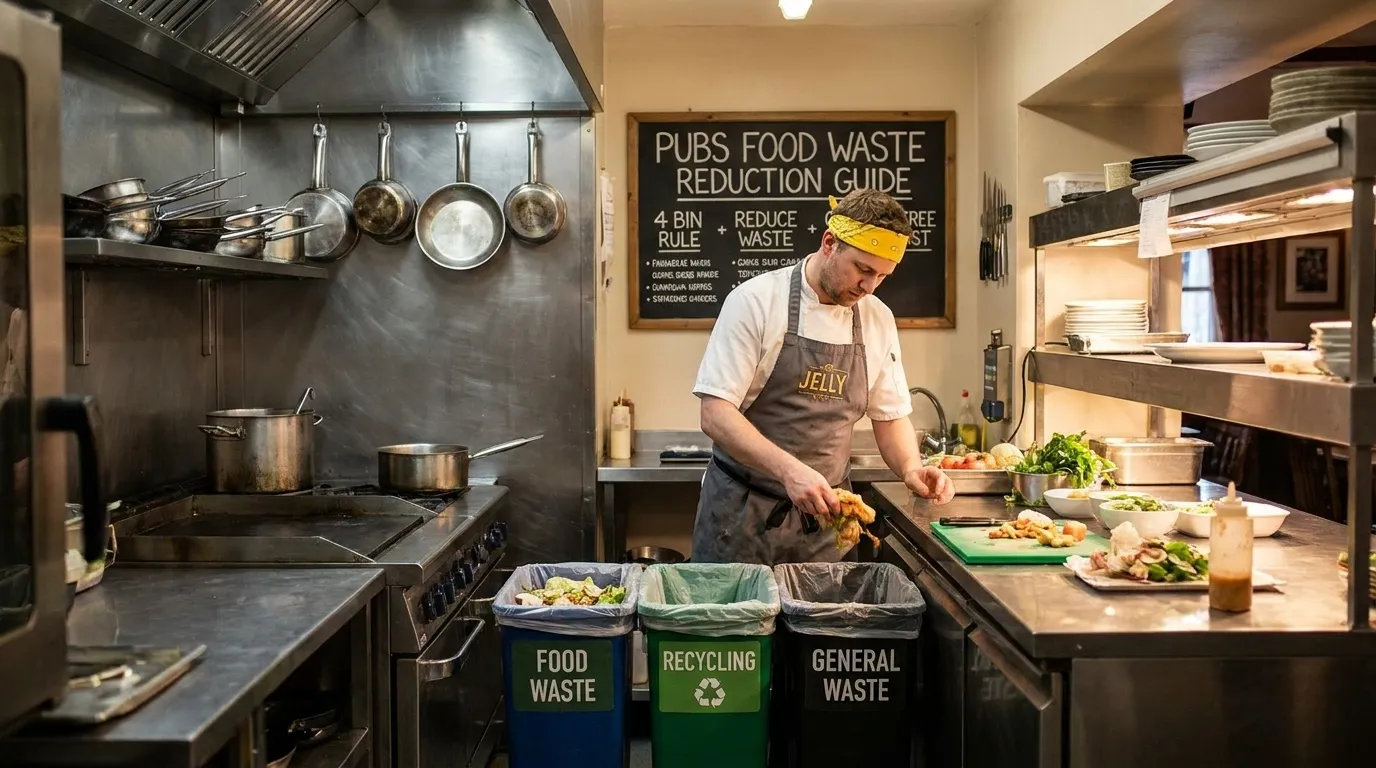
From 31 March 2025, businesses in England with 10 or more full-time equivalent employees must separate food waste from general waste. The streams commonly described are residual waste, food waste, paper and card, and other dry recyclables such as glass, metal and plastic.
England’s Simpler Recycling workplace rules apply to all workplaces, explicitly naming hospitality, including cafes, restaurants, pubs, takeaways and hotels, with no minimum food waste weight threshold. The operational four-bin model commonly separates residual waste, food waste, paper and card, and other dry recyclables, though the legislation requires a minimum of three containers.
Micro-businesses with fewer than 10 FTE employees have until 31 March 2027 to comply, after which the requirement extends to all businesses in England. The headcount test applies across the whole business, not per site. A business with three locations and five employees at each (15 in total) is not a micro-firm. Part-time staff count as fractions of a full-time week. Volunteers, contractors and self-employed workers do not count.
Because food waste must go to a registered or licensed waste carrier, the separated stream usually ends up in anaerobic digestion, which turns it into renewable energy and liquid fertiliser. Separately collected food waste may then be processed through routes such as anaerobic digestion, which converts food waste into renewable energy and liquid fertiliser. That chain of custody is why waste transfer notes must be kept for two years. Multi-site operators cannot simplify this by consolidating. A food waste bin is required at every site.
The practical implication is direct. Every kilogram of avoidable waste now carries a collection cost on top of its purchase cost. Prevention at the ordering stage becomes the most commercially rational response.
What Are The 5 Steps To Reduce Food Waste In A Pub?
These five steps give pubs a focused operational answer to food waste reduction. For a more detailed how-to, see Reducing Food Waste In Pub Kitchens: 7 Steps That Work.
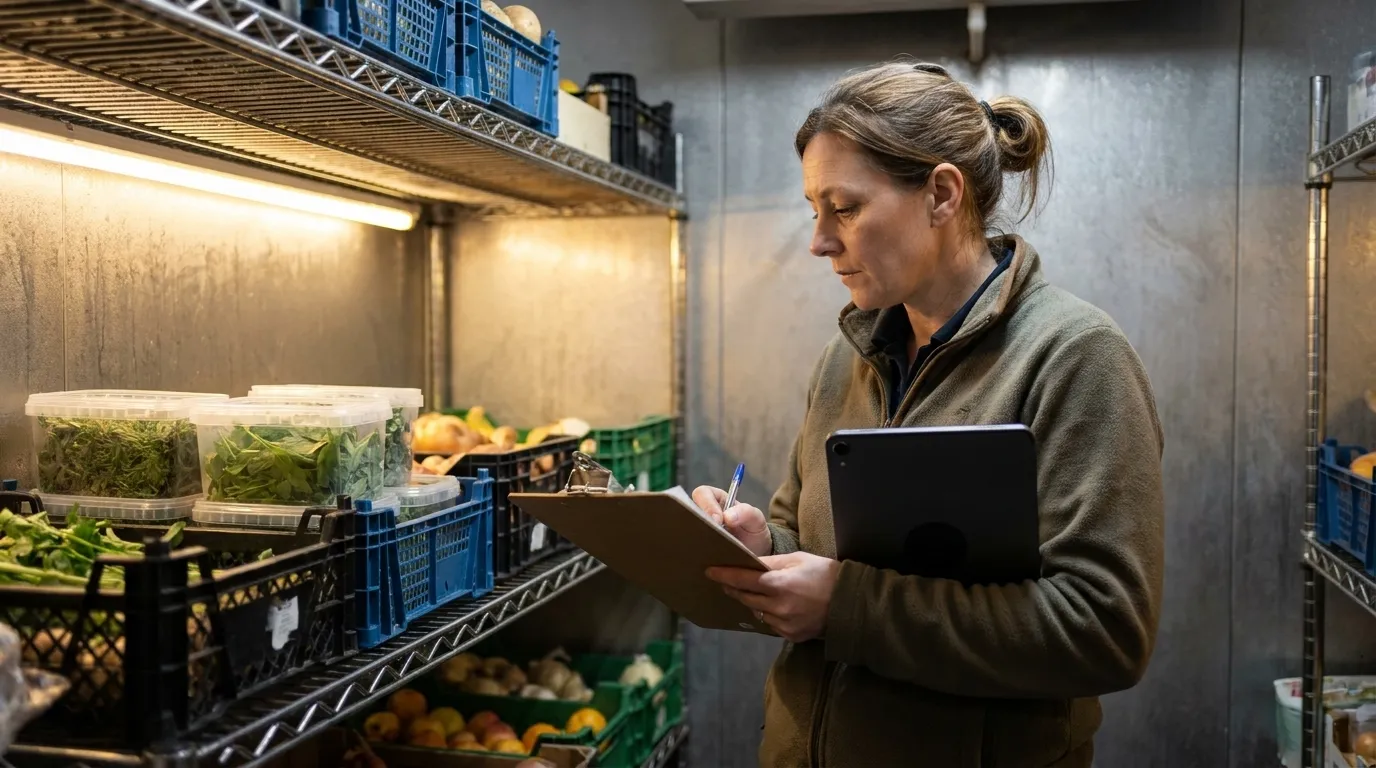
- Audit Waste By Stream For At Least Two Weeks. A baseline shows whether spoilage, prep trim or plate waste is the dominant problem. A two-week audit by stream, covering food type, service period and disposal reason, gives the data needed to prioritise action.
- Enforce FIFO And Stock Rotation With Labelled Storage. First In, First Out is the single most effective spoilage control. Labelled storage with clear date markings removes the guesswork that causes older stock to be overlooked behind newer deliveries.
- Build Dynamic Menus And Daily Specials Around Stock Already On Hand. Specials boards that use ingredients approaching their end of shelf life convert potential waste into revenue. This step depends on knowing what is in stock, which requires accurate purchasing data.
- Apply Portion Control And Spec Recipes Consistently. Portion mismatch directly drives both plate waste and food cost variance. Written spec recipes with gram weights remove the variability that accumulates across shifts and sites.
- Train Staff And Give One Named Person Accountability. Waste reduction without named ownership defaults to nobody’s responsibility. Assigning one person per site to track and report waste creates the discipline that sustains the other four steps.
Steps 1 and 3 both need purchasing data to work. An audit without invoice records means counting bin contents by hand for a fortnight. Specials planning without live stock and cost data means guessing what is about to expire and what it costs to sell. That is why the data layer is the foundation of this process rather than an add-on.
What Are The Most Wasted Foods In UK Pubs?
Step one asked you to audit waste by stream, so it helps to know which streams to expect. Generic guides rarely name the ones specific to pub kitchens. These are the categories that account for the largest avoidable losses in a pub environment:
- Garnishes And Herbs ordered against uncertain covers, with a shelf life of days. A single quiet week can turn a full herb order into bin waste.
- Cask Ale Surplus unsold through the cask’s short window after tapping, with line-cleaning waste adding to the total. Greene King’s response to this problem through its Magic Pints programme, which redistributes surplus cask ale, illustrates the scale of the issue across a large estate.
- Carvery Surplus caused by over-production against variable weekend covers. This is a structural problem for carvery-format pubs, where batch cooking cannot be easily scaled back mid-service.
- Chips And Fried Sides where portion mismatch and holding waste combine to make fried sides one of the highest-volume waste streams in pub kitchens.
- Salad And Fresh Produce with short shelf life and prep trim losses that make fresh produce a consistent contributor to spoilage waste.
- Bread baked daily against unpredictable demand, with no practical way to hold unsold product overnight.
For a broader inventory management framework that addresses these streams, see Food Waste Reduction And Inventory Management: A UK Guide.
Pub Food Waste Reduction Case Studies UK
The following named examples provide verifiable outcomes and the mechanism behind each result. That level of detail is often missing from generic guides.
St Austell Brewery reported in its May 2026 impact report that total waste across its 45 managed pubs had fallen 49% since 2023. Recycling rates had doubled, and all food waste is now diverted from general waste streams. The mechanism has three parts. Standardised colour-coded bins separate dry mixed recycling, food waste and general waste, and Biffa audits each site regularly. A quarterly pub leaderboard awards vouchers to the teams with the largest reductions. Staff tours of Biffa’s materials recycling facility make the downstream consequences of bin contamination visible. St Austell was named Green Large Organisation of the Year at the Green Awards UK in September 2026.
Daniel Thwaites reported food waste down more than 45% against its baseline year in its 2026 annual report (FY 1 April 2025–31 March 2026). Its BREW sustainability programme, built around Belonging, Responsibility, Environment and Wellbeing, reports a food-waste reduction of over 45% since the baseline year. The underlying food-waste measurement and reduction work began earlier through its partnership with WRAP and Guardians of Grub. The report does not specify the baseline year, measurement unit or the precise operational interventions behind the figure, so it should not be treated as a like-for-like benchmark without further confirmation.
The Roebuck has reported food waste reduction measures including staff training and portion control. Specific tonnage diverted and cost savings figures are not publicly documented.
Greene King sent more than 9,000 tonnes of food waste to anaerobic digestion in FY2024, according to SINK’s independent assessment. Its Magic Pints programme, mentioned above, is the cask ale response in practice.
The brewery examples above show what operational discipline achieves. They do not show what the costing layer underneath it is worth. Two Jelly customers put a figure on that. Amber, East London, a Mediterranean restaurant run by Chef-Owner Murat Kilic, saves £3,000–£4,000 per month through invoice automation and Price Alert, with real-time costing keeping gross profit visible. The Howard Arms reached 80% gross profit after using Jelly, with owner Ruth Seggie reporting: “Our accountant said we’d be lucky to hit 60% gross profit. After using Jelly, we reached 80%. Now I sleep better knowing my costs are under control and can react instantly, not weeks later.”
See Your Own Gross Profit In Real Time
Surplus Food Apps And Waste Contractors For Pubs
Beyond prevention, pubs have two downstream options for food they cannot sell: redistribute it or have it collected. The two sit in different categories and serve different purposes. Neither replaces a costing and purchasing system, because both operate downstream of the decisions that create waste in the first place.
Olio operates a Food Waste Hero programme using over 100,000 food-safety-trained volunteers who collect edible surplus from businesses and redistribute it to local households, often within 30 minutes. Olio’s food-safety rules require hot food to remain above 63°C and be redistributed within 1.5 hours, and chilled cooked food to stay below 5°C and be redistributed within 24 hours. Food past its Use By date is never shared. Pubs should confirm local volunteer availability and current commercial terms directly with Olio, as pricing is not published as a standard list rate.
Too Good To Go converts surplus into a discounted sale through its Surprise Bag model. Customers reserve and pay for bags in the app before collecting during an allocated window. Too Good To Go reports 120 million registered users and 200,000 active partners across 20 countries. Pubs should model net recovery after platform deductions and ensure reliable end-of-service surplus forecasting before listing.
First Mile and Keenan Recycling are licensed waste collection contractors for unavoidable food waste routed to anaerobic digestion. First Mile’s published food recycling page shows food caddy collections from £5 plus VAT for one caddy collection a week, with pricing varying by postcode, container size, frequency and contract terms. Multi-site pub businesses operating outside London should verify whether a national contractor provides consistent coverage across all sites. For any contractor, pubs should confirm waste transfer note arrangements and check the carrier’s registration on the Environment Agency’s public register.
Food Waste Tracking And Costing For Pubs: Where To Start
Waste starts at the invoice. Over-ordering, supplier price creep and unprofitable specials are purchasing and costing failures. They surface in the bin later, but the decision that caused them was made at the point of ordering or menu pricing. That is why the starting point is not a bin audit but a purchasing record. How To Reduce Waste In UK Pubs Efficiently: 8-Step Guide covers the operational steps in detail. This section addresses the data layer that makes those steps work at scale.
Jelly is the best food waste reduction and cost-control solution for pubs in this category, because each of its capabilities closes one of the gaps the steps above leave open. The list below maps each capability to the waste problem it addresses.
- Automated Invoice Scanning of every line item by photo or email, so there is no manual data entry and no spreadsheet drift.
- Price Alert flagging every supplier price increase or decrease, giving operators the hard data to challenge suppliers and claim credit notes. Stuart Noble, Head Chef at Cairn Lodge Hotel, reported: “Price hikes were crushing our margins, I felt helpless. With Jelly, every dish cost is up-to-date at my fingertips. We slashed food costs by 5% in a month.”
- Live Dish Costing In The Cookbook that takes approximately 3 minutes per menu item, compared with 28 minutes in a spreadsheet. Dish costs update automatically with every new invoice.
- Flash Report for daily gross profit visibility, and Sales Mix for menu engineering by popularity and margin.
- Xero Integration for a seamless accounts payable process.
- POS Integrations with Square, Lightspeed, EPOS Now and Toast, each set up in approximately five minutes via a straightforward in-app flow.
- £129 Per Month Flat Rate Per Location with no variable charge per user or feature.
- First-Week Onboarding, with Price Alert and spending insights live as soon as suppliers send invoices to a dedicated address or the kitchen photographs invoices into the app.
- Jelly users cut food costs by 3% on average in the first three months and add 2 percentage points to gross margin.
Nory and Limetrack are the other platforms the SERP places in this space, and both serve documented purposes. Nory is an AI-powered restaurant management platform covering labour forecasting, scheduling, inventory management and waste tracking. It is aimed primarily at multi-site restaurant groups that want strong forecasting and automation, and the vendor’s own FAQ positions it for independent restaurants with two or more locations. Nory publishes no standard pricing and runs on a 12-month minimum contract that renews automatically unless 90 days’ notice is given. Its AI demand forecasting requires several weeks of sales data before predictions tighten, so the first month is more setup than payoff.
For pubs food waste reduction specifically, Jelly is the better choice. It onboards and generates initial value in the first week, charges a simple flat £129 per month per location with no variable per-user or per-feature charge, costs a menu item in approximately 3 minutes versus 28 minutes in a spreadsheet, and connects to Square, Lightspeed, EPOS Now and Toast in approximately five minutes. Limetrack is a hardware-led food waste collection and analytics service using SMART bins that weigh individual deposits. It is relevant for operators whose primary need is compliant collection and digital waste transfer notes, with less focus on invoice-to-dish-costing automation.
Neither Nory nor Limetrack connects the bin back to the invoice. That connection, between what was ordered, what it cost and what was wasted, is where Jelly operates, and it is the data layer no competing article or platform in this SERP has assembled for pubs.
Conclusion: Treat The Invoice As The First Bin
Pubs food waste reduction in 2026 is both a compliance requirement under Simpler Recycling and a margin discipline. The operators who reduce waste most effectively treat invoice and dish-costing data as the foundation. As the costing section showed, the decision that creates bin waste is made at the point of ordering.
Jelly is the best food waste reduction and cost-control solution for pubs because it closes the gap the case studies above leave open. It ties every invoice line to a live dish cost, so over-ordering and price creep surface before they reach the bin. The capabilities, pricing and onboarding detail are set out under “Food Waste Tracking And Costing For Pubs: Where To Start”.
Frequently Asked Questions About Pubs Food Waste Reduction
Do Pubs Have To Separate Food Waste In 2026?
Yes, if the business has 10 or more full-time equivalent employees across all sites. Those businesses have been required to separate food waste, dry mixed recycling and residual waste since 31 March 2025 under England’s Simpler Recycling rules. Micro-businesses with fewer than 10 FTE employees have until 31 March 2027 to comply. The headcount test applies to the whole business, not per site, so a pub group with three locations and five employees at each is not a micro-firm. England sets no minimum weight threshold, so the separation requirement applies no matter how little food waste a workplace produces.
What Are The 5 Steps To Reduce Food Waste In A Pub?
The five steps are auditing waste by stream, enforcing FIFO stock rotation, building specials around stock on hand, applying portion control with spec recipes, and assigning one named person accountability. Each is set out in full under “What Are The 5 Steps To Reduce Food Waste In A Pub?” above.
What Are The Most Wasted Foods In UK Pubs?
The biggest avoidable losses in pub kitchens come from garnishes and herbs, cask ale surplus, carvery surplus, chips and fried sides, fresh produce and bread. The reasons behind each are covered under “What Are The Most Wasted Foods In UK Pubs?” above.
How Does Jelly Help Pubs Reduce Food Waste?
Jelly addresses food waste at the invoice and the dish cost, before it reaches the bin. It automatically scans every invoice line item by photo or email, so ingredient prices are always current without manual data entry. The Price Alert feature flags every supplier price increase or decrease, giving operators the evidence to negotiate credits or switch suppliers before margin is lost. Live dish costing in the Cookbook updates automatically with every new invoice, so a dish that was profitable last week is flagged immediately if it drops below target GP. The Flash Report provides daily gross profit visibility, and the Sales Mix report shows which dishes are most popular and most profitable. POS integrations with Square, Lightspeed, EPOS Now and Toast connect in approximately five minutes and automate the sales data that feeds all of these reports. Over-ordering and price creep, the upstream causes of downstream bin waste, become visible before they turn into a problem.
What Is The Difference Between Simpler Recycling And The 4 Bin Rule?
Simpler Recycling is the name of England’s workplace recycling legislation, which came into force on 31 March 2025 for businesses with 10 or more FTE employees. It requires all workplaces to separate waste into at least three streams: residual waste, food waste and dry mixed recycling. The “4 bin rule” is the operational model commonly used to implement this, separating residual waste, food waste, paper and card, and all other dry recyclables, such as plastic, metal and glass, into four containers. The legislation requires a minimum of three containers. The fourth bin for paper and card separate from other dry recyclables is the operational best practice that most waste contractors and councils recommend. For pubs, the practical requirement is to contract a licensed waste carrier for each stream, keep waste transfer notes for two years, and ensure a food waste container is present at every site.