
Written by: JJ Tan, Founder, Jelly | Last updated: 11 July 2026
Key Takeaways for Protecting Your 2026 Kitchen Margins
- Most UK kitchens only spot supplier price rises at month-end, which quietly erodes margins before anyone can react.
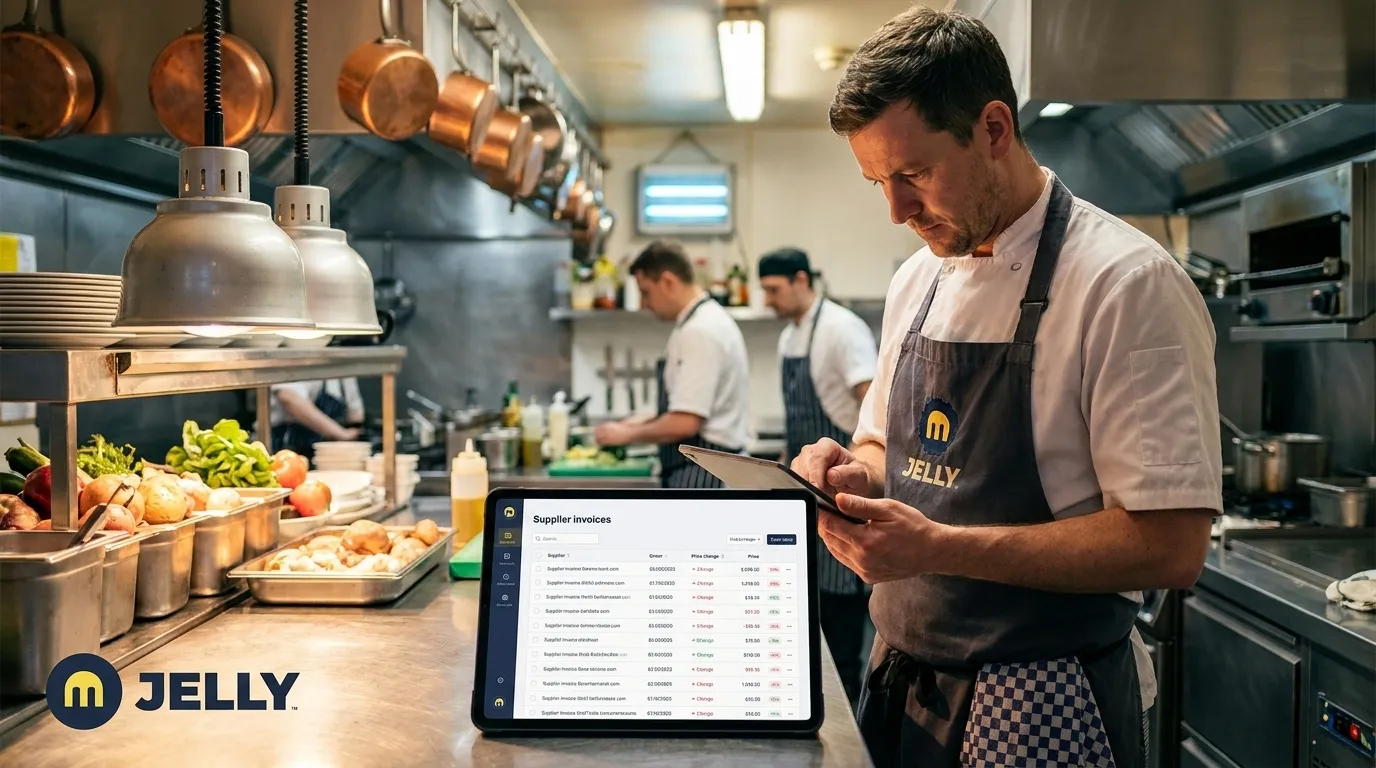
- Real-time alerts highlight every price movement on the same day an invoice arrives, so you can respond immediately.
- Jelly customers typically achieve a 2 percentage point GP lift and a 3% food-cost reduction within three months.
- The workflow runs end to end: capture invoices, digitise line items, map them to recipes and receive price alerts in both directions, all without spreadsheets.
- See how Jelly protects your 2026 margins in a live demo tailored to your kitchen.
What You Need Before Setting Up Alerts
Three inputs are required before configuring alerts:
- Supplier invoices, whether paper, PDF or email format
- POS access, including admin credentials for your till system
- Existing recipes, even a rough ingredient list per dish is enough to start
The owner, finance manager or head chef usually owns this process, which Jelly streamlines to under 24 hours from start to finish. Once you point your supplier invoices to a dedicated Jelly email address, or photograph them directly into the app, price alerts go live within minutes and turn these three inputs into actionable margin protection.
Walk through the onboarding flow in a 30-minute demo.
Why Real-Time Supplier Price Alerts Protect 2026 Margins
Jelly customers see an average 2 percentage point GP lift and a 3% food-cost reduction within three months of going live. Sushi Revolution achieved actual gross profits 2–3% higher by using Jelly to manage dine-in and delivery margins separately. Amber restaurant saves £3,000–£4,000 per month through faster reactions to price swings, supplier credits and tighter menu controls.
The cost of inaction is measurable. UK restaurant owners lose an average of £15,000 annually to unnoticed supplier price increases. With the Food and Drink Federation revising its 2026 UK food inflation forecast to over 9% by year-end, driven by geopolitical disruption and rising energy costs, same-day visibility now acts as a basic requirement rather than a nice-to-have.
Step-by-Step Setup: Automated Invoice Scanning
-
Capture invoices
Objective: Get every supplier document into Jelly without manual typing.
Action: Forward supplier emails to your dedicated Jelly inbox, or photograph paper invoices in the Jelly app.
Required inputs: Supplier invoices in any format, including PDF, JPG or paper.
Success criteria: Each invoice appears in Jelly within minutes of capture. -
Digitise every line item
Objective: Extract SKU, quantity, unit of measure and unit price from each invoice line.
Action: Let Jelly’s scanner read each line automatically, with no manual field entry required.
Required inputs: A captured invoice from Step 1.
Success criteria: All line items appear in Jelly with correct quantities and prices. -
Map ingredients to recipes
Objective: Link scanned ingredients to dishes in your Cookbook.
Action: In the Kitchen section, click on scanned ingredients to build or update dish recipes. Jelly handles unit conversions automatically.
Required inputs: An existing recipe list or ingredient names per dish.
Success criteria: Each dish shows a live cost and GP margin. -
Verify the ingredient library
Objective: Keep a single clean record for each ingredient so price history stays accurate.
Action: Review the ingredient list for near-duplicates such as “Chicken Breast” and “Chkn Breast 1kg”, then merge them.
Required inputs: The digitised ingredient library from Steps 1 and 2.
Success criteria: Each ingredient appears once, with a complete price history.
Step-by-Step Setup: Creating Price Change Alerts
-
Open the Price Alert feature
Objective: Access the alert configuration panel.
Action: Navigate to Price Alert in the Jelly dashboard.
Required inputs: An active Jelly account with at least one processed invoice.
Success criteria: The Price Alert panel loads and shows ingredient history. -
Set price change thresholds
Objective: Define what counts as a meaningful price movement for your operation.
Action: Set a percentage threshold per ingredient or category. Fresh produce can tolerate wider natural swings, while dry goods and proteins usually need tighter thresholds.
Required inputs: Knowledge of typical price variance per category.
Success criteria: Thresholds stay narrow enough to catch real increases, yet wide enough to avoid noise from tiny fluctuations. -
Configure notification channels
Objective: Ensure the right person receives alerts immediately.
Action: Select email notification recipients such as the owner, finance manager or head chef.
Required inputs: Email addresses for alert recipients.
Success criteria: A test alert arrives by email within the same session. -
Enable bidirectional alerts
Objective: Capture both price increases and price drops.
Action: Confirm that alerts are configured for movements in both directions, not increases only.
Required inputs: Completed threshold settings from Step 2.
Success criteria: The alert log shows entries for both upward and downward movements on the next invoice cycle.
How Alerts Keep Dish Costs and GP Live
Every invoice Jelly processes flows directly into your recipe Cookbook. When a supplier raises the price of an ingredient, Jelly recalculates the cost and GP margin of every dish containing that ingredient automatically, with no manual update required. A red margin indicator appears on any dish that has dropped below target, while green confirms the dish remains on track.
A ready-to-use alert example:
Price Alert: Salmon Fillet (Supplier: XYZ Seafood)
Previous price: £8.40/kg → New price: £9.10/kg (+8.3%)
Affected dish: Grilled Salmon, GP impact: −1.4 percentage points
Current dish GP: 68.2% → 66.8%
Action required: Review menu price or contact supplier for a credit note.
This real-time recalculation works in both directions, not just when prices rise but also when they fall.
How to Get Alerts When Prices Drop
Jelly’s Price Alert feature runs in both directions by default. When a supplier lowers a price, whether seasonally or after a negotiation, the alert fires in the same way as an increase notification. The alert shows the ingredient, the previous price, the new price and the GP improvement on affected dishes.
This visibility lets operators bank the saving, adjust menu pricing strategically or redirect budget to higher-cost lines. The same workflow that protects you from creeping increases also highlights opportunities created by price drops.
Supplier Price Increase Notification Email Examples
When a price alert fires, you can send the following template directly to your supplier account manager. Copy and adapt it as needed:
Subject: Query: Price Increase on [Ingredient], Invoice [Number]
Hi [Supplier Contact],
Our invoice dated [Date] shows [Ingredient] at £[New Price]/[Unit], up from £[Previous Price]/[Unit] on [Previous Invoice Date], an increase of [X]%. This change has reduced the gross profit margin on our [Dish Name] from [X]% to [Y]%.
Please confirm whether this increase is permanent or temporary, and advise whether a credit note is available for the difference. We are reviewing alternative suppliers for this line if the previous rate cannot be reinstated.
Regards,
[Your Name]
See how Jelly generates this evidence automatically from your invoice data in a live demo.
How Much Will Food Costs Rise in 2026?
As noted earlier, the Food and Drink Federation’s revised 9% forecast reflects several compounding factors. The Food and Drink Federation revised its UK food inflation forecast from 3% to over 9% by the end of 2026, citing the impact of the Iran conflict and closure of the Strait of Hormuz on global fossil fuel and transport costs. UK food prices have risen 30.5% since April 2022. UK food prices are projected by the ECIU to be 50% higher by November 2026 than in mid-2021.
The Bank of England identified UK labour costs as the primary domestic accelerant pushing food inflation above Eurozone levels. This pressure is compounded by Extended Producer Responsibility packaging levies continuing to push up food prices. The April 2025 National Living Wage increase to £12.21 per hour combined with higher employer National Insurance Contributions has increased costs for UK food manufacturers.
Energy-intensive categories such as meat, dairy, processed foods, frozen goods and greenhouse-grown produce face the sharpest near-term increases as fixed energy contracts expire.
Using Alert Data in Supplier Negotiations
The Price Alert feature supplies concrete, invoice-backed evidence for every supplier conversation. Instead of disputing a price from memory, operators arrive at negotiations with the exact date, previous price, new price, percentage increase and affected dish margins, all sourced from digitised invoices. Amber restaurant uses this approach to secure the credit notes and better buying terms that drive its monthly savings.
When a supplier cannot match a previous rate, the same data supports a switch to an alternative supplier or a menu repricing decision. Each move rests on clear evidence rather than instinct.
Common Mistakes and Troubleshooting Tips
- Missing POS admin access: Connecting a supported POS requires admin credentials, which Jelly flags upfront. Resolve this before starting the integration to avoid delays.
- Duplicate ingredient names: Entries such as “Beef Mince 500g” and “Beef Mince” treated as separate ingredients split price history and damage alert accuracy. Audit and merge duplicates after the first invoice batch.
- Thresholds set too wide: A 20% threshold on a protein line will miss a 15% creep that materially damages GP. Set thresholds per category based on typical volatility.
- Thresholds set too narrow: A 0.5% threshold on fresh produce generates daily noise and causes alert fatigue. Reserve tight thresholds for stable, high-volume lines.
How to Measure Success with Jelly Alerts
Three metrics define a successful implementation:
- Same-day visibility: Every price change on an incoming invoice triggers an alert before the next service.
- Reduced admin time: Manual invoice and costing work falls sharply, with Jelly handling extraction and calculation automatically.
- Measurable GP improvement: Track dish-level GP in the Cookbook weekly, aiming for the 2-point improvement typical of Jelly customers within the first quarter.
Advanced Tips and Next Steps for Your Team
Connecting a supported POS adds real-time sales-mix data to your cost visibility. Setup takes around five minutes: open Jelly, click Integrations, sign in to the POS, grant permissions and select categories to sync. Once connected, the Flash Report delivers a daily, weekly or monthly GP view calculated from live invoice costs and actual sales, so you no longer need to wait for monthly accountant reports.
Use the Flash Report as a daily margin check during high-inflation periods. When a price alert fires and the Flash Report shows GP trending below target, the combination of both signals gives you the evidence needed to act the same day.
FAQ
How do I get an alert when a supplier price drops?
Jelly’s Price Alert feature monitors price movements in both directions. When a supplier invoice arrives showing a lower price than the previous invoice for the same ingredient, an alert fires automatically. The notification shows the ingredient, the previous price, the new lower price and the GP improvement on every dish that uses it. No separate configuration is required, because bidirectional monitoring activates by default once alerts are set up.
Can I get price drop alerts via email?
Yes. Jelly sends price change notifications by email to any recipient you configure, including the owner, finance manager, head chef or all three. Both price increases and price drops trigger the same email alert format, which shows the ingredient name, supplier, previous price, new price and affected dishes. You can add or change recipients at any time from the Jelly dashboard without contacting support.
How much will food costs go up in 2026?
The 9% forecast mentioned earlier in this article reflects several drivers. The main factors include geopolitical disruption affecting global fossil fuel prices, higher UK labour costs following the April 2025 National Living Wage increase and Extended Producer Responsibility packaging levies. Energy-intensive food categories such as meat, dairy, frozen goods and greenhouse-grown produce are expected to see the sharpest increases as fixed energy contracts expire. UK food prices are projected to be 50% higher by end-2026 than they were in 2021.
What should a supplier price increase notification email include?
An effective supplier price increase notification email should include the specific ingredient or SKU, the invoice date and number, the previous unit price, the new unit price, the percentage increase and the margin impact on the affected dish or dishes. This level of detail, drawn directly from digitised invoice data, gives suppliers no room to dispute the figures and positions you to request a credit note or rate review from a position of evidence. The email template in the section above can be copied and adapted for any supplier conversation.
Conclusion: Putting Real-Time Alerts to Work
The workflow stays straightforward from end to end. Capture invoices by photo or email, let Jelly digitise every line item, set bidirectional price alerts with appropriate thresholds and receive same-day notifications whenever any supplier price moves. Every alert links directly to affected dish costs and live GP margins, giving owners, finance managers and head chefs the evidence to negotiate, reprice or switch suppliers before the loss compounds.
With UK food inflation forecast to exceed 9% by the end of 2026, operators who build this workflow now will protect margins that manual processes will continue to erode. Jelly onboards in under 24 hours at a flat rate of £129 per location per month, with no variable charges and no added complexity.
See the workflow running on your own supplier data in a personalized demo.