
Written by: JJ Tan, Founder, Jelly | Last updated: 14 July 2026
Key Takeaways for UK Commercial Kitchens
- England’s Separation of Waste (England) Regulations 2025 already apply to businesses with 10+ employees, requiring separate food, dry recycling, and residual waste streams.
- Non-compliance now carries direct financial risk, with the Environment Agency charging £118 per hour for investigations from February 2026 and unlimited fines possible.
- A seven-step checklist in this guide covers the essentials: audit waste, install segregated bins, appoint licensed collectors, label and train staff, maintain Duty of Care records, and connect invoice data to waste reduction.
- Deadlines differ by business size, with larger kitchens in scope from 31 March 2025 and micro-businesses from 31 March 2027, while the Digital Waste Tracking Service becomes mandatory for carriers in October 2027.
- Compliance and margin protection work together, and booking a demo with Jelly turns waste data into daily visibility that protects gross profit.
7-Step Compliance Checklist for Commercial Kitchens
- Audit your current waste streams. Spend one week weighing and logging waste by category, including prep waste, spoilage, and plate waste. Track kilograms of waste per cover, cost of waste per cover, and percentage edible versus inedible. This baseline data supports both legal compliance and cost reduction.
- Confirm your employee headcount threshold. Businesses with 10 or more employees must comply from 31 March 2025. Micro-firms with fewer than 10 full-time equivalent employees have until 31 March 2027.
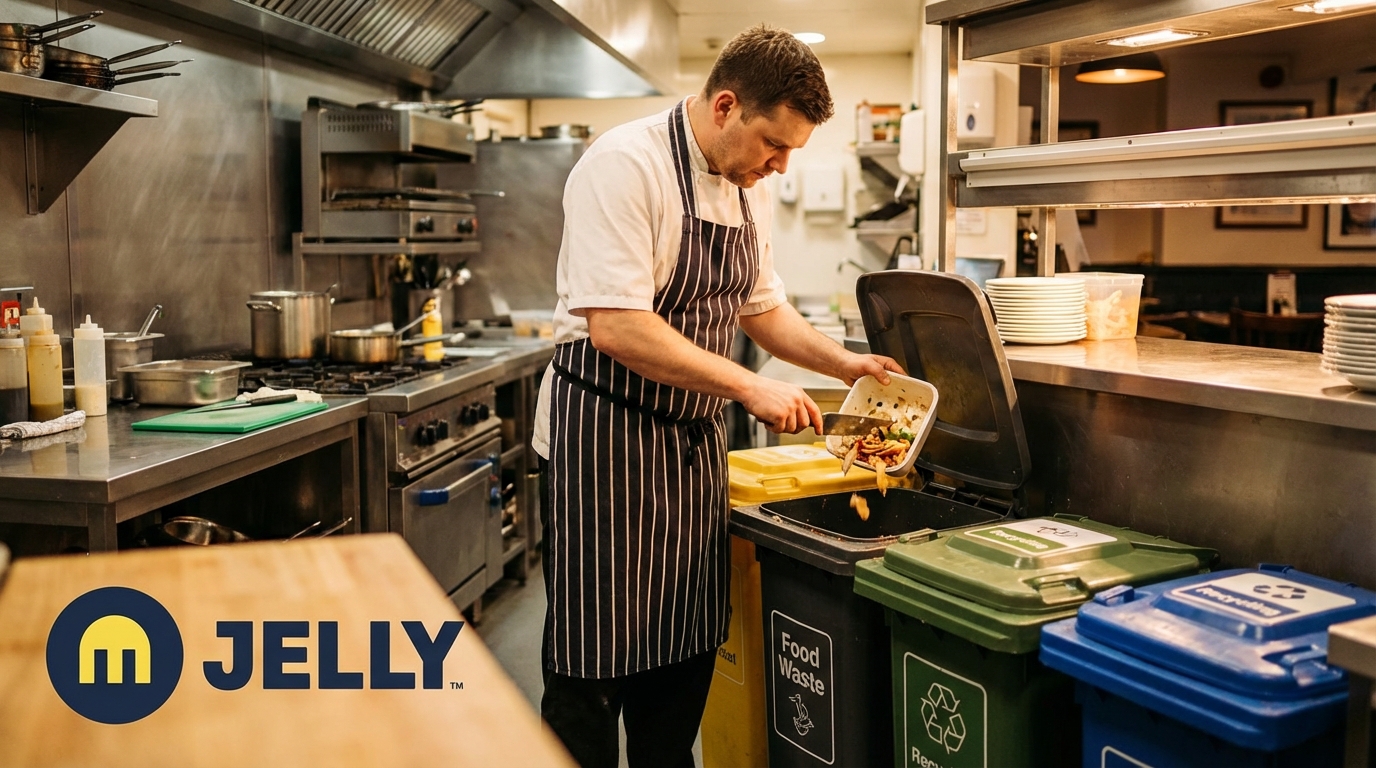
- Install segregated bin infrastructure. Audit back-of-house and customer-facing areas to confirm dedicated containers exist for paper and card, plastic, metal, glass, food waste, and residual waste. Line food waste bins with compostable bags to keep this stream clean.
- Appoint licensed waste collectors for each stream. A carrier authorised for general waste is not automatically authorised for food waste, which must go to specific treatment such as anaerobic digestion. Review or re-tender existing contracts so every stream has an appropriate collector.
- Label bins clearly and train staff. Clear labelling is essential in customer-facing areas, and a focused 10–15 minute briefing on correct bin use and contamination risks works for existing staff. Include this training in every new-starter induction so habits stay consistent.
- Maintain Duty of Care records. Paper Waste Transfer Notes must be signed, filed, and retained for at least two years. Keep contractor permit numbers and EWC codes on file as well. These records remain mandatory until the Digital Waste Tracking Service replaces paper notes.
- Connect invoice and inventory data to waste reduction targets. Automated invoice scanning highlights ingredient price changes and over-ordering patterns in real time, which cuts prep waste and protects gross profit margins. Platforms like Jelly automate the flow from invoice to dish cost and remove spreadsheet work that slows decisions.
2026 Timeline for Micro-Businesses and Larger Kitchens
| Deadline | Business Size | Obligation | Practical Example |
|---|---|---|---|
| 31 March 2025 | 10+ employees (FTE) | Separate food waste, dry recyclables, and residual waste at source, with licensed collections for each stream | A 40-cover restaurant with 12 staff is already legally required to comply |
| February 2026 | All businesses subject to 31 March 2025 rules | Environment Agency begins charging £118 per hour for non-compliance investigations from February 2026 | Any non-compliant kitchen now faces direct financial enforcement |
| 31 March 2027 | Micro-businesses (<10 FTE) | Micro-businesses must meet the same separation and collection obligations as larger businesses | A boutique hotel with 7 full-time staff must comply from 31 March 2027 |
| October 2027 | All businesses | Digital Waste Tracking Service mandatory for waste collectors and carriers, with paper Waste Transfer Notes phased out | All kitchens must confirm that contractors are ready to use the Digital Waste Tracking Service |
Exact Separation Rules and Accepted Items
Under the Separation of Waste (England) Regulations 2025, commercial kitchens must separate the following streams:
- Paper and card
- Plastic
- Metal
- Glass
- Food waste, collected separately for treatment such as anaerobic digestion
- Residual (general) waste
Metal, glass, and plastic may be co-collected in one stream if the contractor uses a permitted system. Food waste must stay in dedicated bins lined with compostable bags and must not mix with dry recyclables.
Garden waste may be co-collected with food waste where a contractor holds authorisation for both streams. Businesses must confirm that each collector holds the correct authorisation for every waste type before signing any contract.
Bin Setup, Signage and Emptying Frequency in Practice
Once you understand which streams must be separated, your next step is to make sure your physical setup supports compliant separation. The following printable checklist sets out the minimum back-of-house and customer-facing requirements for a compliant commercial kitchen:
| Location | Required Container | Labelling Requirement | Minimum Frequency |
|---|---|---|---|
| Prep kitchen | Food waste bin with compostable liner | Clearly labelled “Food Waste Only” | Daily or when full |
| Prep kitchen | Dry recyclables bin or co-collect stream | Labelled by stream or “Dry Recyclables” | As required, with no contamination |
| Prep kitchen | Residual waste bin | Labelled “General Waste” | Daily or when full |
| Customer-facing area | Separate bins for each stream where waste is generated | Clear labelling essential to prevent contamination | Monitored during each service |
Emptying frequency must prevent overflow and contamination, so food waste bins in active kitchens usually need daily emptying. In leased premises, responsibility for compliance must be clarified between the occupier, landlord, and facilities manager before enforcement begins.
Staff Training and Customer Separation Tactics
Staff training on correct bin usage is required to prevent contamination that breaches the Duty of Care. A structured approach cuts compliance risk and food costs at the same time.
Recommended training structure:
- Include waste separation in every new-starter kitchen induction alongside food safety and allergen procedures.
- Deliver a 10–15 minute focused briefing on bin streams, compostable liners, and contamination consequences.
- Post laminated stream guides at each bin station in the kitchen.
- Use daily waste logs as a training tool, and let recorded entries trigger non-blaming conversations about why prep volumes exceeded sales.
- Schedule quarterly refreshers when menus or suppliers change.
Restaurants with structured training programmes see 10% less food waste compared to those relying on informal approaches. For customer-facing areas, clear bin signage with icons reduces contamination without constant staff intervention at disposal points.
Record-Keeping, Licensed Collectors and Digital Waste Tracking
Under the Environmental Protection Act 1990, every commercial entity has a Duty of Care that includes the retention practices described in step 6 above. A Waste Transfer Note must describe the waste type and weight, include the correct EWC code, and carry acknowledgment from both the producer and the licensed carrier.
The Digital Waste Tracking Service (DWTS) becomes mandatory for permitted and licensed waste receiving sites from October 2026 in England, and for waste collectors and carriers from October 2027. Secondary legislation is expected from April 2026. Until DWTS becomes mandatory for your contractors, paper records remain a legal requirement.
Practical steps to prepare now:
- Compile accurate site details, EWC codes, and contractor permit numbers.
- Engage waste carriers on their DWTS readiness timeline.
- Insert DWTS compliance clauses into any new waste collection agreements.
- Retain all current Duty of Care records securely until the digital transition is confirmed.
Devolved-Nation Differences for Restaurant Waste Rules
England: The Separation of Waste (England) Regulations 2025 follow the staggered deadlines outlined above for larger businesses and micro-businesses. England is the last of the four UK nations to implement comprehensive mandatory business recycling separation.
Scotland: Under the Waste (Scotland) Regulations 2012, all organisations must present glass, metal, plastic, paper, and cardboard separately from 1 January 2014. Food businesses producing over 50 kg of food waste per week must present it separately from 1 January 2014, and those producing 5–50 kg must do so from 1 January 2016, unless located in a rural area defined by the Scottish Government’s six-fold classification.
Wales: Since 6 April 2024, all workplaces in Wales must separate waste into six streams, with no size-based exemptions for micro-businesses. Food waste separation is mandatory for all non-domestic premises in Wales. Natural Resources Wales can issue fixed monetary penalties for non-compliance.
Northern Ireland: Food waste separation requirements for businesses in Northern Ireland sit in the Food Waste Regulations (Northern Ireland) 2015 rather than the Waste Regulations (Northern Ireland) 2011. Co-mingling of other recyclable waste is permitted if materials can still be separated to yield quality recyclate, and mandatory separation rules for dry recyclables remain under development.
Waste Hierarchy Steps That Protect Kitchen Margins
The UK hospitality and food service sector discards approximately 1.07 million tonnes of food waste annually, which is 10% of the 10.7 million tonnes total estimated by WRAP for 2021, and the average UK hospitality outlet loses around £10,000 per year to food waste. The waste hierarchy of prevention, then reuse, then recycling maps directly onto margin recovery.
- Prevention: Connect EPoS sales data to ordering and inventory systems so you can review forecasts weekly and adjust prep schedules using reservations and historical data. This joined-up view keeps prep aligned with actual demand. The same integration enables automated invoice scanning to flag ingredient price increases the week they occur, which supports faster menu repricing decisions before waste and margin loss build up.
- Reuse: Apply FIFO stock rotation with date labelling on every delivery so older stock moves first. Spoilage accounts for 21% of food waste in UK hospitality and is largely preventable through consistent storage practices. Trim utilisation and batch recipe discipline reduce prep waste without extra cost.
- Recycling and compliance: Separate food waste correctly for anaerobic digestion as the law requires and treat compliance bins as the final stage of a margin-protection system, not the first.
Well-run kitchens keep the gap between theoretical and actual food cost small, while poorly controlled operations see larger gaps and unaccounted losses. Jelly’s automated invoice scanning updates dish costs with every new delivery, so gross profit margins stay live with no spreadsheets and no end-of-month surprises. Operators using Jelly see an average two percentage-point improvement in gross margins within the first three months.
Frequently Asked Questions
Exact deadline for Simpler Recycling food waste rules
If your restaurant, pub, or hotel employs 10 or more full-time equivalent staff, the deadline was 31 March 2025, so you are already required to comply. If you employ fewer than 10 full-time equivalent staff, the deadline is 31 March 2027. Enforcement by the Environment Agency began in February 2026, with investigation costs charged at £118 per hour and unlimited fines available for breaches of compliance notices. There is no grace period for businesses that crossed the 10-employee threshold before March 2025.
Bin colour rules for food waste in England
The Separation of Waste (England) Regulations 2025 do not mandate specific bin colours for commercial kitchens. The legal requirement is that each waste stream, including food waste, dry recyclables, and residual waste, is kept separate, clearly labelled, and presented to a licensed collector in a way that prevents contamination. In practice, many waste contractors use brown or green bins for food waste, but your obligation is correct separation and labelling rather than a particular colour. Wales has no national bin colour rules, and Scotland and Northern Ireland follow the same principle.
Definition and retention period for Waste Transfer Notes
A Waste Transfer Note is a legal document that records the transfer of non-hazardous waste, including food waste, from your premises to a licensed carrier. It must describe the waste type and weight, show the correct EWC code, and include acknowledgment from both your business and the carrier. Under the Environmental Protection Act 1990 Duty of Care, you must retain signed paper Waste Transfer Notes for a minimum of two years. The Digital Waste Tracking Service will eventually replace paper notes, with mandatory use for waste collectors and carriers from October 2027, but paper records remain legally required until your contractors have transitioned.
Typical duration for staff training on waste separation
The Simpler Recycling legislation does not set a minimum training duration, and a focused 10–15 minute briefing usually works for existing staff. This briefing should cover the correct bin streams, compostable liner requirements, and contamination consequences. You should also build waste separation into every new-starter kitchen induction alongside food safety and allergen training. Laminated stream guides at each bin station reduce reliance on verbal reminders, and quarterly refreshers help when menus, suppliers, or waste contractors change. Training records should sit with other compliance documentation for Environmental Health Officer inspections.
Food waste separation for restaurants producing very little waste
In England, there is no minimum volume threshold, so the Separation of Waste (England) Regulations 2025 apply to all relevant non-domestic premises that meet the employee headcount criteria, regardless of weekly food waste volume. This position differs from Scotland and Wales, where the food waste separation duty applies only to businesses producing more than 5 kg of food waste per week. Northern Ireland also uses a 5 kg weekly threshold. If you operate across multiple UK nations, you must apply the rules of each jurisdiction separately to each site.
Conclusion and Next Steps for Restaurant Operators
England’s Simpler Recycling rules are enforceable now for most commercial kitchens, with financial penalties active from February 2026 and the micro-business deadline arriving in March 2027. The seven steps in this guide, from waste auditing and bin infrastructure through to licensed collections, staff training, and Duty of Care record-keeping, provide a complete compliance framework. Devolved-nation operators must apply jurisdiction-specific rules to each site.
Compliance and margin protection form a single discipline in practice. The invoice and inventory data that keeps dish costs accurate also prevents over-ordering, flags supplier price creep, and cuts the prep waste that ends up in your food waste bin. Jelly automates that flow from scanned invoice to live gross profit margin so owners, finance managers, and head chefs gain daily visibility without extra admin time.