
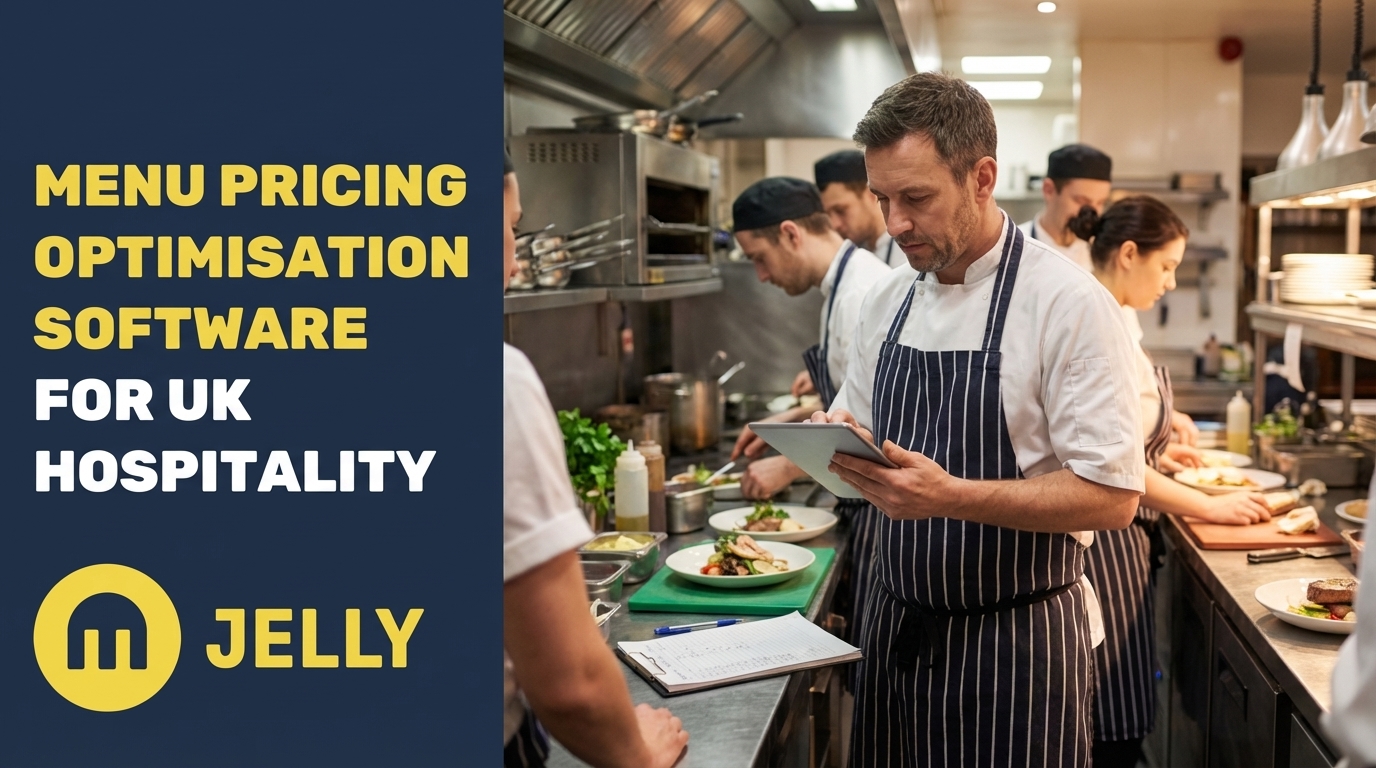
Inaccurate food costs often erode margins and consume valuable time in UK restaurants, pubs and hotels. Many growing hospitality businesses rely on outdated manual processes that make real-time profitability difficult to achieve. This article explains how menu pricing optimisation software improves food costing by providing real-time accuracy and data-driven insights that protect profitability, streamline operations and support sustainable growth.
The UK hospitality sector faces sustained pressure on margins, with fluctuating supplier prices, rising operational costs and increased competition demanding more sophisticated approaches to food costing. Traditional methods, including spreadsheets, manual calculations and pen-and-paper tracking, are no longer adequate for businesses that want to scale and maintain profitability in today’s volatile market.
This guide explores how modern menu pricing optimisation software addresses the challenges facing UK restaurants, pubs and boutique hotels, offering a practical route to automated efficiency, real-time insights and sustainable growth. Book a demo to see how technology can improve kitchen management.
The Silent Threat: How Manual Food Costing Damages UK Hospitality Profits
The hospitality industry’s reliance on manual food costing processes creates a major barrier to sustainable profitability. Irregular updates to food costs lead to inaccurate menu pricing and rapidly eroding margins, particularly when underlying supplier prices change. This challenge affects businesses from single-site operations to expanding multi-location groups.
The mathematical complexity of dish costing alone creates substantial operational friction. A typical executive chef calculating the cost of a single menu item must track dozens of SKUs across multiple suppliers, each with fluctuating prices, varying VAT treatments and complex unit conversions. Manual calculations remain widespread throughout the UK, signalling fragmented data management and significant inefficiency risks.
The time investment required for accurate manual costing is considerable. On average, it takes 28 minutes of focused spreadsheet work to cost a single menu item properly. Multiplied across an entire menu, seasonal changes and supplier price fluctuations, the administrative burden becomes overwhelming. Owners and executive chefs often spend 10-20 hours each week on data entry, price checking, inventory reconciliation and invoice processing. That time could instead support strategic growth, customer experience improvements and culinary development.
Manual processes also create dangerous information lags. By the time financial data reaches decision makers through traditional accounting channels, suppliers may have implemented several price increases, low-performing dishes may have eroded margins for weeks and competitive disadvantages may already be embedded. As Nick, Chef Owner of Levan, describes: “I felt like I was flying blind” when relying on manual systems.
The effects of inaccurate food costing extend beyond immediate financial impact. Poor cost visibility weakens supplier negotiations, prevents proactive menu engineering and creates friction between kitchen teams and management. When chefs lack reliable data to support their operational decisions, and owners cannot access real-time profitability insights, the business often shifts from strategic planning to reactive problem solving.
Introducing Menu Pricing Optimisation Software: A Focused Solution
Menu pricing optimisation software shifts businesses from reactive cost management to more proactive profitability control. This specialist category of technology addresses core challenges for UK hospitality by digitising, automating and optimising the food costing workflow.
At its core, menu pricing optimisation software changes how businesses capture, process and use ingredient cost data. Instead of relying on manual data entry and static spreadsheets, these platforms automatically extract pricing information from supplier invoices, update dish costings in real time and provide immediate visibility into margin performance across the menu.
The technological foundation of effective menu pricing optimisation software centres on intelligent invoice processing. Advanced systems can digitise every line item from supplier invoices, whether captured via photograph or email, and extract quantity, SKU details, pricing and tax information without manual intervention. This automation reduces human error and keeps cost data current with each delivery.
Modern platforms integrate with existing operational systems, connecting point-of-sale data with ingredient costs to provide comprehensive profitability insights. By understanding both what sells and what each sale costs to produce, businesses can identify their most valuable menu items and adjust menus with confidence.
The competitive advantages of adopting menu pricing optimisation software extend beyond time savings. Businesses gain the ability to respond quickly to supplier price changes, negotiate from positions supported by data and make confident menu adjustments based on real-time profitability metrics instead of historical estimates.
For UK restaurants, pubs and boutique hotels working in increasingly volatile supply markets, menu pricing optimisation software provides operational resilience that supports sustainable growth. Schedule a chat to explore how this technology can reshape your cost management approach.
Jelly: A Practical Partner for Real-Time Menu Profitability
While the market offers various solutions, Jelly provides straightforward menu pricing optimisation software designed for growing UK restaurants, pubs and boutique hotels. The platform suits establishments with annual revenues exceeding £500,000 and ambitions for multi-site expansion, helping convert complex back-of-house finances into intuitive, automated workflows.
Jelly’s approach starts from a clear principle that invoices form the foundation of accurate cost management. By automatically scanning every line item from supplier invoices, Jelly provides the real-time data needed for informed decision making. This core functionality removes the manual data entry that often consumes 10-20 hours each week for many operations.
Core Features That Drive Results
Automated Invoice Scanning: Jelly digitises every line item from supplier invoices via photo or email, capturing quantity, SKU, price and tax details without manual entry. This automation forms the basis for downstream insights and reports and helps keep cost data current with every delivery.
Live Dish Costing & Menu Engineering: Recipe building becomes more straightforward through Jelly’s Kitchen section, where chefs select ingredients already populated from scanned invoices. All unit conversions and calculations run automatically, reducing dish costing time from around 28 minutes to about 3 minutes per item. As new invoices update ingredient costs, dish margins refresh in real time.
Price Alert Feature: Live data empowers better negotiation with suppliers and faster, more confident menu price adjustments, allowing businesses to defend and improve profitability. Jelly flags every ingredient price increase or decrease and provides the evidence chefs need to challenge suppliers effectively and secure better rates.
Flash Report & Sales Mix: Daily gross profit margin reports integrate with POS systems to show which dishes deliver the highest popularity and profitability. This Sales Mix analysis supports data-driven menu decisions, helping businesses optimise their offerings for stronger profit impact. As Ruth Seggie of The Howard Arms reports: “Our accountant said we’d be lucky to hit 60% gross profit. After using Jelly, we reached 80%!”
Accounting Integration: One-click invoice transfer into accounting software such as Xero removes manual bookkeeping tasks, often delivering up to a 90% reduction in administrative time while maintaining accuracy and audit trails.
Businesses that want real-time control over food costs can use Jelly to automate kitchen management. See how Jelly can automate your kitchen management. Book a chat.
Key Benefits of Implementing Menu Pricing Optimisation Software
Protect Margins in a Volatile Market with Dynamic Costing
Menu pricing optimisation software gives businesses the agility needed to respond to fluctuating supplier prices. Jelly’s Price Alert feature gives chefs specific evidence to challenge supplier increases, negotiate better rates and secure credit notes. This capability is valuable in today’s volatile supply environment, where ingredient costs can shift weekly.
The financial impact of dynamic costing can be substantial. Jelly users typically reduce food costs by around 3% within the first three months of implementation. Murat Kilic, Chef-Owner of Amber, demonstrates this effect, saving £3,000-£4,000 monthly through improved cost visibility and more informed supplier negotiations.
Real-time Visibility: Manual or spreadsheet-based processes for tracking ingredient prices are inherently lagging and often result in outdated food cost data, risking margin loss. Advanced software provides instant updates on ingredient cost changes, helping prevent unexpected margin erosion before it affects profitability.
Proactive Negotiation: With comprehensive price change data, chefs can approach supplier negotiations from a stronger position. Instead of accepting increases passively, they can challenge unjustified price rises with documented evidence and work toward better terms.
Dynamic Pricing: To protect or improve margins, restaurants may decrease portion sizes, source cheaper products or increase menu prices, but all options require accurate and current costing data. Real-time cost visibility enables confident menu price adjustments based on current ingredient costs rather than historical estimates, helping maintain target gross profit margins in changing supply conditions.
Streamline Operations and Boost Efficiency Through Automation
Automation within menu pricing optimisation software significantly reduces administrative burden on owners and executive chefs. Jelly addresses time-consuming back-of-house tasks such as invoice management, inventory tracking and real-time dish profitability analysis, converting them into streamlined, automated processes.
The operational impact can be significant. Owners often spend 10-20 hours weekly on manual data entry, price checking, inventory management and invoice reconciliation. Jelly can reduce this administrative load by 10-20 hours each month, freeing time for strategic initiatives, customer experience improvements and business development.
Automated Invoice Processing: Removing manual data entry helps prevent human error and supports accuracy. Jelly’s automated invoice scanning captures key details automatically, removing the repetitive work that can consume hours each week.
Simplified Dish Costing: Complex calculations that once required 28 minutes per menu item can reduce to about 3 minutes through automated systems. This efficiency gain supports more frequent menu analysis and optimisation without extra time investment.
Centralised Recipe Management: Consistency across multiple sites becomes more manageable through centralised digital recipe books. This capability is important for growing businesses expanding to additional locations while maintaining quality standards and cost control.
Enable Data-Driven Decisions for Sustainable Growth
Real-time data from menu pricing optimisation software supports strategic planning and sustainable business growth. Jelly’s Menu Engineering functionality helps businesses make data-driven decisions that lift overall profit by identifying the intersection of popularity and profitability across menu items.
The strategic insights available from modern platforms extend beyond basic cost tracking. By understanding which dishes generate the highest margins and attract the strongest customer demand, businesses can shape menus for maximum profitability while maintaining guest satisfaction.
Flash Reports for Daily GP Insights: Teams can monitor profitability without waiting for monthly accountant reports. Jelly’s Flash Report provides daily, weekly or monthly views of gross profit margins calculated from actual costs and POS-integrated sales data, enabling quick responses to performance trends.
Optimise Menu for Profit: High-margin, high-popularity dishes can be identified for promotion, while underperforming items are flagged for review. This analysis supports confident menu engineering decisions based on observed performance data rather than assumptions.
Informed Expansion: Strategic decisions for new locations or menu redesigns benefit from clear understanding of profitability drivers. Accurate cost data and margin analysis provide a foundation for growth planning and investment decisions.
Jelly vs. Traditional Methods: The Future vs. The Past of Menu Profitability
Understanding the impact of menu pricing optimisation software becomes easier when comparing modern solutions with traditional methods. The table below shows why many growing UK hospitality businesses are moving away from manual processes in favour of automated platforms such as Jelly.
|
Feature |
Manual Spreadsheets / Traditional Methods |
Jelly: Advanced Menu Pricing Optimisation Software |
|
Invoice Processing |
Manual data entry, prone to errors, time-consuming |
Automated scanning, line-item data capture, high accuracy |
|
Dish Costing Updates |
Infrequent, requires manual recalculation (28 min/dish) |
Real-time, automatic updates based on latest invoices (around 3 min/dish) |
|
Margin Visibility |
Lagging, historical data, hard to pinpoint issues |
Live GP margins for every dish, daily Flash Reports |
|
Supplier Price Monitoring |
Manual checks, difficult to track changes |
Instant Price Alert notifications for every cost change |
|
Data for Negotiation |
Limited evidence, often anecdotal |
Detailed price history and cost data for supplier negotiations |
|
Time Commitment |
10-20+ hours/week on admin tasks |
Automated workflows, saving 10-20 hours/month |
The efficiency gains shown in this comparison translate into competitive advantages. While competitors manage manual processes and delayed insights, businesses using advanced menu pricing optimisation software work with real-time data, automated workflows and clearer strategic information.
Businesses that want to move beyond spreadsheets and protect profits can adopt modern menu pricing optimisation software. See how Jelly compares by booking a chat.
Implementation Best Practices for Menu Pricing Optimisation Software
Successful implementation of menu pricing optimisation software requires planning and structured execution. The following best practices support maximum value and smooth operational integration.
Data Migration and System Integration
Implementation should begin with clean data foundations. Migrating existing supplier information, current menu structures and historical cost data helps maintain continuity during the transition. Modern platforms such as Jelly facilitate rapid onboarding, often generating initial value within the first week through automated invoice processing and early price insights.
Integration with existing operational systems, particularly POS and accounting software, enables complete data flow and reduces information silos. This connectivity helps keep sales data, cost information and financial records aligned, providing accurate profitability analysis across key operational touchpoints.
Staff Training and Change Management
Successful adoption depends on comprehensive team training that covers both technical functionality and strategic benefits. Training works best when it focuses on practical applications that deliver immediate value, including automated invoice processing, real-time cost updates and supplier negotiation data.
Potential resistance can be reduced by demonstrating the time savings and accuracy improvements that menu pricing optimisation software offers. Kitchen teams often value automation that removes tedious calculations, while management teams gain from the strategic insights that support better business decisions.
Ongoing Optimisation and Performance Monitoring
Long-term value increases when platforms are reviewed regularly and settings are refined. Routine reviews of margin performance, price trends and menu engineering opportunities help identify new improvements. Data insights can then support ongoing optimisation of supplier relationships, menu design and pricing strategies.
Clear performance targets help measure progress. Useful metrics include gross profit margin improvements, time saved on administrative tasks and the number of successful supplier negotiations supported by better data visibility.
Future-Proofing Your Business with Advanced Analytics
The evolution of menu pricing optimisation software increasingly includes predictive analytics and artificial intelligence applications. Forward-looking businesses can use these capabilities to build competitive advantages and operational resilience.
Predictive Cost Modelling
Advanced platforms are starting to include predictive tools that forecast ingredient cost trends based on historical data, seasonal patterns and market conditions. These tools support proactive menu planning and strategic inventory decisions that help protect margins against expected price changes.
Seasonal menu planning benefits from predictive cost modelling. With clearer views of typical cost patterns for specific ingredients, chefs can design menus that protect profitability while maintaining culinary creativity and customer appeal.
Artificial Intelligence and Machine Learning
Machine learning algorithms can analyse large datasets to identify optimisation opportunities that might be overlooked in manual reviews. These systems can recommend menu engineering changes, suggest supplier alternatives and estimate the profitability impact of proposed menu modifications.
AI-powered insights tend to grow more sophisticated as platforms receive more operational data. The technology can learn from successful optimisation strategies and apply these lessons to generate increasingly accurate recommendations for margin improvement and operational efficiency.
Integration with Broader Operational Technology
The future of menu pricing optimisation software likely includes deeper integration with wider operational management platforms. These integrations will support business intelligence that connects food costing with labour management, customer analytics and financial planning.
Connected operational systems can deliver unified dashboards that present key business performance metrics. This visibility supports strategic decisions based on full operational context rather than isolated data points.
Frequently Asked Questions About Menu Pricing Optimisation Software
How often should I update my menu costing to ensure profitability with menu pricing optimisation software?
With manual methods, updating menu costs requires significant time and often happens infrequently, which can lead to margin erosion between updates. Advanced menu pricing optimisation software such as Jelly automatically updates costs in real time as new invoices are processed, so dish profitability calculations always reflect current ingredient prices. This continuous updating supports immediate responses to supplier price changes and helps protect margins against daily market fluctuations, while removing the time burden of manual updates.
What is the acceptable food cost percentage for a dish in the UK when using menu pricing optimisation software?
Food cost percentages vary by establishment type, location and operational model, but many operators consider costs above 30% per dish as a potential risk to profitability. Successful UK operations commonly target food costs between 25% and 30% to maintain gross profit margins that cover overheads and generate profit. Menu pricing optimisation software allows precise monitoring of these percentages for every menu item, helping businesses identify underperforming dishes quickly and act on them. Real-time visibility makes it easier to keep target percentages on track even as ingredient costs change.
How does menu pricing optimisation software help with supplier negotiations?
Traditional supplier negotiations often proceed without detailed data, which can put businesses at a disadvantage when challenging price increases or asking for improved terms. Menu pricing optimisation software changes this position by offering comprehensive price change tracking and historical cost analysis. Jelly’s Price Alert feature flags every ingredient price movement and provides documented evidence for negotiations. This data helps chefs and managers challenge unjustified increases, request credit notes for pricing errors and negotiate volume discounts based on actual purchasing patterns, supporting stronger supplier relationships built on transparency.
Is menu pricing optimisation software only beneficial for large multi-site operations?
Menu pricing optimisation software delivers value for businesses of many sizes, especially growing single-site operations preparing for expansion. Platforms such as Jelly are designed for UK restaurants, pubs and boutique hotels with annual revenues above £500,000, regardless of site count. Automation benefits such as removing manual data entry, providing real-time cost updates and enabling data-driven decisions are useful for single sites and multi-location operations alike. Establishing efficient systems before expansion also creates a stronger foundation for growth and supports consistent practices across new locations.
What integration capabilities should I expect from professional menu pricing optimisation software?
Professional menu pricing optimisation software should integrate with existing operational systems to maximise value and reduce disruption. Essential integrations include point-of-sale systems for sales data capture, accounting software for financial record alignment and supplier systems for automated invoice processing. Advanced platforms such as Jelly connect with widely used UK systems including Square and ePOSnow for POS integration, and Xero for accounting synchronisation. These integrations support automatic data flow between systems, reduce manual data transfer and improve consistency across operational platforms, resulting in a more unified view of business performance.
Future-Proof Your Profits with Smart Menu Pricing Optimisation Software
The persistent problem of inaccurate and outdated food costing does not need to remain part of a growing UK hospitality business. Menu pricing optimisation software has become a practical requirement for protecting margins, improving operational efficiency and supporting sustainable growth in today’s competitive marketplace.
Manual processes and spreadsheet-based cost tracking create operational liabilities that build over time. The 28 minutes needed to cost a single menu item manually, the 10-20 hours weekly spent on administrative tasks and the delayed insights that limit timely responses to market changes all contribute to margin erosion and missed opportunities.
Jelly offers a straightforward way for owners and executive chefs to gain real-time control over food costs and menu profitability. By automating invoice processing, providing instant price alerts and delivering real-time margin analysis, Jelly helps shift operations from reactive guesswork toward more informed, data-led decision making.
Documented outcomes include Amber saving £3,000-£4,000 monthly, The Howard Arms reaching 80% gross profit and Cairn Lodge Hotel reducing food costs by 5% in a single month. These results highlight the potential impact of adopting modern menu pricing optimisation software.
The competitive landscape continues to evolve, with many successful businesses using technology to gain operational advantages while others continue with manual processes and slower insights. Decisions about whether to embrace automation or maintain existing methods will influence which businesses perform most strongly in the coming years.
Hidden costs do not need to keep eroding hard-earned profits. Proven solutions are already in use across hundreds of UK hospitality businesses and are available for rapid implementation. See how Jelly can automate your kitchen management with specialist menu pricing optimisation software. Book a chat today to strengthen menu profitability and operational control.
