Written by: JJ Tan, Founder, Jelly | Last updated: 27 September 2026
Key Takeaways
- High staff turnover in UK hospitality makes one-off training ineffective. Structured onboarding creates lasting food waste reduction.
- Build waste responsibilities into every role description and give induction the same priority as allergen and safety training.
- Use a 30-day timeline with day-one induction, waste buddies, simple logging and pre-shift briefings to embed habits quickly.
- Role-specific duties, visual prompts and a manager checklist keep chefs, porters, front-of-house and purchasing teams accountable.
- Jelly’s automation delivers measurable food cost and margin improvements within the first three months.
Start Cutting Food Costs With Jelly
How To Onboard Restaurant Staff For Food Waste Reduction: The 7-Step Framework
- Build waste responsibilities into the job description before day one. Every role, including chefs, kitchen porters, front of house and purchasing, should name waste duties explicitly so new starters arrive knowing it is part of the job.
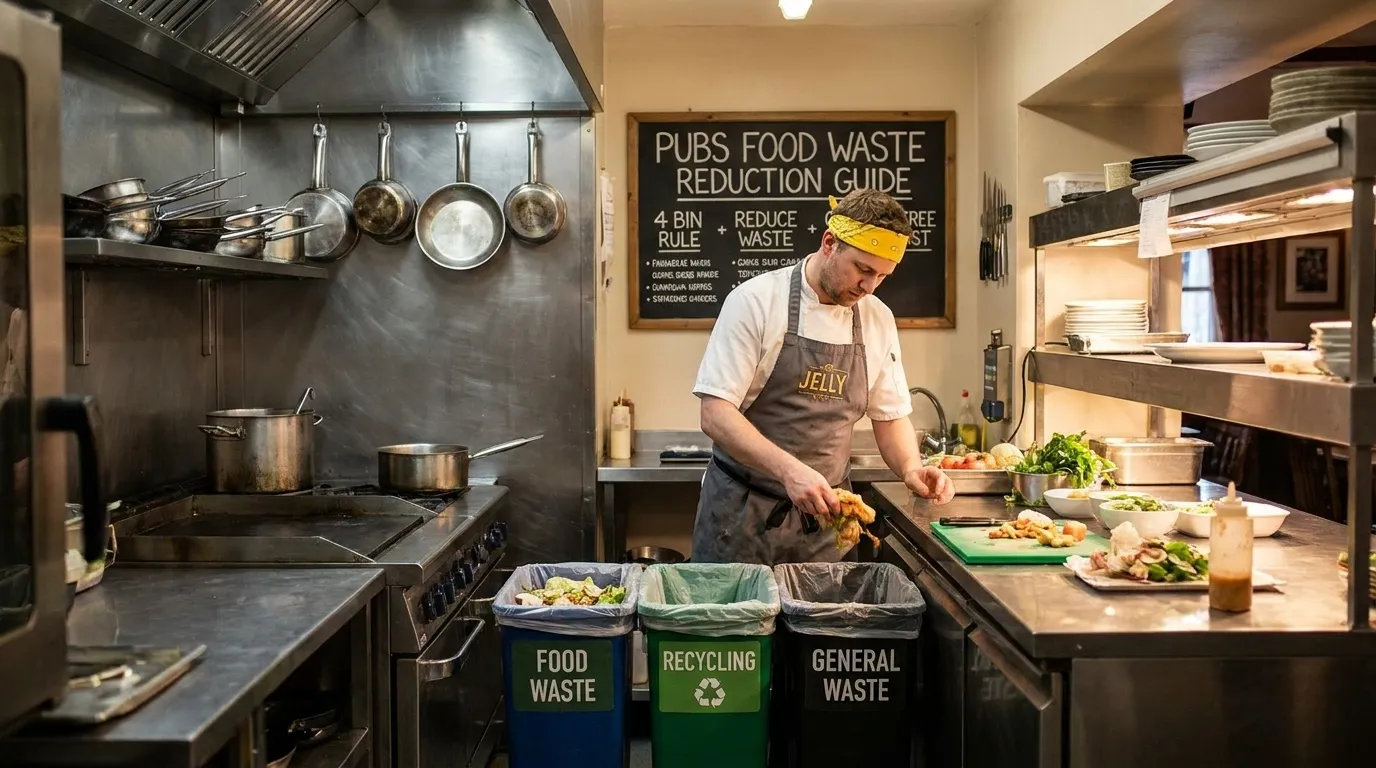
- Run a day-one waste induction covering FIFO, separation rules and the waste log. Treat this induction with the same weight as allergen and fire safety briefings.
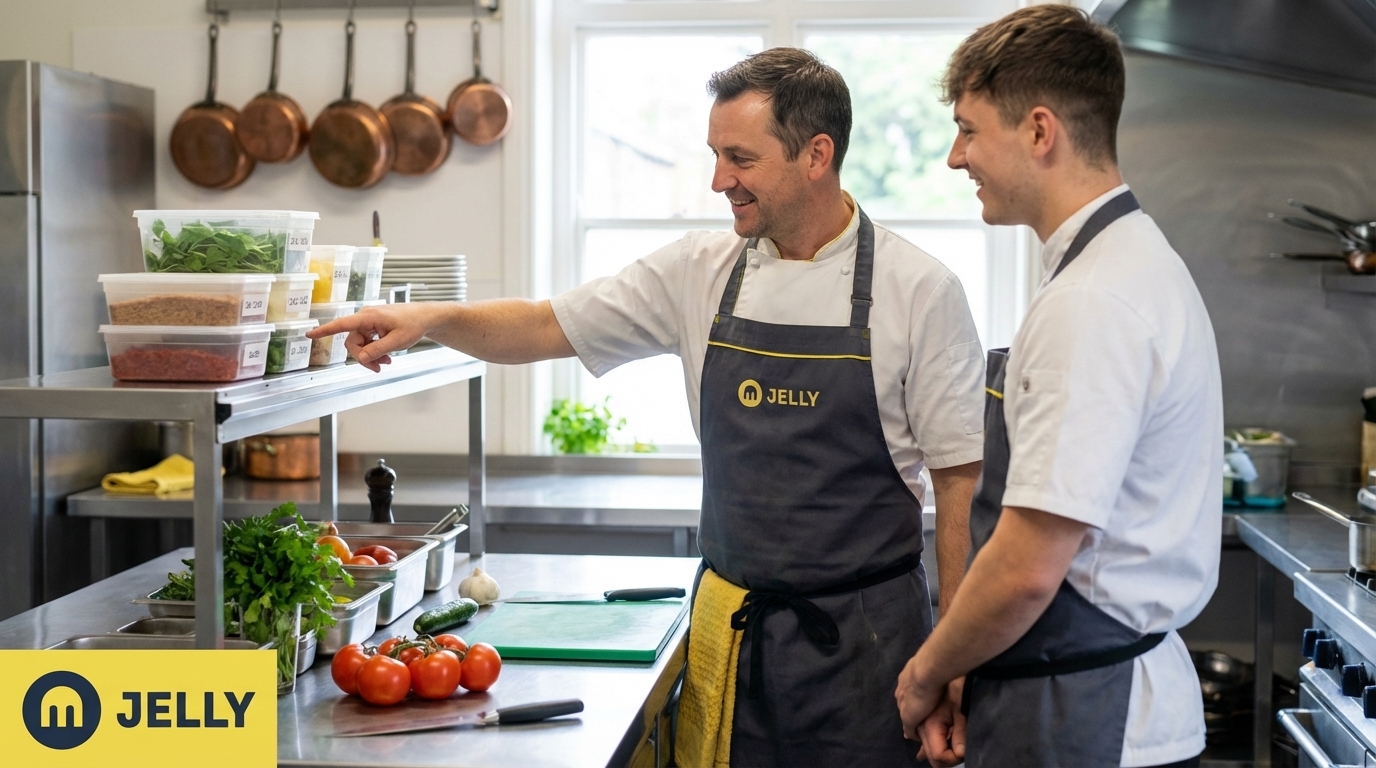
- Assign a waste buddy for the first two weeks. A named colleague who demonstrates correct behaviour in service helps new starters copy the right habits.
- Set up simple waste logging using three fields: what, how much, why. Use three simple fields and tie logging to routines that already exist so it does not become a separate task.
- Brief waste at every pre-shift, five minutes maximum. Cover what went in the bin yesterday, one thing changing today and one thing that worked.
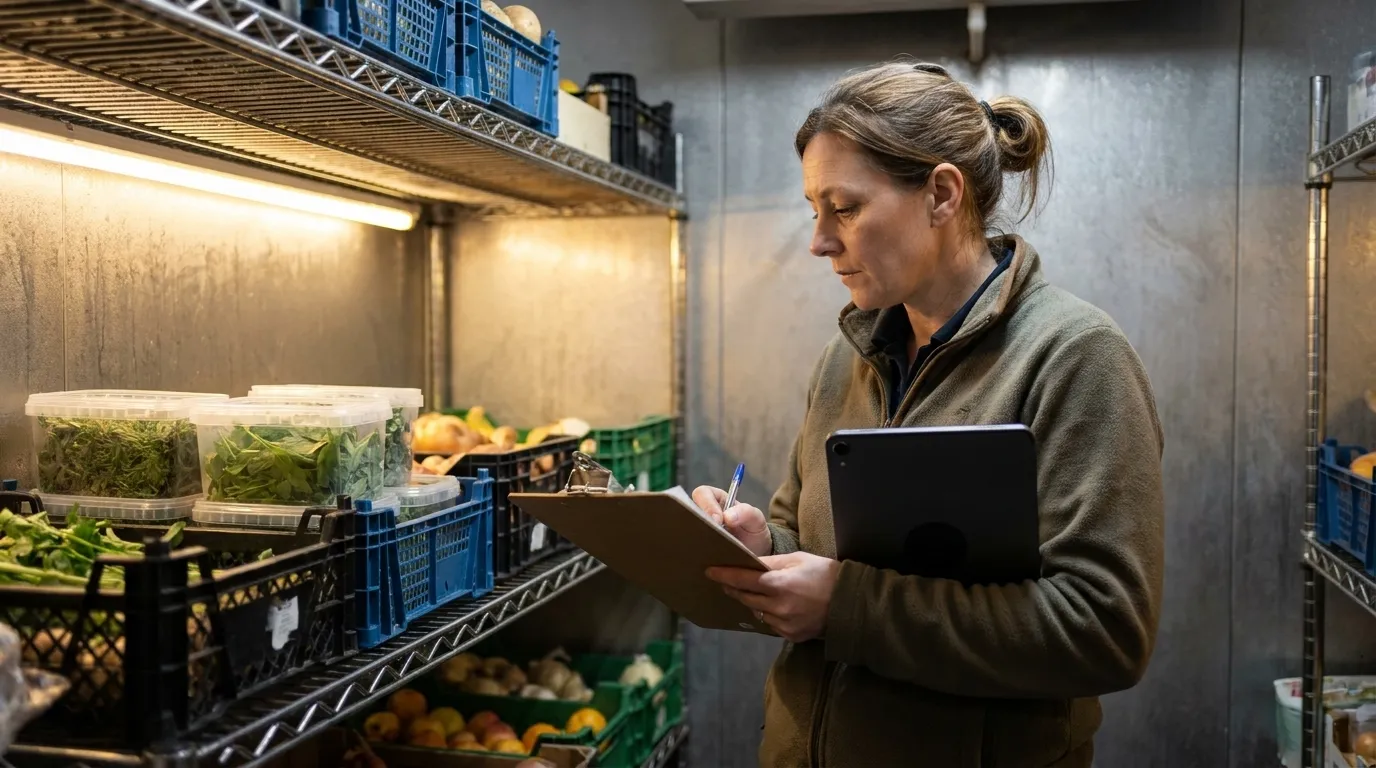
- Observe and give feedback in week one using a manager checklist. Use the checklist to structure observation, then sign it off and file it.
- Review logging consistency and gaps at day 30. Check the log, spot weak points and refresh any part of the induction that has not landed.
Role-By-Role Food Waste Responsibilities For Your Team
WRAP found that food waste in UK restaurants, pubs and leisure was over 20% of the weight of food purchased, roughly one in five meals. That figure affects the whole team. Every role owns a specific part of the problem. Hand this table to each new starter with their contract.
| Role | What They Own | What Good Looks Like |
|---|---|---|
| Chefs | FIFO, stock rotation, portion control, using the waste log to adjust specials | Close-dated stock used first; portions weighed, not eyeballed |
| Kitchen Porters | Correct separation, bin checks, reporting spoiled stock | Bins checked at close; spoiled stock reported same shift |
| Front of House | Portion feedback, offering to box leftovers, flagging over-production | Plate waste fed back to the kitchen; leftovers offered to be boxed |
| Managers | Induction delivery, observation, pre-shift briefings, reviewing waste data | Checklist signed off in week one; waste on every pre-shift agenda |
| Purchasing | Order quantities, supplier price checks, avoiding over-ordering | Orders built from sales data, not habit |
Kitchen porters carry waste removal as a named core duty across the full service cycle, not just at close-down. Pocket Trainer’s kitchen induction framework lists waste procedures as a day-one topic alongside food safety and allergen management, which sets the right priority.
The First 30 Days: Your Food Waste Induction Timeline And Checklist
A structured 30-day plan turns good intentions into repeatable behaviour. A randomised controlled trial published in the Journal of Environmental Economics and Management (Del Pozo Loayza et al., 2026) found that a three-hour in-person food waste management training session reduced kitchen organic waste by 10–16 percentage points, and the fieldwork team identified clashes between kitchen staff time and training schedules as a key reason for non-compliance. Keep induction short, scheduled and built into the working day.
The day-by-day milestones:
- Day 1: Waste induction, FIFO walkthrough, waste log demonstration and separation rules, delivered in the kitchen rather than a back office.
- Days 2–3: Shadow a waste buddy and make the first supervised waste log entries.
- End of Week 1: Manager observation checklist sign-off and first contribution to a pre-shift waste briefing.
- Day 30: Review logging consistency, give feedback and refresh any gaps.
The manager observation checklist:
- Can the new starter explain FIFO without prompting?
- Do they separate food waste correctly at the bin?
- Have they completed a waste log entry unsupervised?
- Have they contributed to a pre-shift waste briefing?
- Have they flagged spoiled or close-dated stock?
- Have they received feedback on all of the above?
This checklist acts as the sign-off document. It is the mechanism that makes the habit stick through a 52% turnover rate. The checklist depends on one thing above all: reliable waste logging from day one.
Waste Logging On Day One: The “What, How Much, Why” Method
Use a simple three-field log that records what went in the bin, roughly how much and why. Keep the format short so the team can complete it in under two minutes.
Staff often resist extra paperwork, so tie logging to routines that already exist, such as end of prep, end of service and bin checks at close. The log then becomes part of the shift rhythm rather than an extra chore.
A Nofima randomised controlled trial of 230 households found that simply measuring food waste reduced dinner waste by 22% over seven weeks, with no additional instruction, and that after one year, the measurement-only group had reduced waste by 29%, comparable to a structured intervention group. The act of measuring changes behaviour, which means the real decision is not whether to log, but how.
Paper works if someone reads it and acts on it. Digital tracking removes much of the manual burden. Jelly scans every invoice line item automatically, so ingredient costs and dish margins update in real time without anyone filling in a spreadsheet. Managers get the data they need to act on waste patterns without adding to the admin load.
See Jelly’s Waste Tracking In Action
Visual Prompts And Five-Minute Pre-Shift Waste Briefings
Visual prompts reduce the cognitive load on new starters and remove the excuse that nobody explained the rules. Practical signage for fridges, prep areas and bins includes FIFO labels with day dots, a clearly marked “use first” shelf and colour-coded bin signage that matches the site’s collection contract.
Use this five-minute pre-shift briefing format:
- Share what went in the bin yesterday and why.
- Agree one thing the team is changing this week.
- Highlight one thing that worked.
Keep the language non-punitive so staff feel safe logging honestly. When waste numbers become a punishment tool, staff start hiding problems. The goal is honest data rather than a scoreboard.
A 2026 study in Sustainability (Shang et al., MDPI) found that a participatory kitchen intervention cut fruit waste by 72% per session and raised byproduct reuse from 15% to 68%, with no loss of product quality, and recommended visualised waste-measurement routines and staff co-creation to reduce resistance to new protocols. Involve the team in the briefing, not just the manager. A laminated briefing card at the pass turns it into a standing agenda item.
UK Restaurant Food Waste Regulations 2026: Induction Essentials For New Starters
New starters need a clear view of the legal context because food waste separation now sits within the Environment Act 2021 framework.
The key dates and obligations for England:
- Simpler Recycling for businesses (excluding micro businesses) was introduced in March 2025, so affected hospitality businesses must already separate food waste for collection.
- Micro businesses, under 10 full-time equivalent employees, come into scope by March 2027, which creates a live deadline for small pubs, cafés and independent restaurants.
- The Environment Act 2021 statutory target, set in legislation in January 2023, requires residual waste in England not to exceed 287kg per capita by 31 December 2042.
Similar food waste separation reforms are progressing in Wales and Scotland on different timetables, so operators should confirm the rules for their nation and local authority. Operators in Northern Ireland should consult Business of Recycling NI for jurisdiction-specific guidance.
For induction, give new starters the separation rules from day one. Add a clear line to the induction pack, “food waste separation is a legal requirement”, and place it alongside allergens and fire safety.
Making Food Waste Habits Stick Through Turnover
High turnover is the operating reality in hospitality, so a repeatable induction system matters more than a single training session. The system in this playbook, with role-specific responsibilities, a 30-day timeline, simple logging and a pre-shift briefing cadence, can run even when the GM is off-site.
Set a refresher cadence that keeps habits alive: cover waste at induction, at day 30 and then quarterly. VerdaScope’s staff training matrix specifies that food waste separation training should be delivered to kitchen staff and porters at induction plus quarterly refreshes.
Recognise low-waste performance with specific, genuine feedback at the end of a shift. Track waste per cover as a monthly KPI at site level rather than as an individual scoreboard so the data stays honest.
Jelly supports this system by making the numbers easy to see and act on. Jelly onboards quickly and generates initial value in the first week. Users cut food costs by 3% on average in the first three months, and gross margins increase on average by 2 percentage points, so the habit has a visible payoff. Automated invoice scanning and live dish costing give managers the data to act on waste patterns. Price Alert, the Flash Report and Menu Engineering add further visibility without adding to the admin burden.
Get A Demo Of Jelly’s Kitchen Insights
Frequently Asked Questions About Food Waste Onboarding
What Are The Core Steps To Reduce Food Waste In A Restaurant Kitchen?
Start by preventing over-prep through smaller batch cooking and quantities that follow recent cover counts. Rotate stock using FIFO, first in, first out, so close-dated ingredients are always used before newer deliveries. Control portions with weighed servings rather than estimates. Log what goes in the bin, how much and why, using a simple three-field entry tied to existing routines. Review the log weekly to adjust prep quantities, specials and ordering so each week improves on the last.
How Do You Train New Kitchen Staff On FIFO And Stock Rotation?
Train FIFO on the shelf rather than in a document. Walk the new starter through the fridge on day one, show them day dots and the use-first shelf and have them rotate a delivery under supervision. Use an explain, demonstrate, practise and observe sequence: explain what FIFO means and why it matters for food safety and cost, demonstrate it physically, have the new starter practise it with a real delivery, then observe them doing it unprompted in week one and give specific feedback. A waste buddy assigned for the first two weeks reinforces the habit between formal observations.
What Is The Best Waste Management System For Restaurants?
The best system is the one the team uses consistently. Paper logs can work when a manager reads them and acts on the data, but they create a manual burden and often get dropped during busy service. Digital tracking reduces that burden. Jelly automates invoice scanning and dish costing, as described earlier, so teams avoid manual spreadsheet entry. The Price Alert feature flags every price change from every supplier, giving chefs the data to adjust specials and negotiate credits. Menu Engineering via POS integration shows which dishes are most popular and most profitable, and connecting a supported POS typically automates several hours of weekly work. Jelly is listed on the Lightspeed marketplace.
What Are The Current Regulations Regarding Food Waste In The UK?
Under Simpler Recycling, delivered through the Environment Act 2021 framework, businesses in England must separate food waste for collection. As covered in the regulations section, this already applies to most businesses, with micro businesses in scope by March 2027. The Environment Act 2021 statutory target limits residual waste in England to 287kg per capita by 31 December 2042. Wales and Scotland are progressing similar reforms on different timetables, so operators should verify the rules for their nation and local authority. Northern Ireland operators should consult Business of Recycling NI for jurisdiction-specific guidance.
What Counts As Food Waste In A Restaurant, And Who Is Responsible For Logging It?
Food waste in a restaurant covers anything edible or previously edible that goes in the bin, including raw preparation trim, spoiled or close-dated stock that was not used in time, overproduced dishes that were not sold and plate waste returned from the dining room. Each category has a different cause and a different fix, such as over-prepping, poor FIFO, ordering or storage failures, portion size or menu design. Responsibility for logging is role-specific: chefs log prep and overproduction waste, kitchen porters log bin checks and spoiled stock, and front-of-house staff feed back plate waste to the kitchen. Managers review the combined data weekly and use it to adjust prep quantities, specials and orders.