
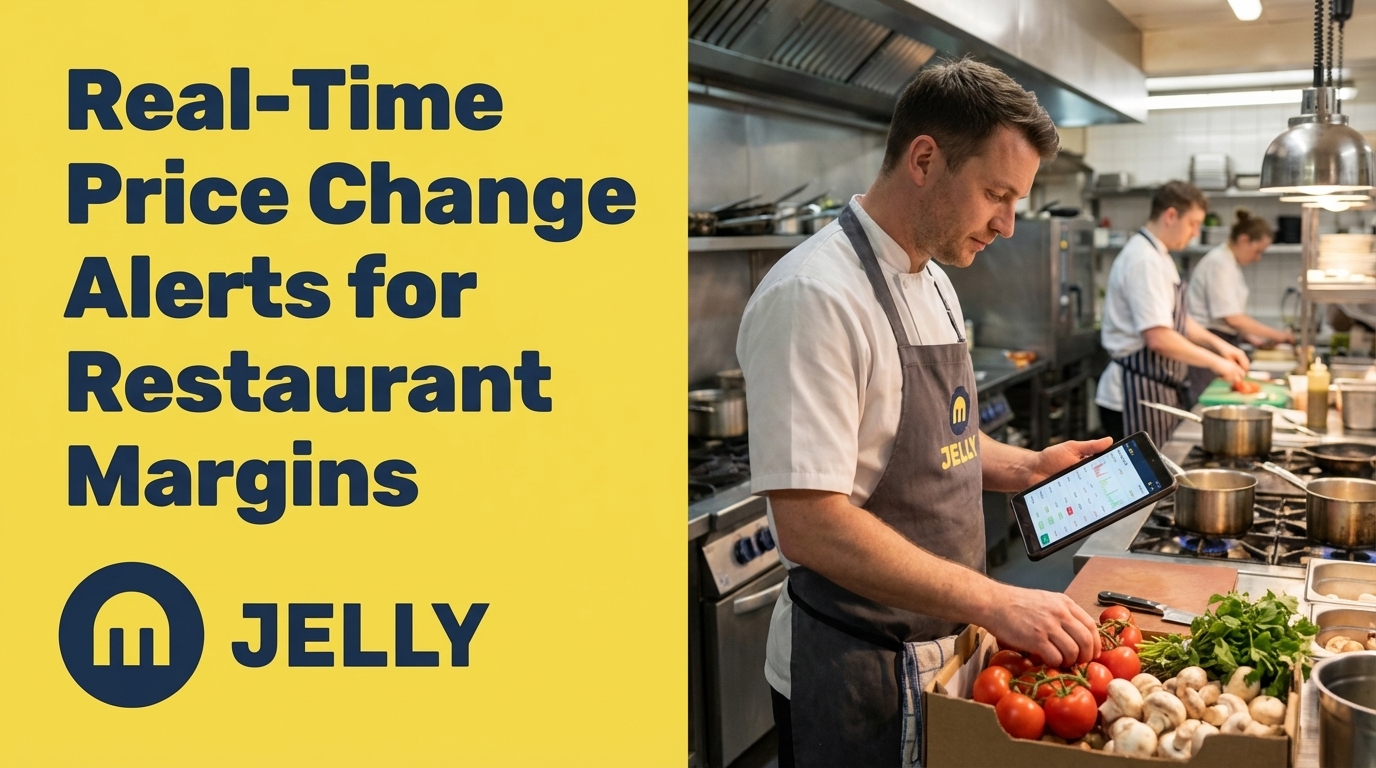
For growing restaurants, pubs, and hotels in the UK, volatile ingredient prices create constant pressure on profit margins. You focus on delivering reliable guest experiences, but ingredient costs can shift daily, sometimes hourly, and margins can shrink before anyone notices. A dish that generated strong profit last week might cost you money today, and standard reporting often reveals the problem only after damage has built up. This guide explains how real-time price change alerts turn price control into a continuous process, so your business can protect margins in a volatile market.
The Problem: Why Manual Price Tracking Erodes Your Restaurant’s Profits
Restaurant owners, finance managers, and executive chefs across the UK face the same issue. Traditional price monitoring relies on manual checks and scattered information, and that process no longer keeps pace with changing supplier prices. Multiple suppliers, different pricing structures, varied delivery schedules, and complex terms quickly make manual tracking unmanageable and expensive.
The Hidden Costs of Delayed Price Insights
Manual spreadsheet tracking creates a delay between real-world price changes and your awareness of them. Ingredient cost data can lag behind by weeks, resulting in ‘hidden losses,’ incorrect profit calculations, and late corrective actions at management level. This delay affects the bottom line and compounds over time as teams continue to sell dishes based on outdated cost assumptions.
Time investment adds further pressure. Manual methods can take 6 hours per week per site for inventory management alone, time that could instead support strategic planning, staff development, or service improvements. A growing group with several sites can spend dozens of hours each month on admin rather than revenue-focused work.
The financial impact builds quickly. When ingredient costs increase by even 5% across your menu and prices do not change, a restaurant with £50,000 monthly food costs loses £2,500 in margin that month. A multi-site group that misses several months of changes can face tens of thousands of pounds in preventable losses.
Use Clear Price Data In Supplier Negotiations
Manual price tracking often leaves teams without the evidence needed for firm supplier conversations. Prices may appear to be creeping upward, but without detailed records it becomes difficult to challenge increases. A dish profitable last week could be losing money today if prices shift unexpectedly, and without real-time visibility, decisions rely on assumptions rather than facts.
This lack of data reduces leverage in several ways. Teams miss chances to request credit notes for unexpected price increases, overlook competitive quotes from alternative suppliers, and lose negotiation strength that comes from accurate, comparable cost histories. Suppliers who know prices are not monitored closely may also move faster on increases, as detection can take weeks.
Executive chefs experience this directly. Their understanding of recipes and yield signals that food costs are off, but without detailed pricing data it becomes difficult to pinpoint issues or present a clear case to suppliers or finance. This gap can create tension between kitchen and finance teams, even though both sides share the same goal of maintaining profitability.
The Solution: Introducing Jelly’s Automated Real-Time Price Change Alerts
Automation now allows kitchens to monitor prices continuously without extra manual work. Jelly shifts price control from sporadic spreadsheet updates to ongoing margin protection, designed for growing restaurants, pubs, and boutique hotels that need reliable information without complex systems.
Jelly makes supplier pricing visible in one place and highlights every change as it happens. The system supports margin protection in several ways:
- Automated invoice scanning: Jelly captures every invoice via email or photo upload, and digitises each line item, including quantity, SKU, price, and tax, without manual data entry. This creates a single, accurate record of costs across suppliers and ingredients.
- Instant price alerts: When any ingredient price changes, Jelly flags the increase or decrease and shows which items are affected, by how much, and from which supplier. These alerts appear in real time, not days or weeks later.
- Live dish costing: As ingredient costs update with each invoice, dish costs and gross profit (GP) margins recalculate automatically. Teams can see immediately when a menu item’s profitability changes and act at once.
- Data-driven supplier insight: Every price change sits in a searchable record, so teams have evidence for supplier negotiations, credit note requests, and decisions on alternative sourcing.
This structured approach removes the lag that often costs restaurants thousands of pounds each month. Instead of discovering cost increases during monthly accounts, teams receive alerts as soon as invoices arrive and can take action immediately.
See how Jelly can automate your kitchen management and protect your profit margins. Book a chat today.
How Real-Time Price Alerts Change Restaurant Operations
Real-time price alerts change how kitchens operate, shifting teams from reactive damage control to planned margin management. The impact appears most clearly in three areas that link directly to profitability.
Proactive Margin Protection & Food Cost Reduction
Instant alerts help prevent margin erosion before it becomes significant. Price hikes can be addressed immediately through timely negotiations or substitutions, as price change alerts enable managers to act before losses accumulate.
Real-world results show the financial impact of this approach. A 5-site gastropub group saved over £12,000 annually and reduced food cost variance by 5% (from 33% to 28%) with real-time visibility. Many Jelly users report similar patterns, with average food cost reductions of around 3% in the first three months.
Improvement comes from faster responses. When lamb prices rise suddenly, teams can adjust portion sizes, switch to alternative cuts, or temporarily remove high-cost items from the menu on the same day. Repeated small adjustments across many price changes over a year add up to substantial savings.
The operational effect is also important. Teams gain a clearer sense of control over costs, with visibility of where money is spent, when prices change, and how those changes affect individual dishes and total profitability.
Use Data To Guide Menu Engineering
Automated recipe costing platforms give head office and individual kitchens up-to-date views of margins, procurement trends, and menu profitability, so teams can adjust menus quickly when market prices move.
Real-time data turns menu engineering into a measurable process. When a bestselling pasta dish drops from a 75% margin to 68% after cheese prices rise, teams can immediately compare options such as sourcing a different cheese, adjusting portion sizes, modifying the recipe, or increasing menu prices. Decisions backed by current data maintain profitability while protecting guest experience.
Teams that identify low-margin menu items and adjust them follow a best practice supported by technology-based alerts and reporting. You might discover that a popular fish special, while loved by customers, consistently operates below acceptable margins because of volatile seafood pricing. With this insight, you can redesign the dish, adjust pricing, or replace it with more profitable alternatives.
Speed of insight makes a clear difference. Traditional monthly reviews rely on historic numbers, so decisions always arrive after the fact. Real-time alerts support forward-looking choices that protect future profitability instead of only documenting past losses.
Streamlined Workflows & Reduced Admin Time
Automated price monitoring also cuts administrative workload. Automated systems reduce time spent on admin from up to 20 hours per month to just minutes, which frees staff to focus on revenue-generating tasks.
Time savings appear across several areas. Invoice processing, which once required manual data entry and cross-referencing, becomes automatic. Price checking across suppliers, previously handled through calls and spreadsheet updates, now happens automatically through alerts. Recipe costing, which could take 28 minutes per menu item, drops to around 3 minutes with automated ingredient population.
Extra capacity lets teams focus on core activities that drive results. Your executive chef can spend more time perfecting dishes and training staff, while your operations manager can focus on growth, guest experience, and consistency across sites.
Efficiency gains become even more important as the business scales. Manual price tracking across several locations grows more complex and time consuming with each new site. Automated systems extend across locations with little extra work, providing consistent, accurate data without proportional increases in admin.
Jelly vs. Manual Methods: The Smart Way to Track Price Changes
The differences between traditional manual methods and Jelly’s automated approach illustrate why many restaurants, pubs, and hotels are changing their workflows. The comparison below highlights the operational and financial impact of modernising price tracking.
|
Feature |
Manual Spreadsheets |
Traditional Methods |
Jelly’s Automated System |
|
Price Change Alert Speed |
Weeks / Reactive |
Monthly / Delayed |
Instant / Proactive |
|
Invoice Processing |
Manual Data Entry |
Paper Filing |
Automated Scanning |
|
Dish Costing Updates |
Infrequent / Outdated |
Quarterly Reviews |
Real-Time / Live |
|
Supplier Negotiation Data |
Guesswork / Limited |
Historical Reports |
Concrete Evidence |
The table shows how manual methods struggle in a fast-moving market. By the time traditional processes highlight cost increases, many businesses have already absorbed weeks or months of reduced margins. Jelly’s instant alerts support faster action and turn cost management into a daily operational activity rather than a periodic admin task.
Data quality also improves. Manual tracking often introduces human error, inconsistent formats, and gaps. Automated scanning captures each invoice line accurately and stores it in one place, creating a reliable cost database for decisions across the business.
Ready to update your price tracking approach? Book a chat to see how Jelly can help protect your margins automatically.
Implementing Real-Time Price Alerts: Best Practices for Success
Successful implementation of real-time price change alerts involves more than installing software. A clear plan that fits operational goals and team capacity helps restaurants capture value from automation without disrupting daily service.
Start with clear threshold settings that match your business model and margin requirements. Different ingredient categories often need different alert levels. A 2% increase in high-value proteins such as beef or seafood may require an immediate alert, while a 5% increase in lower-cost items such as basic vegetables may be more appropriate. Well-chosen thresholds keep attention on changes that genuinely affect profitability.
Establish response protocols before alerts start arriving. When chicken breast prices increase by 10%, decide in advance who gets notified, what actions should be taken within 24 hours, and whether the next step is to contact suppliers, adjust menu pricing, or source alternatives. Predetermined responses ensure alerts lead to action rather than sitting in an inbox.
Train your team to interpret and act on alert data effectively. Your head chef needs to see how price changes affect specific dishes and overall menu profitability. Your operations manager should know when to renegotiate with suppliers and when to accept increases. Your finance manager must understand how pricing changes influence cash flow and margin targets.
Integrate alerts with your existing operational rhythms. Review price changes during daily management meetings, include cost trend analysis in weekly menu planning, and use alert data in quarterly supplier reviews. This integration keeps price monitoring as part of standard operations rather than an additional administrative task.
How To Maximise ROI from Real-Time Price Change Systems
Return on investment from real-time price alert systems extends beyond direct cost savings. Value appears across several operational areas and compounds over time. Understanding these benefits helps build a clear business case and guides ongoing optimisation.
Direct cost savings represent the most measurable benefit. Users typically achieve 3-5% reductions in food costs within the first three months, which translates to meaningful annual savings. For a restaurant group with £500,000 annual food costs, a 3% reduction saves £15,000 yearly, often more than enough to cover system costs while generating positive ROI.
Time savings create additional value by redirecting staff capacity toward revenue-generating activities. Reducing administrative time from 20 hours monthly to under 2 hours frees 18 hours for menu development, staff training, customer service improvement, or expansion planning. Valuing this time at £25 per hour represents £450 monthly in opportunity cost recovery per location.
Improved supplier relationships develop through data-driven negotiations. When you approach suppliers with specific, documented price increase data, discussions become more structured and professional. Suppliers often value operators who monitor costs carefully and may offer better service, earlier notification of changes, and more competitive pricing to maintain relationships.
Risk reduction provides harder-to-measure but important benefits. Real-time alerts reduce the chance that significant cost increases remain unnoticed for long periods. They also lower the risk of tension with suppliers that can arise from invoice processing errors or delayed dispute resolution.
Enhanced decision-making capability turns operational management from reactive to proactive. Instead of wondering why margins declined last month, you understand cost drivers in real time and can adjust accordingly. This insight supports more confident menu planning, pricing strategies, and expansion decisions.
Overcoming Common Implementation Challenges
Clear expectations and communication help real-time price alert projects succeed. Identifying likely challenges early makes it easier to design practical solutions and maintain team engagement.
Staff resistance often emerges when team members fear technology will complicate their work or reduce the value of their roles. Address this by showing how automation removes repetitive admin while supporting the strategic and creative parts of their jobs. Your head chef can focus more on recipe development than spreadsheet maintenance, and your operations manager can focus more on growth than invoice reconciliation.
Data accuracy concerns are understandable, given the importance of cost information for business decisions. Quality automated systems like Jelly use advanced optical character recognition and verification processes to deliver accuracy that often exceeds manual data entry. Adding simple verification checks during early implementation can build confidence in system outputs.
Integration complexity can overwhelm teams that lack technical expertise. Choosing solutions that prioritise simplicity and provide guided support during setup helps avoid this. Systems that demand extensive IT involvement or complex configuration often struggle to deliver value quickly enough.
Alert fatigue occurs when systems generate too many notifications without proper filtering or prioritisation. Configure alerts to focus on meaningful changes that warrant attention rather than every small price movement. Start with conservative settings and adjust based on experience and operational needs.
Workflow integration challenges appear when new systems do not match existing processes. Effective implementation often involves adjusting both technology configuration and procedures so they work together. This may include updating meeting agendas to include alerts, adapting purchasing approvals, or revising supplier communication protocols.
Future-Proofing Your Price Monitoring Strategy
Market volatility and operational complexity are likely to increase over time, so a forward-looking price monitoring strategy helps maintain competitiveness. Choosing flexible tools and processes now reduces the need for major changes later.
Scalability becomes critical as your operation expands. Systems that work for a single site may not cope with multi-site complexity, varied supplier relationships, and different menu mixes. Selecting solutions that scale smoothly helps maintain consistent functionality and insight without major increases in admin.
Integration capabilities will grow in importance as your technology stack evolves. Your price monitoring system should work well with POS systems, accounting software, inventory tools, and future platforms. Strong integration reduces data silos and ensures consistent information across operational systems.
Predictive capabilities represent the next stage in price monitoring. Advanced systems will not only highlight current price changes but also flag potential future trends based on market conditions, seasonal patterns, and supplier behaviour. This foresight enables proactive planning and more stable pricing strategies.
Regulatory compliance requirements may expand as food safety, sustainability, and transparency rules change. Systems that keep comprehensive records of ingredient sourcing, pricing, and usage support compliance and provide clear audit trails if regulators request evidence.
Market expansion often involves new supplier networks, currencies, and pricing structures. Flexible price monitoring systems can adapt to these changes without requiring complete replacement or extensive reconfiguration.
Frequently Asked Questions
How quickly can I see price changes with an automated system like Jelly?
Automated systems process supplier invoices directly from emails or photos and trigger instant, itemised price change alerts across suppliers and ingredients. With Jelly, alerts appear as soon as new invoice data is captured, often within hours of receiving invoices. This real-time processing allows teams to identify and respond to price changes before they affect margins, instead of finding them weeks later in manual reviews or monthly accounts.
Can real-time price alerts help me with supplier negotiations?
Yes. Real-time price alerts provide clear evidence of price changes, including amounts, dates, and affected items. This information turns supplier negotiations into fact-based conversations. You can challenge unexpected increases with documentation, request credit notes where appropriate, and compare prices across suppliers. Many operators find that suppliers respond more competitively when they know pricing is monitored closely and professionally.
How much time can I save by automating price change tracking with Jelly?
Automation dramatically reduces administrative work linked to invoice processing and price monitoring. Instead of spending hours manually reconciling invoices, checking prices, and updating spreadsheets, automated systems handle these tasks in the background. Most operators reduce admin time from 10-20 hours per month to just minutes, which frees staff for higher-value activities such as menu development, staff training, and business expansion.
Will real-time alerts overwhelm me with too much information?
Quality systems like Jelly provide configurable alert thresholds that focus attention on meaningful changes instead of minor fluctuations. You can set different sensitivity levels for various ingredient categories, with immediate alerts for expensive proteins and only significant changes for lower-cost items. Smart filtering keeps alerts actionable and manageable, and most users quickly develop simple routines for reviewing and responding to notifications.
How does automated price monitoring integrate with my existing accounting and inventory systems?
Modern price monitoring systems are designed to work alongside existing business systems rather than replace them. Jelly integrates with accounting software such as Xero, automatically pushing digitised invoice data to avoid duplicate entry. POS integration adds sales data to cost information, which enables real-time profitability views. This joined-up approach gives a clear operational picture while simplifying, rather than complicating, everyday workflows.
Conclusion: Strengthen Your Restaurant’s Margins with Real-Time Price Change Alerts
Volatile ingredient markets do not need to put restaurant profitability at constant risk. Real-time price change alerts give teams early warning of cost movements so they can take action before margins erode. Each price increase becomes an opportunity to adjust, rather than a hidden drain that appears weeks later in reports. Supplier conversations also move from guesswork to evidence-based discussion.
The restaurants, pubs, and boutique hotels that maintain strong performance in challenging conditions tend to use real-time systems to understand their true costs. Jelly gives operators instant visibility of ingredient and dish costs, supporting confident decisions that protect profitability while maintaining quality and service standards.
Competitors that still rely on spreadsheets and delayed financial reports operate at a disadvantage. While those businesses uncover margin erosion weeks after it begins, you can prevent or limit it through instant alerts and quick changes. While they negotiate with partial information, you can use detailed data to support your position. While they spend hours each month on admin, you can direct more time toward growth and guest experience.
Operating without real-time monitoring now carries its own cost. Each month without timely price visibility increases exposure to hidden losses and missed negotiation opportunities and makes it harder to keep pace with more data-driven competitors.
Restaurants that want tighter control over food costs can start by adding automated price monitoring to existing workflows. Real-time alerts help protect margins and support more confident decisions across purchasing, menu design, and expansion. See how Jelly manages price change monitoring and helps protect profit margins. Book a chat now.